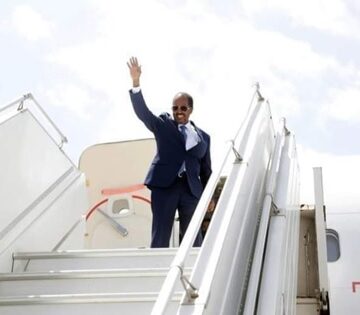
By Abdiweli Sheikh Ahmed Former Prime Minister of Somalia Somalia’s president is not just seeking re-election; he is rewriting the constitution. The changes appear democratic on paper but are designed to eliminate genuine competition and make defeat impossible. This piece explains exactly how. In January, I floated a proposal that Somalia establish a caretaker government...
Beyond borders; is it time for a horn of Africa economic block?
By Dulmar Maalim The Horn of Africa is currently at a critical juncture, transitioning from a history of fragmentation and instability to a period where deeper regional economic integration is not merely an option, but a necessity. For Somalia, this imperative is particularly acute, necessitating the advocacy for a Horn of Africa Regional Economic Bloc...
Fragile Dialogue, High Stakes: Somalia’s Leadership Confronts a Defining Political Test
By Abdiqani Haji Abdi A new round of political dialogue between Somalia’s federal government and a broad opposition coalition has begun under intense scrutiny, with both sides entering the talks burdened by deep mistrust, competing interpretations of the constitution, and sharply divergent visions for the country’s electoral future. At the center of this high-stakes process...
Rethinking Somalia’s enduring governance crisis
By Balal M. Cusman Although I consider myself someone who has closely engaged with Somali’s political journey, both in theory and in practice, I do not claim to have all the answers, nor to fully grasp every dimension of its complexity. However, like many others who care deeply about the country, I remain a student...
The importance of checks and balances in government: the case of the president Sharmarke’s speech in Adanyabal district, Somalia
By Ali Haji Warsame As a young man eager to learn in the 1970s, I frequently heard the term “dowladdii musuqmaasuqa”, or “the corrupt government”, used in reference to the civilian administration of 1960-1969. This derogatory term was often employed by those who sought to discredit that period, and I was no exception. At that...
Somalia’s Governance Paradox: Strong Individuals, Weak Institutions
By Bashir M. Sheikh Ali, J.D., Ph.D. [1] Somalis demonstrate high levels of individual capability across education, entrepreneurship, professional achievement, and economic mobility. In diaspora communities and regional markets, Somali individuals perform competitively in trade, business, academia, law, healthcare, and technology. Remittance flows and private investment reflect organizational capacity, adaptability, and risk tolerance at the...
How clan rivalries and a belligerent pastoral mindset undercut Somalia’s quest for unity and bona fide statehood
By Prof. AliNur Mohamed Introduction In the post-colonial era, Somalia has been counted as one of the rarest nation-states in sub-Saharan Africa, ostensibly for her unique “cultural and ethnic homogeneity”. By and large, Somalis speak the same language, are almost 100% Muslim, and with urbanization over the last century, have witnessed the expansion of the...
Somalia’s Foreign Policy — A Spectacle of Incompetence
By Dayib Sh. Ahmed When the Somali people have struggled to defend their sovereignty, territorial integrity, and national authority—particularly in the face of the direct threat posed by Israel’s grave violations—the underlying challenge has often been the absence of a cohesive and clearly articulated foreign policy. A nation’s ability to protect its borders and assert...
Our Unhealing Nation—The Silence of Somali Art and the Aesthetics of Ruin
Dr Zakariya Weyrax For many years, I have returned to the same question, unable to leave it alone: why has Somalia’s collapse endured so long? Why has a people once so cohesive, so linguistically unified, so morally literate, remained suspended in fracture for more than three decades—long after other nations ravaged by civil war, genocide,...
South Korea – How a $280 Billion Baby Plan Failed and What It Says About Modern Society
Abdikarim Haji Abdi Buh By 2750, Seoul still runs on time. But no one is left to arrive The year is 2750. The streets of Seoul are immaculate. Trains glide through underground tunnels with mathematical precision. Fiber-optic cables still hum beneath the pavement. Skyscrapers stand intact—monuments to a civilization that once defined technological modernity. But...