
By Eng. Mohamed Ali Mirreh
What drives the cost of power, why Somali customers pay so much, and what can be done about it
Somalis pay some of the highest electricity prices in the world, often four to ten times what households pay in neighbouring Kenya or Ethiopia. For many families and small businesses, the monthly electricity bill is one of the largest and most painful expenses they face.
The cause is not one greedy company or one bad decision. It is a sector built on small diesel generators, poor networks and no working referee to check what customers are charged. Each of these problems raises the bill on its own; together, they multiply. The good news is that every one of them can be fixed, and the fixes are already proven in other countries.
Key takeaways
1) Diesel is the main cost driver. Fuel alone costs around 30–40 US cents for every kilowatt-hour generated, before any other expense.
2) Half the power may be lost. By some estimates, losses in Somali networks are not less than 50%, which can double the fuel cost of every kilowatt-hour a customer pays for.
3) No one checks the price. The 2023 National Electricity Act has not yet been implemented, so there is no regulator approving tariffs or hearing complaints.
4) Four steps can change this: implement the Electricity Act, establish an independent regulator, create fair competition, and invest in smart systems such as solar, batteries, smart meters and well-built networks.
The question every Somali household asks
“Why is my electricity bill so high?” It is asked in Garowe, Mogadishu, Bosaso, Kismayo and many other towns, by shopkeepers, families and small factory owners. A small business can spend more on electricity than on rent. A family that can afford one fan and a few lights sees a bill that would power a whole house elsewhere in Africa. For a restaurant, a cold store, a welding workshop or a water-pumping business, electricity is not a side cost; it can decide whether the business survives.
Anyone who works in Somalia’s electricity sector hears this question constantly. It deserves a clear and honest answer. This article answers it in three parts: what makes electricity expensive anywhere, what makes it especially expensive in Somalia, and what government, power companies and customers can each do to bring bills down.
What customers have a right to expect
- First, a reminder of what customers should expect. A good electricity supply rests on four pillars:
- Safe: it must not put lives or property at risk through fires, electric shocks or dangerous installations.
- Reliable: it must be available when customers need it, without frequent outages or unannounced cuts.
- Good quality: 240 V within 216–264 V (±10%), and 50 Hz within 49.5–50.5 Hz, the values our appliances are designed for. Supply outside these limits damages motors, refrigerators and electronics, and shortens their lives.
- Affordable: the price must reflect the genuine, efficient cost of supplying power, plus a fair return for the provider, and no more.
Today, most Somali customers get none of the four in full. They pay a premium price for a supply that is often unsafe, unreliable and of poor quality.
How Somalia gets its electricity today
Somalia has no national grid. Since the collapse of the state utility in 1991, private Electricity Power Providers (EPPs) have filled the gap. Their contribution deserves recognition: without them, most Somali towns would have no electricity at all. But the system they built grew piece by piece, without a plan or common rules. Each provider runs its own isolated network in its own town or district, with its own generators, its own poles and wires, and its own prices.
Together they generate only about 128 MW, according to the U.S. Commerce Department’s country guide, for a country of more than 18 million people. That is a very small amount of generating capacity for a population of this size, and it is spread across many separate systems that cannot help one another.
Most of that power comes from diesel generators. Solar and wind are growing (BECO’s 10 MW solar farm near Mogadishu, NECSOM’s wind turbines in Garowe), but diesel still sets the cost of almost every kilowatt-hour sold. Access has improved: about 62% of Somalis had electricity in 2023, 80% in towns but only 39% in rural areas. This structure, many small diesel islands with no connection between them, is the starting point for understanding the bill. Almost every cause described below flows from it.
Why the bill is so high: six causes
Around the world, four things decide the price of electricity: the energy source, the condition of the network, government policy and the structure of the market. Somalia scores badly on all four. The six causes below explain how.
1. Imported diesel is an expensive fuel
A diesel generator produces roughly 3 kWh from one litre of fuel. With diesel imported by sea, trucked inland over long distances and sold at around one US dollar a litre, fuel alone costs about 30–40 US cents for every kilowatt-hour, before any salaries, spare parts, network or profit.
Countries that run on hydropower or a large national grid start far below that line. Ethiopia’s dams, for example, produce power at a fraction of the cost of diesel. When world oil prices rise, Somali bills rise with them, as Somaliland saw in 2022 when a temporary 10-cent fuel surcharge was added.
2. Small, isolated generators waste fuel
Each EPP must size its plant for its own evening peak, when lights, fans, televisions and other appliances are all switched on together, and keep spare units running in case one fails, since there is no neighbouring network to call on for help.
At midday many generators run at low load, where they burn far more fuel per kWh. A large interconnected system shares reserves and runs its best machines most of the time, switching off the rest; dozens of small islands cannot, and customers pay for the inefficiency.
3. Heavy losses in poorly built networks
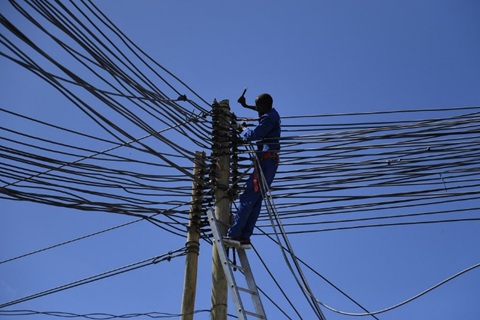
A large share of the energy generated never reaches a paying meter. Undersized or low-quality cables, poor joints, overloaded transformers and long low-voltage lines with many T-offs turn electricity into heat. Tangled overhead connections also make illegal tapping easy. Much of this comes from a shortage of technical expertise, both in buying materials and in installation work. Every lost kilowatt-hour still burned fuel, and its cost is spread over the customers who do pay.
How large is this share? By some estimates, the total power loss in Somali EPP networks is not less than 50%. That means for every two kilowatt-hours a generator produces, only one is billed.
Read more: Why Are Electricity Bills So High in Somalia?
Eng. Mohamed Ali Mirreh
Email: m.mmirreh@gmail.com
————
The author is an electrical engineer with extensive international experience
Leave a Reply