
By Osman Hassan
I recently watched Professor Ahmed I. Samatar’s appearances on Somali satellite TVs posted on WardheerNews. This time, he was interviewed on 29 July by Abdiwahid Mohamoud Jama, one of the most gifted and competent Somali interviewers I have come across. With professional savvy, he pulled no punches to grill the Professor and give him a good run for his money. The interview covered the Professor’s justifications for renouncing Somalia’s unity having lost the presidential election in 2012, when hitherto the union was for all appearances an article of faith for him to which he dedicated a great deal of his time. And as if that was not a bombshell, no less shocking was his overnight turnaround adoption of the secession and electing to champion it with missionary zeal at a time when many of its life-long adherents are despairing of recognition and gravitating towards the union. He could well be once again on the wrong side of Somalia’s history.
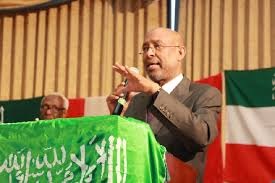
For southern Somalis, what draw their attention most from the Professor’s appearances and speeches is his rant against Mogadishu and southern Somalia politics. But for most of us unionists from northern Somalia, it is first his justification for changing sides – from unionist to secessionist; and secondly his flawed, spurious defence of Somaliland – a mainly one-clan based enclave – as being a country, a nation and a State to which all those who hail from the north (former British Somaliland) belong to it by choice, if not by force, which is case with the occupied Somalia regions of Sool, Sanaag, and Cayn regions (SSC) and his own Awdal region.
The question that arises immediately is what makes the secession acceptable to the Professor today which he has openly shunned or shied away from for nearly quarter of a century since its declaration by the one-clan based Somali National Movement (SNM)? No satisfactory answer is forthcoming from him other than to say that he had never at anytime denounced Somaliland, and hence the secession. And since Somalia is terminally a failure, as he would say ad nauseam, he opted for Somaliland, all the more so since he comes from the area. The conclusion one can draw is that he had all along kept one foot in each camp – identifying with Somalia and the union and at the same time maintaining his bridges with the secessionist enclave as a fallback position if need be.
Much as his critics will feel unhappy about his unexpected total turnaround in his loyalties, yet it is his fundamental right to do so. It is also the fundamental right of his critics, above all the unionists from the north who challenge his advocacy of the enclave when it is based on false or distorted historical claims and flawed reasoning legitimising its treacherous secession and illegal occupation of our regions, denying our people their inalienable right to be free and remain part and parcel of the Federal Republic of Somalia.
In embracing the secession, Professor Samatar has also come to imbibe and regurgitate it’s hackneyed mantra- warts and all: that as a British colony, Somaliland transformed from disparate unrelated clans to a “country” uniting people with common identify, loyalties and aspirations (not true); that on gaining independence from Britain on 26 June 1960, it was recognized by 34 countries (not true); that having become a recognized separate independent nation and State, with its flag and all the other trappings of a fully independent nation, it chose to join Italian Somaliland on its independence on 1 July 1960 (not true; the desire for union preceded the one for independence); that representatives from all the clans from northern Somalia have freely and unanimously opted for the secession at a conference in Burco on 18 May 1991 (not true); that the secession was subsequently ratified overwhelmingly by a “national” referendum on 31 May 2001(not true); that this result is binding on all, including the unionist regions and clans in the north (null and void).
These baseless claims have been repeatedly debunked in the past but the secessionists never tire to recycle them in the hope that with persistence they will be accepted in the end as facts, perhaps taking a leaf from the book of Joseph Goebbels, Hitler Minister for propaganda during the Second World War, when said that ” if you tell a lie big enough and keep repeating it, people will eventually come to believe it”. Professor Samatar seems to have followed that trail to prove his secessionist credentials but in the process losing his wider credibility. I respond to each of his main claims.
Read more: Professor Samatar’s flawed support for Somaliland
Osman Hassan
Email: osman.hassan2 @gmail.com
———
Osman Hassan is a seasoned journalist and a former UN staff member. Mr Hassan is also a regular contributor to WardheerNews