
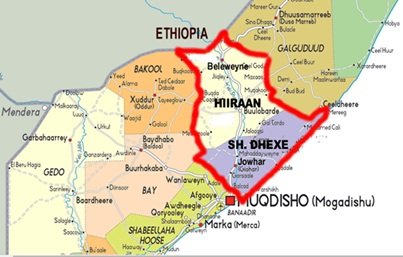
The confrontation in Beledweyne is exposing the political costs of the Federal Government’s handling of Hirshabelle’s leadership transition. A disputed election in Jowhar, opposition from influential local figures and growing armed mobilisation have turned a regional political dispute into a serious security challenge.
Mogadishu (WDN) — Somali President Hassan Sheikh Mohamud has held a sensitive meeting at the Presidential Palace with Hirshabelle Deputy President Abdifatah Hassan Afrah and a large number of lawmakers from the Hawadle clan, as tensions continue to escalate in Beledweyne over the region’s disputed political transition.
The meeting reportedly focused on the growing confrontation in Beledweyne, where politicians and armed groups opposed to the Federal Government’s political approach and the newly elected Hirshabelle administration in Jowhar have been mobilizing. Discussions centered on how to contain the unrest and prevent the dispute from escalating into armed confrontation.
One of the immediate concerns is Afrah’s planned visit to Beledweyne. Although he is seeking to travel to the city, there are fears that his arrival could trigger clashes given the strength of local opposition to the political arrangements that produced the new regional leadership.
The meeting comes at a particularly sensitive moment for the Federal Government, which is facing mounting political resistance over its handling of regional elections and constitutional and electoral disputes.
A crisis rooted in a contested political process
The growing confrontation in Hirshabelle cannot be understood simply as a security problem or a local disagreement between rival politicians. At its core lies a deeper dispute over political legitimacy, representation and the process through which regional leadership is selected.
The election in Jowhar, which produced the new Hirshabelle administration, has faced opposition from political figures and constituencies in Beledweyne who argue that the process did not adequately reflect local interests and political consensus. The Federal Government’s perceived involvement in shaping the outcome has further fueled suspicions that the regional election was driven more by political calculations in Mogadishu than by an inclusive agreement among Hirshabelle’s stakeholders.
This is the central political weakness of the process. When a regional leadership transition is perceived as imposed rather than negotiated, the resulting administration may win formal recognition without securing broad acceptance among the communities it is expected to govern.
The Federal Government may regard the election in Jowhar as a completed political process, but the resistance in Beledweyne suggests that the dispute remains unresolved. An election cannot deliver lasting legitimacy simply because a president or a group of political actors endorses its outcome. It requires an agreed process, meaningful participation and confidence among the principal stakeholders.
The consequences of unilateral political decisions
President Hassan Sheikh’s approach to regional political processes is increasingly facing questions about whether it is strengthening federal institutions or deepening divisions between Mogadishu and regional constituencies.
The crisis in Hirshabelle illustrates the danger of pursuing political outcomes without sufficient consultation and consensus. Rather than consolidating the authority of the newly elected administration, the process has generated resistance, armed mobilisation and uncertainty over whether its senior officials can safely exercise authority across the region.
The involvement of the Hawadle lawmakers in the presidential meeting is also politically significant. It suggests that Mogadishu recognises the importance of securing the support of influential representatives from a community whose political and security position is central to the situation in Beledweyne. However, engagement with lawmakers alone may not be sufficient to resolve a crisis involving wider political grievances and armed actors.
There is also a risk that attempts to manage the confrontation primarily through political alliances and security arrangements will leave the underlying grievances untouched. Without a credible process for dialogue and reconciliation, any temporary reduction in tensions could prove fragile.
A test of federal leadership
The Federal Government now faces a difficult choice: continue defending the outcome of a contested regional election or acknowledge that the process has failed to secure the political consensus necessary for a stable administration.
The responsibility for preventing further escalation rests with both the Federal Government and Hirshabelle’s political leadership. They must prioritise dialogue, address legitimate grievances and avoid steps that could turn political disagreement into armed confrontation.
Independent details of the confidential discussions at the Presidential Palace have not been made public. It is therefore unclear whether the meeting produced a concrete agreement or merely explored ways to contain the immediate tensions.
What is clear, however, is that the crisis has exposed the limits of a political strategy that places electoral outcomes ahead of broad-based agreement.
The lesson from Hirshabelle is difficult to ignore: political authority imposed without consensus can produce resistance rather than stability. President Hassan Sheikh’s unilateral approach to the regional election has become a central source of the current confrontation. Unless Mogadishu is prepared to address the legitimacy dispute through genuine political dialogue, the new administration in Jowhar may find it increasingly difficult to govern beyond its immediate political base — and Beledweyne could remain a flashpoint for a much wider federal crisis.
WardheerNews
Leave a Reply