
By Abdullahi A. Nor
The Somali Future Council, Haybad Qaran and other opposition alliances cannot demand political consensus and accountability from the government while allowing their own affiliated politicians to undermine those same principles
Somalia’s opposition cannot credibly challenge President Hassan Sheikh Mohamud’s unilateral approach to governance while turning a blind eye to political conduct within its own ranks that appears to contradict its declared principles. If consensus, consultation and political accountability are the foundations of the opposition’s campaign against the government, those principles must apply equally to its own leaders.
Recent political developments in Galmudug and Hirshabelle have exposed precisely this contradiction. Several politicians associated with opposition movements have publicly congratulated regional leaders whose elections have taken place amid wider political disagreements over electoral legitimacy, consultation and the absence of an agreed national political framework.
The question is no longer simply whether congratulating an elected regional president constitutes political courtesy. It is whether opposition politicians can endorse political outcomes without addressing the very concerns about electoral legitimacy and political consensus that their own coalitions have repeatedly raised.
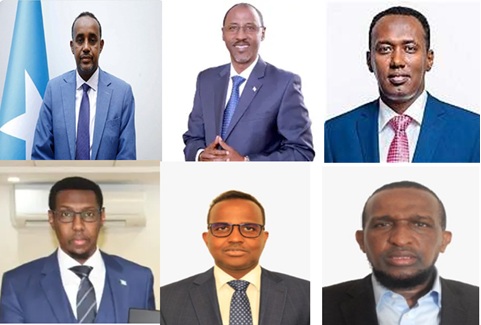
In Galmudug, former Prime Minister Mohamed Hussein Roble, former regional president Abdikarim Hussein Guled, federal lawmaker Abdirahman Mohamed Hussein (Odowaa) and Haybad Qaran opposition member Mr. Guuleed Salah Bare congratulated newly elected regional President Liibaan Axmed Xasan (Shuluq).
In Hirshabelle, Ali Abdullahi Hussein Guudlaawe was re-elected president, while Abdifitah Hassan Afrah became vice president. Their election was followed by congratulatory messages from several prominent political figures. Among them was federal lawmaker Abdulqadir Osoble Ali, associated with the opposition’s Somali Salvation Forum (Samatabixinta)
Former federal Minister of Internal Security Mohamed Abukar Islow Ducaale, associated with the Haybad Qaran alliance, also congratulated Guudlaawe,
Former Prime Minister Ali Mohamed Geedi likewise congratulated Guudlaawe and Afrah. His political position, however, should be distinguished from those of Osoble and Islow Ducaale, whose affiliations with opposition groupings make their political statements particularly relevant to the debate over opposition discipline and consistency.
To be fair, congratulating an elected president does not automatically constitute political defection, endorsement of an electoral process or evidence of a secret political arrangement with the federal government. Political courtesy is legitimate, and politicians are entitled to maintain relationships across political divides. But courtesy cannot become a convenient shield against legitimate questions of political consistency.
As WardheerNews reported, If opposition coalitions have challenged the electoral arrangements and political processes through which regional leaders emerged, their affiliated politicians must explain whether their objections remain valid, whether an understanding has subsequently been reached or whether they have simply abandoned their principle and decided to accept the outcomes. The public deserves clarity. Political ambiguity serves neither the opposition nor the Somali people.
A Double Standard That Undermines the Opposition
For months, opposition leaders have criticized President Hassan Sheikh Mohamud for pursuing political and electoral arrangements without the necessary consultation and agreement among Somalia’s political stakeholders. They have presented consensus as indispensable to national stability and constitutional legitimacy.
Yet what credibility remains in that argument if opposition-affiliated politicians appear willing to celebrate political outcomes without first establishing whether the same standards of consultation and agreement have been respected?
The opposition cannot have one set of principles for Villa Somalia and another for its own political associates. Nor can it demand accountability from government officials while allowing its own representatives to operate without political scrutiny.
Such contradictions create the impression that opposition principles are negotiable whenever individual political interests are served. That perception is dangerous. It weakens public confidence, encourages political opportunism and gives the government an opportunity to portray the opposition as divided and motivated by personalities rather than principles.
An opposition movement is not simply a collection of politicians united by their opposition to an incumbent president. It must be an organized political force with common principles and a recognizable programme, agreed positions and a minimum standard of collective responsibility.Those who participate in such a movement must understand that membership carries obligations as well as political benefits.
The Somali Future Council Must Act, Not Remain Silent
The Somali Future Council, Haybad Qaran and other opposition groupings should not allow this matter to pass without clarification. Their responsibility is to protect the political credibility of their alliances and ensure that their public positions are not contradicted by the conduct of affiliated leaders. The Council should take several concrete measures.
First, it must reaffirm its collective political position. The opposition should publicly explain whether it considers the recent electoral processes in Galmudug and Hirshabelle consistent with its principles and demands for consultation, political agreement and electoral legitimacy. It cannot continue criticizing similar practices at the federal level while remaining silent about developments elsewhere.
Second, affiliated politicians must be asked to explain their actions. Those who publicly congratulated the newly nominated regional leaders should clarify their messages of endorsements. Also, if their positions have changed, they should explain what prompted that change.
Third, the opposition must establish consequences for violations of its agreed principles. Where an affiliated politician has knowingly disregarded collective decisions, undermined an agreed political position or publicly represented a position contrary to the coalition’s commitments, the matter should be referred to the appropriate internal disciplinary structures.
Depending on the seriousness of the conduct and the applicable organizational rules, consequences could include a formal warning, suspension of political responsibilities, withdrawal of the coalition’s endorsement or, in serious and established cases, termination of membership or a demand that the individual step aside.
There should be no automatic punishment for ordinary political courtesy or for expressing a legitimate personal opinion. But neither should political affiliation provide immunity from accountability.
The distinction is straightforward: politicians are free to change their political positions, but they must be honest about doing so. Those who no longer subscribe to the coalition’s principles should have the political integrity to withdraw rather than continue benefiting from its collective identity while pursuing a different agenda.
Political Loyalty Must Be Matched by Political Responsibility
The opposition’s challenge is bigger than the conduct of a handful of politicians. It concerns whether Somalia can develop a credible political alternative based on institutions, principles and accountability rather than personal alliances and shifting political calculations.
President Hassan Sheikh Mohamud’s administration should be judged by the standards of consultation, constitutional compliance, and political consensus. The opposition must accept that it will be judged by exactly the same standards. It cannot demand discipline from the government while tolerating indiscipline among its own affiliates. It cannot accuse the president of political opportunism while excusing similar behaviour from politicians within its own camp.
The Somali Future Council and its constituent political organizations should therefore draw a clear red line. Political affiliation must carry responsibilities, and collective decisions must mean something. Those who deliberately undermine agreed positions should face proportionate disciplinary measures. Those who have abandoned the coalition’s principles should step aside and allow others who remain committed to its objectives to represent the movement.
Somalia does not need an opposition that merely changes the occupants of political offices while reproducing the same culture of inconsistency and political opportunism. It needs an opposition that demonstrates, through its own conduct, the standards of governance it promises the country.
The message should be unmistakable: no political leader should be above accountability, whether in Villa Somalia, a regional presidency, or the opposition itself. If the opposition cannot enforce its principles within its own ranks, it has little moral authority to demand that the president respect them.
Abdullahi A. Nor
Email: abdulahinor231@gmail.com
Leave a Reply