
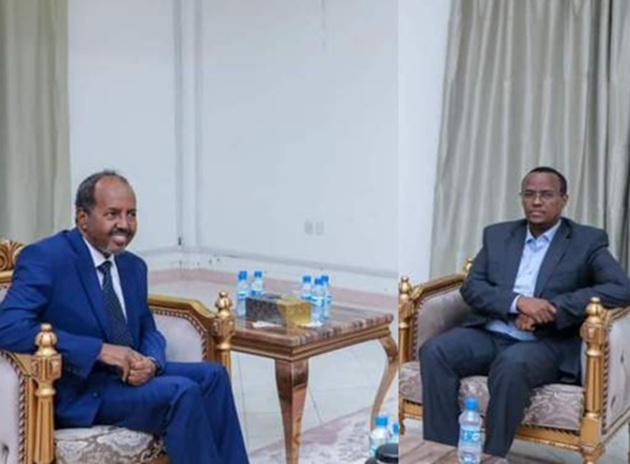
JOWHAR, Somalia (WDN) — In a striking reversal that has raised questions about the credibility of Somalia’s opposition, several politicians who spent nearly a year opposing unilateral elections have congratulated the outcome of the disputed Hirshabeelle leadership vote in Jowhar. This follows the same pattern witnessed in Galmudug, where opposition figures also congratulated the sham election orchestrated by President Hassan Sheikh.
The election produced the re-election of Hirshabelle President Ali Abdullahi Hussein (Guudlaawe) and Vice President Abdifitah Hassan Afrah. Yet critics argue that the result was widely anticipated, raising questions about whether the process represented a genuine electoral contest or merely formalised a political outcome already agreed upon by the federal leadership.
The most controversial reactions have come from politicians associated with opposition coalitions that had challenged the legitimacy of election arrangements conducted without broad political agreement. Their decision to congratulate the winners has prompted accusations of inconsistency and renewed doubts about whether some opposition figures were genuinely committed to the principles they publicly defended.
Opposition figures congratulate the winners
Abdulqadir Osoble, a politician associated with the opposition Salvation Forum, congratulated Guudlaawe and wished him success in carrying out his responsibilities.
In his message, Osoble expressed hope that the newly elected leader would advance development, peace, reconciliation and unity among the people of Hirshabelle.
Former Internal Security Minister Mohamed Abukar Islow Ducaale, who is associated with the Haybad Qaran alliance, also congratulated Guudlaawe, describing him as both a brother and a friend. He wished the president success in the five-year term entrusted to him and urged the new leadership to promote unity and genuine reconciliation, particularly with communities that feel marginalised or aggrieved.
Their messages placed emphasis on reconciliation and the responsibilities of leadership. But they also exposed an uncomfortable political contradiction: how can politicians oppose an electoral process for months on the grounds that it lacks consensus, then publicly endorse its outcome without explaining whether their objections have been resolved?
The issue is not whether political opponents should congratulate newly elected leaders. In a functioning democracy, acknowledging a political outcome can be a responsible gesture, even amid disagreement. The question is whether these politicians have abandoned their earlier objections, secured concessions behind the scenes, or simply decided that political relationships matter more than the principles they previously proclaimed.
Neither Osoble nor Islow, in the statements cited, explained why their congratulations should be understood as consistent with their earlier opposition to elections conducted without a political settlement.
A contrast with Ali Mohamed Geedi
The congratulations from former Somali Prime Minister Ali Mohamed Geedi attracted less surprise among critics because he is not identified with the opposition campaign against President Hassan Sheikh Mohamud’s electoral approach.
Geedi praised Guudlaawe as an experienced and moderate leader whom he believed could bring peace, stability and sustainable development to Hirshabelle. He also congratulated Vice President Abdifitah Hassan Afrah and wished both leaders success in their responsibilities. His position was therefore viewed differently from that of politicians who had presented themselves as opponents of the disputed electoral arrangements.
The contrast has sharpened the debate over political consistency. For critics, the concern is not simply that opposition figures offered congratulations, but that they did so without publicly clarifying whether the underlying dispute over electoral legitimacy had been settled.
The credibility problem facing Somalia’s opposition
The controversy extends beyond Jowhar. Similar concerns have been raised over the electoral process in Galmudug, where disputes over political consensus and the federal government’s influence have also featured in the wider national debate.
For nearly a year, opposition figures have challenged electoral arrangements they say were being pursued without the agreement required to secure broad political legitimacy. Their position helped frame the dispute as a struggle over constitutional principles, federalism and the rules governing the transfer of power.
When politicians associated with that campaign subsequently welcome the results of contested elections, they risk weakening the very argument they had asked the public to support.
That does not automatically prove that they were secretly working for the federal government, as some critics allege. Nor does a congratulatory message, by itself, establish that a politician has abandoned the opposition. But without a clear explanation, the apparent inconsistency invites legitimate questions about their motives, commitments and future role in the opposition movement.
Political alliances can change, and dialogue can produce compromises. If the politicians concluded that the Jowhar process had become acceptable, they should explain what changed. If they continue to believe that the process lacked consensus, they should clarify why they congratulated its outcome without addressing those concerns.
Silence leaves room for suspicion and further erodes public confidence.
A test of principle or political convenience?
The public reaction reflects a deeper frustration with political leaders who invoke democratic principles when opposing their rivals but appear willing to overlook those principles when the outcome suits their political interests.
For ordinary Somalis, the credibility of an opposition movement depends not only on its criticism of the government but also on its willingness to apply the same standards consistently. Opposition cannot be reduced to a collection of personal rivalries, shifting alliances and competing ambitions for power.
The responsibility also rests with the federal government. If its electoral arrangements are to command national legitimacy, it must address substantive objections through transparent dialogue rather than rely on the endorsement of individual politicians as a substitute for broad political agreement.
Ultimately, the controversy surrounding the congratulations in Jowhar presents Somalia’s opposition with a straightforward choice: explain whether its position has changed and why, or risk convincing the public that its declared principles are negotiable whenever political circumstances demand.
For an opposition that spent months challenging the legitimacy of a disputed electoral process, congratulating its outcome without explaining the change may prove more damaging than remaining silent.
WardheerNews