
Muhiddin Mire repeatedly cut the throat of a stranger in a London tube station last year, claiming it was revenge for Syria
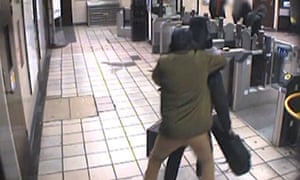
An image from CCTV footage shows the moment that Muhiddin Mire attacked Lyle Zimmerman. Photograph: CPS/PA
By Vikram Dodd and Esther Addley
A man with a history of poor mental health who repeatedly cut the throat of a stranger at an east London tube station and claimed he was acting in response to Britain’s involvement in the Syria conflict has been convicted of attempted murder.
Muhiddin Mire, 30, shouted “This is for my Syrian brothers. I’m going to spill your blood” during the rampage last December, and also attacked or threatened four other travellers.
Police originally classed the attack as an act of terrorism. But further inquiries pointed to Mire’s violence being down to his acute mental health problems rather than a political motivation.
He was Tasered by police to stop the attack at Leytonstone station, having cut at the throat of Lyle Zimmerman, whom he had chosen at random to target after travelling on the same tube carriage.
Zimmerman, who suffered three large lacerations to his neck that exposed his trachea, survived to testify at the trial, where he said he felt his attacker was “a crazy person. A mentally ill person.”
One person was overheard on mobile phone footage of the incident shouting at Mire: “You ain’t no Muslim, bruv.”
Mire denied attempted murder during his trial at the Old Bailey, and admitted wounding Zimmerman with intent and attempting to wound four others.
He will be sentenced on 27 July and has been detained at Broadmoor high-security mental health facility.
Before adjourning for sentencing, the judge Nicholas Hilliard QC told jurors he would be highlighting the “public spiritedness” of the people who rushed to help on the day of the attack. He said: “It would have been very easy to continue one’s journey on, but that did not happen.”
The Guardian understands that Mire was not on any database of suspects or known extremists, and is not believed to have been exploited by any known terrorist group or individual.
Zimmerman, who was carrying an amp, a mandolin and a guitar strapped to his back, was attacked from behind and dragged to the floor. On video footage, Mire was seen turning him over and making what the prosecution described as “a sawing motion with the knife”.
Zimmerman told police he felt he was being attacked by “a crazy person”. Another witness, described Mire as having “wide and staring” eyes, “like he was not there”.
The prosecutor Jonathan Rees QC said Mire’s comments during the attacks showed he was “motivated for revenge for what was happening in Syria”.
Mire had used his phone to download a large number of images including those of murdered fusilier Lee Rigby and the Isis executioner nicknamed Jihadi John. Also found were images of Isis prisoners about to be executed, lying in positions similar to the pose in which Mire placed Zimmerman before attacking his throat.
The defendant had made searches on his mobile phone for “Islam v west” and, two days before the attack, “Islamic State/Isis”. The phone also held a graph of US and coalition airstrikes on Islamic State positions.
Scotland Yard initially treated it as terrorist incident and it was investigated by its counter-terrorism command, but at the close of the trial the Met said they believed that Mire’s poor mental health explained the attack.
Despite police initially classing it as a terrorist incident, there was no meeting of the government’s crisis committee Cobra, which has convened after other terrorist attacks, nor statements from the prime minister. Mire is believed to have acted alone, and there is no evidence he acted under direction or as part of any network.
After the verdict, police said they no longer classed Mire’s actions as terrorism. Commander Dean Haydon, head of counter-terrorism for Scotland Yard, said: “I would not class it as a terrorist incident now.”
Haydon said the attack was not politically motivated but down to Mire’s mental illness. The attacker had been inspired by Isis propaganda, which poses a danger to the vulnerable.
Haydon said it had been right to treat the attack as potentially terrorist at the start because of words uttered by Mire, such as “Allahu Akbar”, and his comments about Syria. That impression was buttressed by the material detectives found on his phone.
But subsequent inquiries did not support Mire’s actions being part of a political, religious or ideological cause, which is the definition of terrorism. Nonetheless, Haydon said Mire had been inspired by Isis material he downloaded on to his phone to commit violence.
“Whilst Mire has not been accused of any terrorist offences, it would appear from comments he made at the time of the attack and the content he had downloaded on his phone that he may have been inspired by extremist ideology,” he said.
“Part of their propaganda is specifically targeted in relation to the vulnerable. We’re not just talking about mental health here, we’re talking about vulnerable individuals within the community. As a result of what I would call inspiration as a result of that propaganda, we are seeing more and more lone actors. Spontaneous volatile extremists is another term.”
Mire had a history of mental illness and suffered from paranoid delusions a month before the attack. He had missed an appointment with a community mental health team four days before the incident on 5 December 2015.
Mire, who was born in Somalia and came to the UK as a young boy, was a practising Muslim who had previously worked as an Uber cab driver but quit because of the debilitating toll of the paranoid delusions.
He was sectioned in 2006 during an episode “when, essentially he lost touch with reality”, the court heard, and a month before the incident his GP referred him to his local community mental health services.
About two weeks before the attack, Mire started wearing traditional Muslim clothing. Jurors were told that in the days before the incident Mire’s brother bought a plane ticket for him to travel from Heathrow to Somalia, and the accused was due to depart the following day.
Rees, for the prosecution, told the jury that Mire appeared to be suffering a relapse of his psychosis in the weeks before the attack, but added: “It is not suggested in this case that the defendant was legally insane during the incident,” nor that he was incapable of forming the intent of attempted murder.
Matthew Smith, a junior doctor who helped save Zimmerman while Mire continued to threaten other passengers around the ticket hall, told the jury he thought the attacker had mental health problems.
“He was behaving quite erratically, moving from side to side – he was waving his weapon about [and] making grunting noises occasionally.”
Other witnesses described trying to intervene in the “relentless” assault to help the victim and being threatened by Mire. Louise McGuinness said in a statement that when she shouted at Mire to stop he turned to her and said: “This is for telling me to stop,” and kicked Zimmerman harder.
“I watched as he began literally to saw through [the victim’s] neck six or seven times,” she said. “I could literally hear the man’s skin just ripping open and blood began to flow.”
When she repeated her call for him to stop, he threatened her with the knife and said: “You’re next,” and she ran from the station in fear for her life.
A Polish man, Daniel Bielinski, whom Mire tried to slash with his knife outside the tube station, reacted by filming him with his phone camera. In the footage, Bielinski can be heard shouting warnings to others to be careful and to call the police.
He asked Mire: “Why do you attack me and my girlfriend?” to which Mire responds: “If you are in Syria, they bomb you.”
Recent police research shows at least 44% of people considered at risk of being radicalised by extremists may have a mental health issue.
Source: The Guardian