
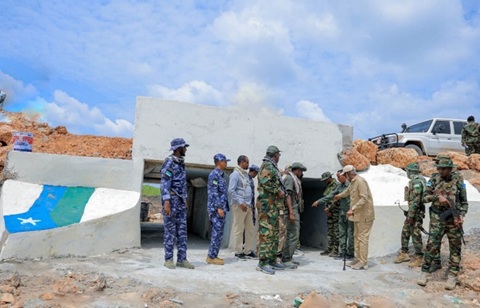
The locally funded Kismayo–Afmadow road project offers a powerful example of self-reliance, demonstrating how communities and regional governments can take responsibility for building essential infrastructure rather than waiting indefinitely for international donors.
KISMAYO, Somalia-(WDN) – Jubaland President Ahmed Mohamed Islam, popularly known as Ahmed Madobe, has inspected the construction of a 120-kilometre road linking Kismayo and Afmadow, an ambitious infrastructure project being financed through local contributions and collective community efforts.
The initiative represents an important example of self-help in a country where infrastructure development has long depended heavily on foreign assistance. Rather than waiting for international donors to finance the project, Jubaland’s government and local communities have taken the initiative to mobilise their own resources to construct a road that will connect communities and improve economic activity across Lower Juba.
During his inspection, President Ahmed Madobe praised residents living along the road for their willingness to contribute to its construction and support government institutions carrying out the work. He described the project as evidence of the commitment of Jubaland’s people and administration to improving public infrastructure through collective responsibility.
The significance of the project extends beyond the physical construction of a road. It challenges a deeply entrenched development culture in Somalia, where many regional administrations have become accustomed to relying on external funding for major infrastructure projects.
Breaking the Cycle of Donor Dependency
For decades, Somalia’s development agenda has been heavily shaped by international donors, humanitarian agencies and foreign-funded programmes. While external assistance remains important, excessive dependence on it has weakened the culture of domestic resource mobilisation and, in some cases, discouraged governments from taking the initiative to address their own infrastructure needs.
Many federal member states continue to depend on external partners to finance roads, public facilities and other essential infrastructure. Consequently, development projects often move at the pace of donor commitments rather than the priorities and urgency of local communities.
Jubaland’s approach offers a different perspective: communities do not necessarily have to wait for international funding before beginning projects that directly affect their livelihoods. By mobilising local resources, engaging residents and coordinating government efforts, regional administrations can begin addressing development priorities with the resources available to them.
If successfully completed, the Kismayo–Afmadow road could become an important example for other Somali administrations, demonstrating that local initiative, community participation and government commitment can deliver infrastructure even in resource-constrained environments.
Security and Development Go Together
During the same visit, President Ahmed Madobe travelled to Miido, Harboole and Biibi in Lower Juba, where he inspected Jubaland Darwish forces stationed in the area.
He was accompanied by the commander-in-chief of Jubaland’s Darwish forces, General Ismail Sahardiid, senior military officers and other government officials.
The simultaneous attention to infrastructure and security highlights two interconnected priorities for Jubaland. Roads improve mobility, facilitate trade and connect isolated communities, while security provides the stability necessary for economic activity and development.
The Kismayo–Afmadow project deserves attention beyond Jubaland’s borders. Its most important contribution may not simply be the road itself, but the principle behind its financing: the willingness of a regional government and its people to take responsibility for their own development.
It would be premature to describe this as the first locally financed road initiative in Somalia without a comprehensive record of comparable projects. Nevertheless, a 120-kilometre undertaking financed through local self-help is an ambitious example of domestic initiative.
Somalia cannot build a sustainable future if its regional administrations remain permanently dependent on foreign donors to undertake basic development projects. International assistance should complement domestic efforts, not replace the responsibility of governments and citizens to develop their own communities.
One important correction: the source gives the road’s length as 120 kilometers, equivalent to approximately 75 miles, not 120 miles.
Leave a Reply