
By Abdiqani Haji Abdi
When elections are manipulated, political consensus abandoned and credible competition undermined, the consequences extend beyond questions of legitimacy. Such processes discourage principled and qualified candidates from participating, creating opportunities for individuals whose financial resources and political connections may matter more than public service, experience and competence.
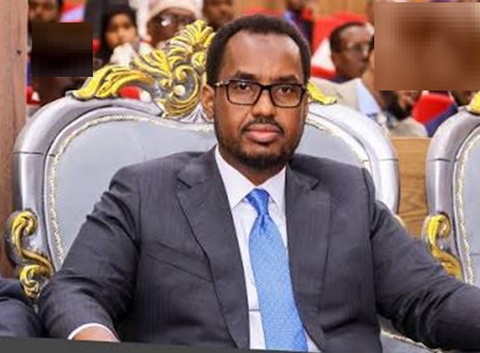
The Galmudug’s newly installed president, Liibaan Axmed Xasan, popularly known as Liibaan Shuluq, unlike many Somali political leaders who have served in government, parliament or public administration, have no widely established record of holding a senior government position before becoming Galmudug’s president. A profile published by Baaritaan Digital, Meet Liibaan Shuluq, describes his background in business activities and regional political networks, while also documenting allegations about his connections to armed groups, Qad (Khat) trading and other controversial activities.
More significantly, the central concern surrounding Liibaan’s presidency extends beyond his personal background to the electoral process that paved the way for his ascent to the highest office in Galmudug.
Liibaan Shuluq has been involved in the operation of illegal checkpoints, arms trading, and the importation and distribution of khat. He also maintained and operated an independent armed militia outside the command structures of the Somali National Army and the Galmudug Darawish security forces.
Liibaan Shuluq maintained this private militia, equipped with heavy weapons, until his installation as president of Galmudug. Following his assumption of the office, his privately owned military vehicles and weapons were transferred to the regional administration’s Ministry of Security. Although the handover has been presented as a contribution to strengthening regional security, it has also drawn attention to the unusual circumstances surrounding his political rise, his personal background and the electoral process that brought him to power.
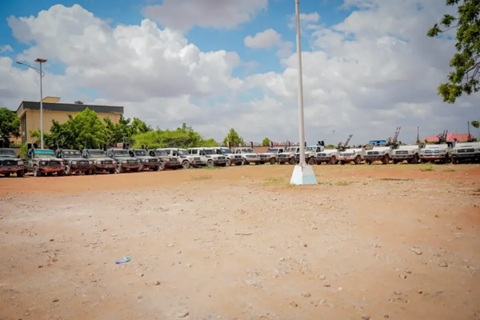
According to a report by Shabelle Media, the military equipment belonged personally to Liibaan Shuluq. The transfer took place in the presence of President Hassan Sheikh Mohamud, shortly after Liibaan’s inauguration. A related report is available from AFREEQUE, citing Caasimada Online. The development raises broader questions about the origins of the new president’s considerable private military resources, his business background and the financial networks behind his political ambitions.
Nevertheless, the transfer of his private military equipment to the regional administration raises an important institutional question: why does a newly elected regional president enter public office with a substantial personal arsenal, and what does this reveal about the relationship between private power and public institutions?
When Elections Produce Unsuitable Leaders
Perhaps the more consequential issue surrounding Liibaan’s presidency is not simply his personal background, but the electoral process that enabled him to reach the highest office in Galmudug.
The controversy surrounding his election did not emerge without precedent. On August 24, 2026, Somalia’s Supreme Court annulled the results of Galmudug’s July parliamentary and local council elections, citing serious violations of constitutional and electoral procedures. The court ruled that the irregularities had undermined the transparency, freedom and fairness of the process and ordered fresh elections.
According to WardheerNews, the Supreme Court Chief Justice stated – the court has found serious irregularities that could not be corrected and that had undermined the integrity, independence and credibility of the electoral process. The court subsequently ordered the Independent National Electoral and Boundaries Commission to restart the electoral process and conduct fresh elections at the earliest practical opportunity.
The Supreme Court ruling documented the court’s decision and the legal challenges brought by opposition political organizations. However, the subsequent electoral process remained controversial. Although fresh parliamentary elections were conducted on September 30, the Towfiiq political organization, which had successfully challenged the original results in court, was excluded from participating in the rerun. This exclusion raised further questions about whether the electoral exercise had genuinely addressed the shortcomings identified by the Supreme Court. These developments illustrate a fundamental problem with elections conducted without genuine political consensus and inclusive competition.
A corrupt or predetermined election does not simply produce a disputed winner; it can undermine the entire process of selecting qualified leadership. When an electoral outcome is effectively controlled by those in power, capable candidates with professional reputations and political principles may see little reason to participate in a contest whose result they believe has already been decided.
No self-respecting candidate committed to democratic principles should be expected to legitimize an electoral exercise that lacks transparency, fairness and meaningful competition. When serious contenders withdraw or refuse to participate, the resulting political vacuum can favor individuals whose financial resources, political connections or willingness to accommodate those controlling the process give them an advantage over more qualified alternatives.
This is one of the most damaging consequences of political manipulation: public office becomes less about competence, integrity and public service and more about money, patronage and political loyalty.
The formal inauguration of Liibaan in Dhusamareeb, attended by President Hassan Sheikh and other officials, may have given the new administration the appearance of political legitimacy. However, an inauguration ceremony cannot erase the questions surrounding the credibility and inclusiveness of the electoral process.
Questions Over the Price of Power
Even more serious are allegations concerning the financial arrangements surrounding Liibaan Shuluq’s election. Political opponents have alleged that approximately $17 million was paid to secure the Galmudug presidency through an arrangement involving President Hassan Sheikh Mohamud. No independently verified evidence has established that such a payment occurred, and the allegation remains unsubstantiated.
Nevertheless, the seriousness of the claim highlights wider concerns about the influence of money in Somalia’s regional political contests.
If public office can be acquired through financial transactions rather than transparent elections, the consequences extend far beyond the individual who wins. Such arrangements risk turning regional administrations into instruments of political and commercial interests rather than institutions accountable to their populations.
They also raise an uncomfortable question: what will a leader who allegedly spends enormous sums to obtain office prioritize once in power—public service and institutional development, or rewarding the networks and interests that facilitated his election?
These concerns deserve public scrutiny and credible answers.
Galmudug Needs Institutions, Not Personal Power
Galmudug faces serious challenges, including persistent insecurity, weak public institutions, corruption, economic hardship and the continuing threat posed by Al-Shabaab. Its population needs leadership capable of strengthening government institutions, restoring public confidence and establishing professional security structures.
These responsibilities require more than financial resources, private military equipment or political connections. They demand administrative competence, integrity, accountability and the ability to build consensus across different communities.
Liibaan Shuluq’s presidency begins under the shadow of a disputed electoral process and serious allegations about his personal and financial background. He now has the responsibility to demonstrate that his administration can rise above these controversies and serve the public interest.
But the larger lesson extends beyond Galmudug. Somalia cannot expect credible institutions and responsible leadership to emerge from electoral processes that exclude genuine competition, disregard political consensus and place political loyalty above competence.
The quality of a government begins with the quality of the process that brings it to power. When elections become political transactions rather than democratic contests, a country risks selecting leaders not because they are the most qualified to govern, but because they are the most useful to those controlling the outcome. Galmudug’s new presidency illustrates the potentially damaging consequences of that failure.
Abdiqani Haji Abdi
Email: Hajiabdi0128@gmail.com
Leave a Reply