
By Abdiqani Haji Abdi
In Somalia, political crises rarely unfold quietly. They escalate, stall, and—almost inevitably—draw in the international community, which arrives as referee, mediator, and sometimes reluctant architect of last-minute compromises.
Except this time. This time, the referee is not just silent—it is absent.
As Somalia drifts toward what many describe as a constitutional and electoral rupture, the international community—long accustomed to “calling the shots” during moments of instability—has opted for an unusual strategy: saying nothing at all.
No warnings. No interventions. No carefully worded concern.
Just silence
And in Somalia’s political ecosystem, silence is rarely interpreted as innocence.
“This is not the international community we are used to,” said a Mogadishu-based political analyst. “In the past, even rumors of a constitutional crisis would trigger immediate diplomatic pressure. Now, we are facing a full-blown rupture—and there is barely a whisper.”
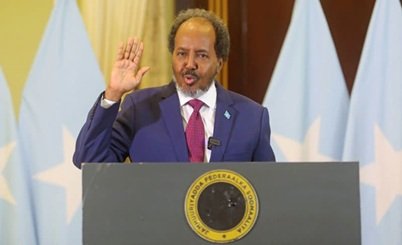
That rupture is being driven by an electoral plan advanced by President Hassan Sheikh Mohamud—a plan that attempts to compress Somalia’s long-delayed transition to universal suffrage into just 41 days.
A Shifting External Actor
Another seismic shift in Somalia’s already fractured political landscape has deepened public disillusionment—Turkey’s apparent loss of neutrality at the most critical moment.
For years, Turkey positioned itself as a trusted partner: training elite Somali forces, supplying weapons, and providing advanced drone capabilities intended for the fight against Al-Shabaab. That partnership carried weight—not just militarily, but symbolically—as a model of strategic support without overt political interference.
But that perception has now been shaken.
For many observers, those same Turkish-trained units and Turkish-supplied drones—appear to have been redirected inward, deployed not against insurgents (Al Shabab) but within Somalia’s own political arena. Their use in the South West State crisis to tilt the balance in favor of the sitting president marks a turning point that many believe will not be easily forgotten.
“What was built as a counterterrorism force is now seen as a political instrument,” one analyst noted. “Those changes everything.”
The implications go beyond a single confrontation. In a country where external actors are constantly judged by their neutrality—or lack of it—this moment risks redefining Turkey’s image in the Somali public consciousness.
No longer viewed solely as a neutral partner, Turkey now faces growing perception among Somalis as aligned with a presidency increasingly accused of centralizing power at the expense of federal balance. And in Somalia, perceptions have long memories.
What was once seen as a brotherly ally may now, in the eyes of many, be remembered as a decisive actor in a political struggle—one that risks pushing an already fragile nation closer to the edge.
The blueprint begins with local council elections—but surprisingly only in FM states that their Presidents have no constitutional mandate to govern and infested by Al Shabab terrorists – Hirshabelle, Galmudug, and Southwest State which is currently under Federal occupation without legitimate leadership. From there, it escalates rapidly into regional presidential contests, before culminating—remarkably—in a national presidential election within the same timeline.
To fools, this is reform.
To others, it is something else entirely.
“It is not a roadmap,” said a constitutional expert familiar with Somalia’s federal framework. “It is a sequence designed to collapse under its own weight.”
Opponents, substantial body, argue that the structure itself is exclusionary. Puntland and Jubaland—two key federal member states remain outside the process altogether, having effectively disengaged from Mogadishu over disputes related to constitutional amendments and power-sharing.
Meanwhile, political support around the president appears to be thinning. Most influential figures within his political orbit have walked out of his so called JSP, while opposition coalitions grow increasingly vocal. President Hassan is the only President in the world that can’t deliver speech to his people. The reason is, all will sing without exception the familiar phrase that defines his leadership “President Hassan the thief – who stole the land beneath our feet, father of nepotism and corruption.”
Even the institutions meant to oversee this transition are under scrutiny. The federal Electoral commission is widely viewed by 99% of the adult citizens as lacking neutrality because the commission was assembled by the President in his kitchen without the required consultations, while the other pillar which is the PFCS was thrown out of the window entirely and its place, the megalomaniac president drafted his own again without any consultations which the people and opposition described as unilateral and lacking national consensus.
Then there is the matter that no political timetable can override: security.
Al-Shabaab continues to control or influence significant areas across southern and central Somalia – they collect taxes from Afgoye and Balcad – the two corridors of Mogadishu. Despite ongoing military operations, large portions of the country remain unstable—raising serious questions about how, where, and by whom elections could realistically be conducted – for a person to line up at a polling station is marking him/herself as a target for Al shabab.
“You cannot run a national election where the state itself does not fully exist, like Afghanistan” said a regional security analyst. “Security is not a detail. It is the foundation.”
Yet it is the silence of external actors that has become the most politically charged element of all.
In previous crises, international partners played a decisive—if controversial—role in shaping outcomes. Today, their absence is being interpreted in sharply different ways. Some see it as a shift toward Somali ownership of political processes. Others see it as strategic disengagement.
And then there is a more controversial—and increasingly widespread—interpretation emerging within certain political circles. “There is a belief gaining ground,” said a senior opposition figure, “that this silence is not passive. It is permissive.”
That belief draws on a broader narrative circulating among some analysts and commentators—that Somalia is part of a group of seven Muslim-majority countries the west earmarked for dissolution by way of external intervention: Iraq, Syria, Libya, Sudan, Somalia, Iran, and Yemen. (Africanews)
While biased mainstream analysts attribute the crises in these countries to a mix of internal governance failures, regional rivalries, and international interventions, more critical voices interpret the pattern differently. “They see a pattern, not coincidence,” said a Horn of Africa political researcher. “Rightly or wrongly, they believe Somalia is not being stabilized—but managed.”
It is an interpretation that remains highly contested—and firmly rejected by many international policy experts—but its growing traction within Somalia reflects a deepening mistrust of both domestic leadership and external partners. Because from the perspective of many Somali observers, the timing is difficult to ignore.
A fractured federal system.
Disputed constitutional changes.
An accelerated electoral plan with limited geographic scope.
An active insurgency.
And a silent international community.
“If this was any previous cycle, there would already be pressure, statements, mediation,” said another analyst. “Now? Nothing. That vacuum is being filled with suspicion.”
Whether that suspicion is justified or not, it is shaping the political narrative in real time. Somalia now approaches a decisive moment without consensus, without institutional clarity, and without the external guardrails that once prevented political crises from spiraling.
If the current trajectory holds, the outcome is unlikely to be orderly. At best, a contested transition.
At worst, a deeper fragmentation of the federal system. And hovering over it all is a question that no one—inside or outside Somalia—seems ready to answer:
Is this silence restraint?
Or is it something far more consequential?
Because in Somali politics, when the referee disappears, the game does not stop. It simply becomes more dangerous.
Abdiqani Haji Abdi
Email: Hajiabdi0128@gmail.com
_____________
Related articles:
Does history repeat itself? By Ali Haji Warsame
Somalia on the Edge: Downgrading C6+ Risks Collapse as International Community Faces Stark Choices By Abdullahi A. Nor
47 Days to Expire: How Mogadishu is Pushing Somalia Toward Fragmentation By Abdullahi A. Nor How president Hassan’s erratic decisions are pushing Somalia toward institutional breakdown By Abdiqani H.
How President Hassan Is Driving Somalia Toward Political Rupture By Abdullahi A. Nor