
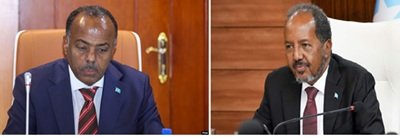
Mogadishu (WDN)- A letter from Somalia’s State Minister for Foreign Affairs, Mr. Ali Omar Balcad, has sparked a wide controversy by declaring the Federal Government’s rejection of the international partners known as the C6+ — a coordination group comprising the United Nations, European Union, United States, United Kingdom, African Union, and IGAD. These stakeholders have long played a pivotal role in guiding Somalia’s path toward political stability, often calling for inclusive dialogue and negotiated electoral processes.
In the letter addressed to UN Special Envoy to Somalia, Ambassador James Swan, Minister Balcad, a close confidant of President Hassan Sheikh Mohamud stated that Somalia no longer recognizes the authority or relevance of the C6+ mechanism. He argued that the era of international tutelage has passed.
“Somalia is no longer a country in transition, but a sovereign state with functioning constitutional institutions, a maturing democratic process, and a clear national agenda for peace and development,” the letter reads.
This declaration marks a stark shift in tone from a government that has until recently relied heavily on international political, financial, and security assistance. The rejection of multilateral oversight is less about asserting sovereignty and more about shielding the administration from international scrutiny over its increasingly unilateral political maneuvers.
The collapse of President Hassan Sheikh Mohamud’s initiative which many critics argue was a symbolic gesture rather than a genuine national dialogue, has also laid bare the deepening political rifts within the country and the administration’s faltering path toward national consensus.
The mounting pressure from C6+ partners on President Hassan Sheikh to pursue a broad-based political consensus has angered the President, especially regarding electoral processes and power-sharing agreements with Federal Member States such as Puntland and Jubaland. The government’s letter, echoes the failed totalitarian tactics used by former President Mohamed Abdullahi Farmaajo, who also clashed with international actors during his term in a bid to centralize power.
Villa Somalia’s latest move is a preemptive attempt to sideline external influence amid growing domestic discontent. President Hassan is seeking to bypass political negotiations to marginalize opposition voices, and impose an electoral framework without national consensus — actions that are fueling instability and public frustration.
In this brazen display of political theatre, Ali Balcad—acting in lockstep with President Hassan sidelined the newly appointed Minister of Foreign Affairs to seize the spotlight for himself. Though officially a State Minister, Ali effectively runs the ministry, reducing the cabinet minister to a figurehead. It’s a familiar tactic under President Hassan’s leadership: appoint a minister for formality, then install his own loyalist to wield the real power from behind the scenes.
Despite the Somali government’s stance, the international community has so far refrained from issuing a formal response. However, diplomatic sources told WardheerNews that C6+ members are preparing to hold a high-level meeting with President Hassan Sheikh in a bid to de-escalate tensions and reaffirm their commitment to Somalia’s peace and democratic progress.
As Somalia continues to navigate a fragile political landscape, the widening rift between Villa Somalia and its long-standing international partners may pose new challenges to the country’s already precarious stability.
WardheerNews