
Africa Confidential
The Jubaland agreement may have saved Somalia from a descent into disastrous factionalism. It is a glimmer of hope amid plenty of bad news.
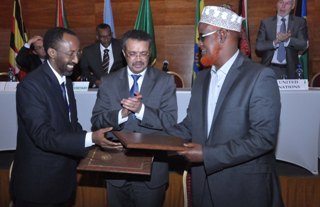
When the government of Somalia and the Jubaland administration of Ahmed Mohamed Islaan ‘Madobe’ signed an interim agreement on 27 August, the sighs of relief were audible. Both sides had stepped back from the brink and defused, for now at least, a political bomb that was threatening to derail the one-year-old Federal Government.
In the run-up to the meetings in Addis Ababa, Ethiopia, that preceded the agreement, there was a serious danger that Darod-dominated sections of the north, especially Puntland, and in the Juba Valley would become actively hostile to the central government.
That danger is now averted, temporarily perhaps, and the agreement revives hope that the Mogadishu government has a chance of holding Somalia together.
Ahmed Madobe and his Ras Kamboni Brigade, acting hand-in-hand with the Kenyan army, had captured significant parts of Middle Juba and the port city of Kismayo from Al Haraka al Shabaab al Mujahideen (AC Vol 54 No 14). They then called a regional conference which declared Madobe President of the ‘Jubaland State of Somalia’.
Mogadishu vehemently opposed this development and the dispute threatened to split the country along Darod pro-federalist and Hawiye pro-centralist lines. Huge tension between the two clan groups and their visions for Somalia remain but the Juba agreement at least buys time to try and come to a common understanding on a way forward nationally.
Two-part agreement
The agreement comes in two parts. The preamble reaffirms the principles that are important to President Hassan Sheikh Mohamud and his government. These mainly concern the leading role that the government should play in the creation of new federal units. When it comes to the substance of the agreement, however, things take a turn in Madobe’s direction.
The concessions made by the Jubaland side are minimal and cosmetic. The region will be referred to as the ‘Juba administration’ in place of the more permanent-sounding ‘Jubaland’. Madobe will be the ‘leader’ of the administration, not ‘president’. The agreement makes no mention of the Jubaland conference that appointed him and it states that the process of formally creating a federal state needs to begin. In theory, this is a two-year transitional agreement. The control of the ports and airport – the major sources of income – remain under Ras Kamboni control for six months and then under federal control, but the revenue is to be used for the Juba administration.