
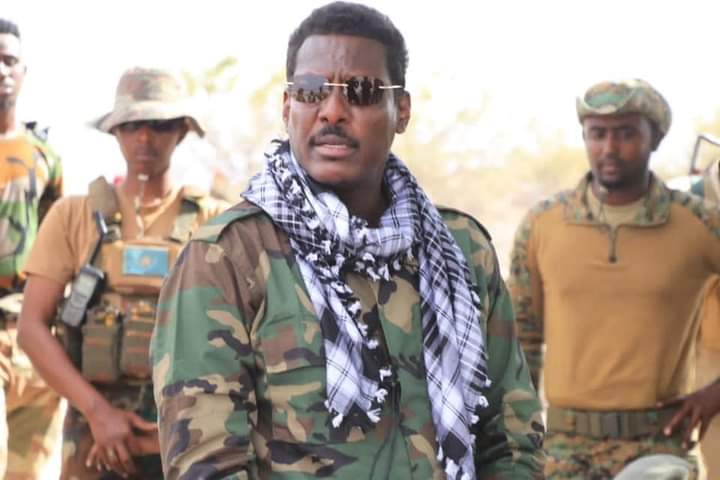
Dhusamareb (WDN) — High-stakes political negotiations entered their second day in the Galmudug capital of Dhusamareb, where Galmudug President Ahmed Abdi Kariye (Qoorqoor) and National Intelligence and Security Agency (NISA) Director Mahad Mohamed Salad remain locked in a tense standoff over the future leadership of the federal member state.
Despite hours of closed-door discussions, sources familiar with the talks say no breakthrough has been achieved, exposing deep divisions over the upcoming presidential election in Galmudug and the broader political agenda being pursued by Villa Somalia.
At the center of the dispute is the future of President Qoorqoor himself. According to political sources, Mahad Salad is pressing a proposal that would see Qoorqoor withdraw from the presidential race and gracefully exit office in exchange for what critics describe as a political “golden handshake”—a package of guarantees, incentives, and financial assurances designed to facilitate a smooth transfer of power.
However, the plan appears to have run into firm resistance. President Qoorqoor has reportedly made it clear that he is prepared to face any challenger in an open and competitive election but is unwilling to surrender his constitutional right to seek another term. Sources close to the Galmudug leader say he remains confident that the people and political stakeholders of Galmudug should determine the state’s future leadership through the ballot box rather than through negotiations conducted behind closed doors.
The deadlock has increasingly highlighted the political mission many observers believe Mahad Salad is carrying out on behalf of President Hassan Sheikh Mohamud and Villa Somalia. Political insiders claim that the NISA chief is actively lobbying for the installation of businessman Libaan Shuluq, who is widely perceived as the preferred candidate of the federal leadership for the Galmudug presidency.
If successful, the move would further consolidate Villa Somalia’s influence over one of Somalia’s most strategically important federal member states. Critics argue that the effort reflects a broader pattern in which federal authorities seek to shape or influence leadership outcomes in regional states rather than allowing political contests to unfold independently.
Supporters of the federal government reject such accusations, insisting that their objective is to ensure political stability and avoid potentially divisive electoral battles. Nevertheless, the ongoing negotiations suggest that the proposed arrangement has failed to gain the cooperation of the one person whose support is essential: President Qoorqoor himself.
Sources close to the talks say the Galmudug leader has shown little interest in stepping aside voluntarily and remains committed to contesting the election if it proceeds under an agreed framework. As a result, discussions that were initially expected to conclude quickly have instead evolved into a prolonged political confrontation. The impasse has already produced broader consequences.
The continuing disagreement has reportedly forced another postponement of Prime Minister Hamza Abdi Barre’s planned visit to Dhusamareb. According to sources, federal authorities are reluctant to proceed with the visit before the dispute between Qoorqoor and Mahad Salad is resolved.
This marks the third reported delay of the Prime Minister’s trip, underlining the significance of the ongoing negotiations and the uncertainty surrounding Galmudug’s political transition. For many observers, the developments in Dhusamareb are about more than a regional election. They are viewed as a test of whether federal member states retain the ability to determine their own political leadership or whether decisions are increasingly being shaped by power centers in Mogadishu.
The outcome may also provide a clearer picture of the political strategy being pursued by Villa Somalia ahead of a series of crucial electoral contests across the country. As negotiations are expected to resume again tomorrow, all eyes remain fixed on Dhusamareb. The central question remains unanswered: will President Qoorqoor accept a negotiated exit from power, or will he insist on taking his chances in an open election?
For now, the answer appears clear. The effort to persuade him to step aside has so far failed, leaving Villa Somalia’s preferred succession plan facing its most significant obstacle yet—the determination of the incumbent president to remain in the race.
WardheerNews