
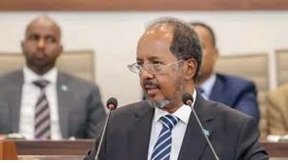
Mogadishu(WDN) — Somalia’s political standoff over the country’s next elections intensified dramatically on Saturday night as former President Hassan Sheikh Mohamud delivered one of his strongest and most uncompromising statements yet, dismissing alternative electoral proposals and insisting that only a one-person, one-vote election will determine Somalia’s future leadership.
Speaking at a farewell ceremony for former Speaker of Parliament Aden Mohamed Nur (Aden Madoobe), who was recently elected President of South West State in a contested election boycotted by oppositions, Hassan Sheikh appeared to direct much of his remarks at the opposition-led Future Forum, which only hours earlier had publicly unveiled a new electoral framework that it says could be implemented within months and help prevent a constitutional crisis.
Hassan Sheikh’s response left little room for interpretation. Visibly irritated by the growing momentum behind the opposition proposal, former President Hassan declared that Somalia would not return to indirect electoral arrangements or any other model that falls short of universal suffrage.
“There will be no election in this country other than one person, one vote,” the President said. “Do not waste your time. Nobody will govern the Somali people unless they are chosen by the Somali people.”
The remarks represent the clearest indication yet that the Federal Government remains determined to proceed with its electoral vision despite mounting resistance from opposition groups, federal member states, and political stakeholders who argue that the necessary political, legal, and security conditions for a nationwide direct election do not currently exist.
The timing of the former President’s statement was particularly striking. Earlier in the day, opposition leaders announced that they had finalized an alternative election model designed to bridge the widening gap between the Federal Government’s one-person, one-vote proposal and Somalia’s previous indirect electoral system.
According to opposition figures, the model seeks to expand popular participation while remaining grounded in the realities on the ground, including security challenges, administrative limitations, and the short time remaining before the next transfer of power.
The proposal was expected to be presented by the international partners and key political stakeholders in the coming days to the president as part of a broader effort to build consensus around an electoral framework capable of avoiding another prolonged political crisis. Yet Hassan Sheikh’s latest remarks suggest that Villa Somalia is not prepared to compromise.
In defending his position, the former President pointed to the recent South West State election that elevated Aden Madoobe to the presidency, presenting it as evidence that Somalia is capable of moving toward broader democratic participation. Supporters of the government view such elections as proof that the country is gradually building the foundations necessary for direct voting.
Critics, however, argue that citing regional elections, does little to address concerns about the feasibility of organizing a nationwide one-person, one-vote election within the current timeframe.
More importantly, the South West State election validated many of the concerns raised by the opposition, as the candidate openly backed by the former president emerged victorious in an outcome that had been widely predicted long before the ballots were cast.
For many observers, the President’s comments underscore the growing divide between two competing visions for Somalia’s political future. On one side stands Villa Somalia, which insists that direct elections are both achievable and necessary to break away from decades of clan-based power-sharing arrangements.
On the other stands an increasingly organized opposition coalition, which argues that political ambition must be balanced with practical realities and that any electoral process must be built on broad consensus rather than unilateral decisions.
The dispute has become one of the defining political battles of the current era. What began as a disagreement over electoral procedures has evolved into a wider struggle over constitutional legitimacy, political inclusion, and the future structure of the Somali state.
International partners are closely monitoring developments, aware that previous disagreements over elections have repeatedly pushed Somalia to the brink of instability. The stakes could hardly be higher. With political tensions rising, mandates disputed, and trust between major stakeholders at one of its lowest points in recent years, the debate over the electoral model has become far more than a technical question. It has become a test of whether Somalia’s leaders can find common ground before the country enters another period of political uncertainty.
For now, however, President Hassan Sheikh has drawn a firm line in the sand. His message to opponents was unmistakable: Somalia’s next leadership, he insists, will be chosen through a one-person, one-vote election—or not at all.
Whether that position strengthens his hand or deepens the political confrontation remains one of the most consequential questions facing Somalia today.
WardheerNews