
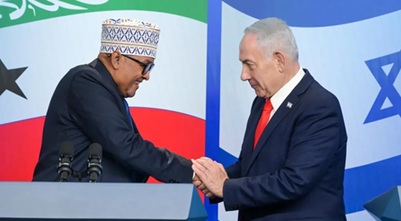
Tel Aviv (WDN) In a stunning and highly controversial development that has sparked outrage across the Muslim world and beyond, Somaliland President Abdirahman Mohamed Abdullahi Irro’s visit to Jerusalem and the opening of a diplomatic office in the city, revered by Muslims as Islam’s third-holiest site, have triggered widespread condemnation and intense debate. Many view the move as a significant departure from long-standing political, diplomatic, and religious sensitivities surrounding the status of Jerusalem.
On the Israeli side, the development has been met with notable interest and enthusiasm. In a remarkable display of admiration and growing political engagement, Israeli politicians, analysts, and influential public figures have increasingly referred to Somaliland as “the Israel of Africa.” The characterization reflects what they perceive as shared attributes between the two entities, including resilience, security consciousness, democratic aspirations, and a unique geopolitical position in a volatile region.
The growing attention has fueled speculation about the future trajectory of Somaliland-Israel relations and their potential implications for the Horn of Africa and the broader Middle East.
The comparison, once confined to private discussions and policy circles, is now being voiced openly at high-profile events and public forums, signaling what many observers view as a deepening relationship between Somaliland and influential voices within Israel.
One of the strongest endorsements came from Dr. Mike Evans, founder and chairman of the Friends of Zion (FOZ) organization, who publicly declared that Somaliland deserves international recognition and urged former U.S. President Donald Trump to formally recognize Somaliland. “Somaliland is the Israel of Africa, and President Trump should recognize it,” Evans made the remarks during a ceremony honoring Somaliland President Abdirahman Irro, where he was presented with the Friends of Zion Award.
The recognition seen as a significant controversy among many Muslims, who view Irro’s acceptance of the award as a serious departure from the longstanding Somali and Muslim position in support of the Palestinian cause. The gesture also amounts to an endorsement of Israeli policies in Gaza. For many detractors, the move is seen not merely as a diplomatic gesture but as a symbolic alignment with the oppressive and discriminatory policies and actions they strongly condemn, fueling accusations that Somaliland’s leadership is willing to sacrifice long-standing principles and public sentiment of Muslim and Palestinian cause.
Evans argued that Somaliland and Israel share a common struggle against extremist violence. According to him, Somaliland has played a significant role in confronting militant threats in the Horn of Africa, while Israel has long faced similar security challenges in the Middle East.
For supporters of the comparison, the similarities extend beyond security. Israeli officials and analysts have pointed to Somaliland’s democratic institutions, relatively stable political environment, and strategic location along one of the world’s most important maritime corridors as factors that mirror aspects of Israel’s own national experience.
Both are frequently described as entities operating in complex and often hostile regional environments, surrounded by geopolitical competition and enduring security pressures. Proponents of the comparison argue that resilience in the face of those challenges has become a defining characteristic shared by both.
Somaliland’s location overlooking the Gulf of Aden and near the Bab el-Mandeb Strait—one of the busiest shipping routes on the planet—has also attracted increasing attention from international strategic planners. Israeli commentators have noted that geography has elevated Somaliland’s importance far beyond its size, much as Israel’s strategic position has shaped its significance in the Middle East.
The growing use of the phrase “The Israel of Africa” by Israeli media personalities, analysts, and political figures reflects more than a rhetorical flourish. It signals an emerging perception within parts of Israel that Somaliland represents a rare combination of stability, democratic governance, and strategic value in a region often characterized by volatility.
For Somaliland, the comparison carries both symbolic and diplomatic significance. It highlights the administration’s success in attracting attention from influential international actors despite decades of limited formal recognition on the global stage.
Whether the comparison ultimately translates into deeper political, economic, or diplomatic engagement remains to be seen. Yet the language emerging from Israeli circles suggests that Somaliland is increasingly being viewed not merely as a regional actor in the Horn of Africa, but as a potential strategic partner worthy of international consideration.
As discussions of closer relations continue to gain momentum, the description of Somaliland as “The Israel of Africa” is rapidly evolving from a provocative slogan into a geopolitical narrative that is drawing attention far beyond the shores of the Red Sea. Nevertheless, Somaliland alignment with Israel, a country that has become increasingly isolated internationally because of its policies toward Palestinians, the move could ultimately backfire on Somaliland.
WardheerNews