
Mogadishu (WDN) – The fragile prospect of political dialogue in Somalia is rapidly unraveling, as opposition leaders moved decisively to confront rather than engage the initiative proposed by President Hassan Sheikh Mohamud.
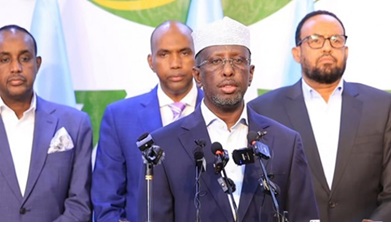
At a charged press conference in Mogadishu, the opposition bloc known as the Future Council—an alliance drawing together leaders from Puntland, Jubaland, and the Somali Salvation Forum—laid out its position with unmistakable clarity: there will be no participation in the May 10 talks without fundamental concessions from the government.
Their demands are sweeping but direct. First, an immediate halt to the government’s unilateral one-person, one-vote (O.P.O) electoral process. Second, the appointment of neutral and mutually agreed mediators to oversee any meaningful negotiations. Without these conditions, opposition leaders signaled, the proposed dialogue is little more than a formality—devoid of trust and destined to fail.
“We are not rejecting dialogue,” one opposition figure noted. “We are rejecting a process that has already been decided before discussions even begin.”
The warning did not stop there. In a statement issued a day earlier, the opposition set a political deadline: if no agreement is reached by May 15, they will take what they described as “necessary measures” to safeguard the unity and existence of the Somali state—a phrase that has raised alarm among political observers for its ambiguity and potential implications.
But it was the announcement that followed that transformed the standoff into open confrontation. Rather than attend the president’s forum, the opposition will take to the streets. A mass demonstration has been called in Mogadishu on May 10—the very day the talks were scheduled to begin—effectively turning a planned moment of dialogue into a public display of resistance.
“We call on those who have been displaced from their homes to rise—we will stand with you,” declared former president Sharif Sheikh Ahmed, speaking on behalf of the coalition. “Come out and claim your rights.”
Sharif’s remarks carried a sharper edge as he addressed the security forces directly. Any attempt to block, intimidate, or suppress the protest, he warned, would not go unanswered. The message was unmistakable: the opposition is no longer negotiating from the sidelines—it is mobilizing.
For many observers, this marks the effective collapse of the May 10 dialogue initiative. What was introduced as a platform for reconciliation now appears unlikely to take place at all, overtaken by events and eroded by deepening mistrust.
At the heart of the breakdown lies the government’s insistence on moving forward with its electoral roadmap—particularly the rollout of one-person, one-vote elections in Hirshabelle, Galmudug, and South West State—despite the absence of broad political agreement.
Opposition figures argue that these elections are neither inclusive nor credible, pointing to what they describe as serious irregularities in recent voting exercises in Mogadishu. Allegations range from inflated voter registration figures to claims of coercion in mobilizing participants—accusations that remain contested but continue to deepen skepticism.
Compounding the crisis is a shifting political landscape. Figures once aligned with the presidency are increasingly distancing themselves, with several prominent allies now openly siding with the opposition. The result is a widening fracture at the core of Somalia’s political system.
The trajectory is clear—and troubling. Dialogue is giving way to confrontation. Consensus is being replaced by competing mandates. And the space for compromise is narrowing by the day.
As May 10 approaches, Somalia stands at a critical crossroads. What was meant to be a turning point toward reconciliation now risks becoming a flashpoint—one that could redefine the country’s already fragile political order.
WardheerNews