
By Faisal A. Roble
A Year of Embarrassment in Review
In the closing days of each year, I pen down the one topic that overwhelms me. In 2012, a Jim Crow style lynching of a Somali man by Kenyan soldiers overwhelmed me, thus “Wailing with my Brothers ……” My pain about that incident was unbearable.
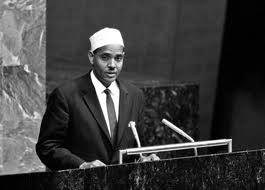
As attention-grabbing as the 2013 Somalia events may have been, a rather simpler and more humble meeting with the aging Somali iconic leader – former Prime Minister Abdi-Razak Haji Hussein – overwhelmed me. I will return to this subject matter after a brief review of 2013.
 Somalia was dubbed the most corrupt country in the world; the 2013 UN Monitoring Group’s report pronounced its Central Bank a “slush fund” center, losing 80 percent of international aid to corruption; two consecutive governors, one explicitly corrupt and the other one only a seven-weeks on the job but only with no more than seven days in Mogadishu, have lost/quit their jobs in the midst of corruptions tirades.
Ms. Fowsia Adan, a close confidante of the President, is accused of embezzling about $4 million dollars. This is all the more disheartening in a country where ambassadors and the nation’s diplomatic service legions are not paid regular salaries. Both Puntland and Somaliland stay relatively free of corruption while implementing good governance and rudimentary democracy.
As crisis begets crisis, President Hassan fired in November his once trusted Prime Minister, Saacid Shirdon, only to replace him with Mr. Abdiwali Sheikh Ahmed, who so far has received positive reception from many corners inside and outside the country. Yet, the nation is wondering whether President Hassan would stay within the confines of the mandate granted to his office by the Provisional Federal Constitution.
Right about the time of the release of Professor Lidwien Kapteijns’ book on “Clan Cleansing” of 1991, a new wave of armed conflicts has once again revisited Jublaland. In the end, though, the stalemate was resolved at the dictate of the Addis Ababa brokered agreement of August 2013. In the Shabelle region, a conflict based on land grabbing is brewing afresh. Both conflicts are a painful reminder that the country’s intractable post-civil war challenges are still with us (I will write about this matter soon).
Somalia’s EU bankrolled legislature remains a dwarf institution swimming in a wide spread corruption allegations. Come 2014, the nation may need a spirited debate on whether a proposed trusteeship under AMISOM mandate from 2013- 2025 is prudent or not. To steer the ship correctly, the nation would expect a collaborative effort between the new PM and the wounded President with some input from statesmen and women like PM Abdi-Razak Hussein.
Getting to Know The Man: Abdi-Razak H. Hussein
In October 2013, after concluding IHASA’s annual meeting at the University of Minnesota, Ms. Fowsia Abdul-Kadir and I decided to pay a visit to PM Abdi-Razak. Initially, we were not sure whether the proposal would get a positive reception by the Prime Minister and his relatives, especially in light of his busy schedule and his advancing age.
Meeting Abdi-Razak surpassed my expectations. Simply put, Abdi-Razak is a rare and perhaps a member of an extinct species of Somali men and women of bygone days. Largely self-educated, he is an extremely well-read and well-versed in several languages including English, Arabic, Italian, and his own native Somali. His unassuming mastery of the Somali ecology, culture and its rich literature is one that could not have been possible without his early upbringing in the Puntland region (Mudug), a cradle of Somali poetry and nomadic values, if not pastoral democracy thanks to the Isim- and Guurti-based culture.
Impression 1: A Wise and Judicious Man:
Prime Minister Abdi-Razak Haji Hussein’s ability to remember names and associate those names with actual deeds are as strong as anyone’s – at the initial introduction of my name to him, the PM took me by surprise when he retorted: “Oh! Mr. Roble, I really like and enjoy your thought-provoking articles and discourse on the Somalia question.” He continued on for a while to draw a chart and a thematic outline of where he stands on the Somalia question, the current system of federalism, a subject we will come back after Somali tea with sweets were served by his humble and gracious wife, and the issue of looted properties in Mogadishu and how to resolve it.
The PM recollected my last brief encounter with him at a reception at the African Development Center in Ceder, Minneapolis, in February of the same year. When I visited him at his residence this time, a humble residence, he literally recalled the contents of our brief conversation by revisiting what is left of his distant memory about my birth place, Jigjiga, and how he as a member of the Somali Youth League (SYL) leadership once escaped to that city.
He then turned to Fowsia and gave her the best reception a gentleman can accord to a respectable woman like Fowsia. Upon remembering her family’s background, he went at length to and gave us a litany of historical words about Fowsia’s great grandfather and his association with the king of Hobyo in the 1900s. You could hear the degree of appreciation the PM was bestowing on this sister both for her good pedigree and for her intelligence as a modern and educated Somali woman.
Remembering and cataloging with ease the brief bios of visitors and constituents, the cynic may say, is the whole mark of successful and prudent politicians. But what I have observed with the PM is authentic and humility. His graciousness to receive us with a short notice as well as his boundless brain power to remember details of our personal and family traits, especially when one looks at his age, is not only magical but a sign of bounty of intelligence and mind power – a rare gift the Almighty gives only to those He entrust with the responsibility to lead us.
Impression 2: Safeguarding the Somali Narrative:
His approach to each and every issue on the political landscape of Somalia is circumspect, measured and judicious. He keeps a long term view about Somali unity and the oneness of its people. His narrative hankers back to the days when Somalis were dignified and drew power and strength from their organic unity and their belief in the ideals of one people united under one God, one history, and one culture/language.
Despite all the problems of the last twenty-three years, he still holds onto the pan-Somali philosophy that shaped the Somali narrative, in favor of the current narrative where both local and foreign forces hijacked, reshaped, and resized it to a point of no recognition. You could read from the age-produced facial contours expressions of grimaces and contortions about his nation in turmoil. Looking deep into his eyes, one will not miss a faint disappointment in his country’s leadership of the last 40 or so years. Yet, that does not stop him for hoping for the best.
At the core of his values, he is still a Somali Youth League (SYL) crusader, only older and more circumspect now than sixty years ago. With Prime Minister Abdi-Razak, Somalinimo (a term lately meant the good aspect of being a Somali) is not dead, but is passing through tough and challenging growing pains. Even in his country’s murky conditions, he still sees a glimmer of hope of Soomaalinimo that is maturing, democratizing and struggling to establish good governance sooner than later.
His confidence that his people will cross the Jordan River and reach the fountain at the top of the Mountain is uplifting and a cause for hope. As he did then when he was a Prime Minster, he exhibits now the will power to defy nepotism in favor of “maxaa taqaan?” or “what are your qualifications.” This simple motto of meritocracy, if followed religiously, could be a road map out of the current inept state of affairs.
Impression 3: No Quick Fix:
His vision of Somali unity is unwavering, and reconciliation is something he lately endorsed as a panacea to the widespread mistrust among Somalis. He also views the implementation of federalism in Somalia as means to an end, and not an end in itself. I got from PM Abdi-Razak this impression: the political problems which the country and its people have experienced, including lootings and killing each other on the bases of exogenous and endogenous factors in the last twenty or so years, require leaders that are inherently democratic, visionaries, and transformative.
While he subscribes to the notion that no quick fix can remedy Somalia’s hardship, he instructs us to also not perpetuate historical slipups. One of his simple but precious advises to rescue Somalia is the need to correctly resolve social conflicts and move on to the next chapter. His relationship as a Prime Minister with his boss, President Aden Abdulla Osman, and the near-perfect working relationship they had enjoyed is a lesson to the current crop of leadership.
Departing Words and Looking Ahead:
My meeting with PM Abdi-Razak was memorable and I came out with a valuable wisdom. An eternal resolve, unending hope, and the sense of unconditional commitment to work for the ideals one holds dearly are only some of the endearing virtues of Abdi-Razak. George Bernard Shaw once said: “MY life belongs to the whole community and as long as I live, it is my privilege to do for it whatever I can. I want to be thoroughly used up when I die, for the harder I work the more I live.” There is no better way but the above citation to assess Abdi-Razak’s enduring qualities as a tireless leader who would give up the last vestige of life while working for his people and their dignity.
In reclaiming the Somali narrative that has been lost- a proud nation whose flag represents a nation with a dream as vast and as limitless as the open blue skies are – PM emphasizes reconciliation, taking small steps towards good governance, and doing away with nepotism to the extent possible.
As 2014 unfolds, one wishes the belated work on his biography that has been started about 13 years ago could be completed. It would also make a fresh start if a public conversation were initiated between the youngest Prime Minister, Abdiwali Sheikh Ahmed, and the nation’s surviving oldest Prime Minister so that the two can exchange friendly views about past, present and future challenges and opportunities. Such a conversation could show the nation that the Somali project and its reconstruction is a responsibility shared by both the old and the new generations of our community.
Faisal A. Roble
Email:faisalroble19@gmail.com