
By Abdiqani Haji Abdi
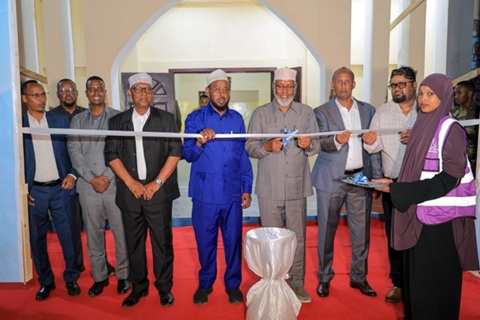
While President Hassan Sheikh Mohamud wages an increasingly bitter public campaign portraying the United Arab Emirates as the principal threat to Somalia’s sovereignty and national unity, Abu Dhabi is continuing to invest in one of the country’s most strategically important regions. The latest development came on November 18, when Jubaland President Ahmed Mohamed Islam (Ahmed Madobe) inaugurated the first phase of the modernisation of Kismayo Port, a project undertaken in partnership with Abu Dhabi-based AD Ports Group.
The timing could hardly be more politically uncomfortable for Villa Somalia. As Hassan Sheikh accuses the UAE of financing political divisions, supporting regional administrations and undermining his government’s authority, Jubaland is showcasing tangible economic cooperation with the same country he now portrays as an enemy of Somalia.
The Kismayo project involves modernised port infrastructure, renovated administrative facilities, improved operational capacity and upgraded services for traders. It represents an important investment in Jubaland’s commercial infrastructure and its ability to connect local businesses with regional and international markets.
The project is also a reminder that foreign investment is not inherently an act of political subversion. For a country struggling with unemployment, inadequate infrastructure, insecurity and chronic dependence on external assistance, investment in ports, transport and commercial facilities can create economic opportunities that successive Somali governments have failed to provide.
The president who welcomed the UAE back
Perhaps the most glaring contradiction in Hassan Sheikh’s latest denunciation of Abu Dhabi is his own political record. The UAE did not simply re-enter Somalia through an arrangement imposed on an unwilling government. Its return was facilitated by Hassan Sheikh himself after he regained the presidency in May 2022, succeeding Mohamed Abdullahi Farmaajo, whose administration had presided over a serious diplomatic breakdown with Abu Dhabi.
In April 2018, the UAE announced the termination of its military training programme in Somalia following the seizure of $9.6 million from an Emirati aircraft at Mogadishu airport. The diplomatic confrontation resulted in the withdrawal of Emirati trainers and the closure of its military training programme.
The UAE had previously trained thousands of Somali soldiers, supported their salaries and established military training facilities and medical infrastructure. When Hassan Sheikh returned to Villa Somalia, relations with Abu Dhabi improved considerably. Emirati military trainers returned, security cooperation resumed, and the two governments signed a renewed security cooperation agreement in February 2023. The Washington Institute for Near East Policy documented this diplomatic restoration, including the UAE’s renewed assistance to federal and regional security forces.
The question Hassan Sheikh must now answer is straightforward: If the UAE was pursuing a deliberate campaign to undermine Somalia’s sovereignty, why did his administration actively restore military and diplomatic cooperation with Abu Dhabi? Was the UAE a reliable strategic partner when its assistance strengthened his government’s security apparatus, only to become an enemy when regional administrations maintained independent relationships with the same country?
General Gordon: A symbolic gesture Hassan Sheikh cannot explain away
One of the most revealing episodes in this relationship occurred in December 2024, when Hassan Sheikh issued a presidential decree renaming the General Gordon military training base in Mogadishu after Emirati Colonel Mohamed Mubarak Al Mansouri.
The Emirati officer was among four UAE military personnel killed in the February 10, 2024, Al-Shabaab attack at the facility, alongside a Bahraini military officer. The original name, General Gordon, honoured Somali Major General Mohamed Ibrahim Farah, a national military figure killed by Al-Shabaab in 2012.
The renaming was a conspicuous gesture of gratitude towards the UAE and recognition of its contribution to rebuilding Somalia’s security forces. It also generated domestic criticism because of the decision to replace the name of a Somali military figure with that of a foreign officer. Hassan Sheikh nevertheless proceeded with the decision.
The contrast with today’s rhetoric is striking. A president who considered Emirati military assistance sufficiently valuable to honour a fallen UAE colonel by renaming one of Somalia’s principal military training facilities now presents the same country’s involvement in Somalia as an existential danger.
There is nothing inherently wrong with recognising foreign military personnel who sacrificed their lives helping Somalia rebuild its security institutions. The problem is the political inconsistency of celebrating that partnership when it serves the presidency and condemning it when political circumstances change.
Jubaland’s investment challenges Mogadishu’s narrative
The Kismayo Port project is part of a broader Emirati economic and security engagement in Somalia. The UAE has maintained substantial commercial and strategic interests in the country, including its involvement in the development of Bosaso Port in Puntland and the modernisation of Berbera Port in Somaliland.
In Jubaland, its engagement has included support for regional security forces, military equipment and investment in infrastructure.
The Africa Center for Strategic Studies has estimated that the UAE committed approximately $613 million to Somali port development and infrastructure projects, including substantial support for Bosaso Port and the Juba Sugar Factory. Its assessment highlights the importance of Emirati investment in Somalia’s regional economies. See the Africa Center for Strategic Studies’ assessment of Gulf investment in East Africa.
The UAE’s relationship with Jubaland is therefore neither a sudden development nor an arrangement invented to frustrate Hassan Sheikh’s presidency. It has evolved over many years through commercial, security and diplomatic engagement.
On January 12, 2026, Hassan Sheikh’s government announced the cancellation of all agreements with the UAE, including arrangements concerning the ports of Kismayo, Bosaso and Berbera. Jubaland, Puntland and Somaliland rejected the decision, arguing that Mogadishu could not unilaterally invalidate agreements concluded by their respective administrations. Reuters reported on January 13 that the regional administrations intended to maintain their cooperation with Abu Dhabi despite Mogadishu’s decision.
The inauguration of the first phase of Kismayo Port’s modernisation demonstrates that the diplomatic confrontation has not automatically brought Emirati investment in Jubaland to a halt. For Jubaland, the immediate concern is economic development, improved trade infrastructure and the creation of opportunities for its population. The administration sees no obvious reason to abandon a commercial partnership simply because the Federal Government has entered into a political confrontation with its foreign partner.
A convenient foreign enemy for domestic political failures?
Hassan Sheikh’s November 17 televised address accused the UAE of interfering in Somalia’s internal affairs, supporting armed groups, establishing military facilities outside federal control and financing regional administrations opposed to Mogadishu.
He also criticised Emirati agreements involving Berbera, Bosaso and Kismayo, describing the ports as national assets that should fall under the authority of the Federal Government.
These are serious allegations and deserve examination. Any foreign security arrangement must respect Somalia’s constitutional order, national sovereignty and applicable laws. The UAE, like every other foreign partner, should be held accountable for its actions where credible evidence establishes wrongdoing. But accusations are not evidence, and diplomatic hostility is not a substitute for effective national leadership.
Somalia’s political crisis did not begin with the latest confrontation with Abu Dhabi. The country has been struggling with constitutional disagreements, disputes over federal power-sharing, deteriorating relations with regional administrations and persistent failures to establish a credible national electoral settlement.
The government’s relations with Puntland and Jubaland have deteriorated, while disagreements over constitutional amendments and the electoral process have weakened political cooperation at the very moment national unity is most necessary.
The security situation remains equally troubling. Al-Shabaab continues to exploit political divisions, attack government installations and threaten communities that have sacrificed heavily in the fight against the insurgency.
Meanwhile, Somalia remains heavily dependent on international assistance to sustain its security institutions and public services. Against this background, portraying the UAE as the principal explanation for the country’s political and institutional failures risks diverting attention from the responsibilities of the federal leadership itself.
A president cannot blame foreign investment for the absence of political consensus, the failure to reconcile with federal member states or the inability to build institutions that command the confidence of the Somali population.
Nor can he expect regional administrations to abandon development partnerships without presenting credible alternatives for financing their infrastructure, security and economic priorities.
Has Abu Dhabi stopped treating Hassan Sheikh as an indispensable partner?
There is another political dimension that deserves consideration. Hassan Sheikh’s relationship with Abu Dhabi was particularly warm after his return to power in 2022. The UAE helped restore security cooperation, provided military assistance and supported the development of Somali security institutions.
Today, however, Abu Dhabi maintains working relationships with regional administrations that have serious disagreements with Mogadishu, particularly Puntland and Jubaland. The UAE’s continued engagement with these administrations appears to have become a major source of frustration for Villa Somalia.
It is reasonable to ask whether the president’s current anger reflects a real change in Emirati policy or his growing realisation that Abu Dhabi is no longer willing to subordinate its relationships with regional governments to the political preferences of the federal presidency.
The suggestion that the UAE has simply decided Hassan Sheikh is a former president, rather than a reliable strategic partner, remains political interpretation rather than an established fact. Nevertheless, the widening gap between his expectations and Abu Dhabi’s regional relationships is evident.
Foreign governments pursue their own national interests. They do not owe permanent political loyalty to individual Somali presidents. Their partnerships can extend across administrations, institutions and regional authorities.
Hassan Sheikh should understand that diplomatic relationships are not personal property. The UAE is entitled to maintain commercial and diplomatic relationships with Puntland and Jubaland, just as Somalia maintains relationships with Türkiye, Qatar, Egypt and other international partners.
If the president believes particular agreements violate Somalia’s laws or constitutional arrangements, the appropriate response is to pursue legal and diplomatic solutions rather than turning foreign investment into a convenient political scapegoat.
Somalia needs investment, not diplomatic isolation
The irony of the current confrontation is that Somalia desperately needs precisely the kind of investment the UAE has provided. Ports are essential to trade, employment, revenue generation and economic recovery. Security assistance remains critical in the fight against Al-Shabaab. Private capital is indispensable to rebuilding an economy that has endured more than three decades of conflict and institutional collapse.
The Federal Government has every right to defend Somalia’s sovereignty and demand transparency in foreign agreements. But sovereignty should not become a political slogan used to obstruct regional economic development or punish administrations that maintain relationships with foreign investors.
The better approach would be to establish transparent federal and regional mechanisms for coordinating strategic investments, resolving disputes over jurisdiction and ensuring that national interests are protected without undermining legitimate regional development initiatives. Hassan Sheikh should also explain why the partnership he personally revived, strengthened and publicly celebrated has suddenly become the principal culprit behind Somalia’s difficulties.
The UAE did not create Somalia’s constitutional crisis, alienate its federal member states, weaken its political institutions or fail to establish a sustainable electoral settlement. Those are responsibilities that belong first and foremost to Somali political leaders. Hassan Sheikh cannot spend years welcoming Abu Dhabi back, restoring its military presence, honouring its fallen officers and benefiting from its assistance, only to portray it as Somalia’s principal enemy when its relationships no longer fit his political calculations. Jubaland’s latest port investment offers a simple lesson: Somalia needs partners willing to build, invest and create opportunities. It does not need a presidency that mistakes criticism for sovereignty, political disagreement for foreign aggression and its own failures for someone else’s conspiracy.
Abdiqani Haji Abdi
Email: Hajiabdi0128@gmail.com
Leave a Reply