
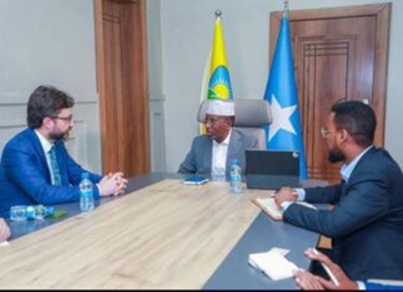
Mogadishu (WDN) — A high-stakes political dialogue convened under the auspices of the Turkish ambassador began at midday in Mogadishu, bringing together opposition leaders in an effort to narrow widening political divisions over Somalia’s electoral timeline and constitutional transition.
The meeting is being held with a five-member opposition delegation, led by former President Sheikh Sharif Sheikh Ahmed, and is taking place at his private residence in the capital. The agenda centers on the increasingly contentious dispute over the expiration of the current government’s mandate and the absence of a mutually agreed framework for national elections.
The talks come at a moment of deepening mistrust between political actors, with regional tensions, constitutional ambiguity, and institutional fragmentation all feeding into an already volatile environment. The mediation effort is being facilitated by Turkey, a long-standing partner in Somalia’s security and reconstruction efforts. However, its role is now facing heightened scrutiny.
“Turkey is no longer seen as a neutral broker by significant sections of the opposition,” one political observer in Mogadishu told WardheerNews. “Its proximity to the presidency has raised questions about whether it is mediating or managing outcomes.”
Another analyst described the situation more bluntly: “Perception matters in mediation. Once neutrality is questioned, every proposal is interpreted through a political lens.”
Concerns largely stem from Ankara’s close cooperation with President Hassan Sheikh Mohamud and its extensive military and training engagement in Somalia’s security sector. Critics argue that Turkish-supported forces, originally deployed to strengthen counter-insurgency capabilities against Al-Shabaab, have increasingly become entangled in domestic political dynamics -the case of the SWS.
“Military assistance has blurred into political leverage,” said one regional security expert. “That perception alone is enough to undermine trust in any mediation effort.”
The same concerns extend to Somalia’s fragile federal balance. Opposition figures have repeatedly accused external actors of indirectly reinforcing the authority of the federal executive at the expense of regional administrations, particularly in disputed states where governance structures remain contested.
A senior diplomat familiar with the talks, speaking on condition of anonymity, acknowledged the sensitivity of the situation. “There is a narrow window for dialogue,” the official said. “But that window is closing quickly if mistrust continues to deepen.”
Despite these tensions, the Turkish-led initiative remains one of the few active diplomatic channels attempting to prevent a full-scale political breakdown. Supporters argue that external facilitation is necessary given the entrenched nature of Somalia’s internal divisions.
Yet skepticism persists. Somalia is at a point where mediation itself has become political,” another analyst told WardheerNews. “Even the identity of the mediator now influences whether dialogue is accepted or rejected.”
As the discussions continue behind closed doors, the broader question remains unresolved: whether Somalia’s political elite can still find common ground—or whether external mediation has itself become part of the country’s contested political terrain.
WardheerNews