
By Isha Qarsoon
Hassan Sheikh Mohamud’s (HSM) four-year term expired on May 15, 2026. He is not leaving office.On March 4, 2026, Somalia’s parliament pushed through amendments to Chapters 5 through 15 of the Provisional Constitution, excluding MPs who came to vote against them. The government’s position is that Hassan Sheikh’s term now runs to May 2027, pointing to the five-year term extension embedded in the Chapter 4 amendments passed in March 2024, which the March 2026 session formally incorporated into the revised constitution.
The one-year extension is the first layer of a two-layered extension strategy. The second is HSM’s insistence that one-person, one-vote elections will be held within one year. The infrastructure for universal suffrage does not exist and cannot be built in one year, and when the one-year extension and the election timetable fails, the parties will be forced back to the table to negotiate a substitute electoral process. The last time Somalia went through that negotiation, from Farmajo’s term expiry in February 2021 to HSM’s election in May 2022, it took fifteen months. Thus, the two-layered extension strategy effectively guarantees at least two-year extension.
A politically astute opposition would recognize this and demand the initiation of the indirect election process now, before the OPOV timetable is even allowed to fail. The current opposition has not done this. HSM is not making an implausible promise of OPOV in error. He is making it because its failure is the whole strategy. The one-year extension and the insistence on OPOV directly contradict HSM’s own public statements that the amended constitution would take effect starting with the next administration. No explanation has been offered for the reversal.
The mechanics are not complicated. Universal suffrage in a country where 1) Al-Shabaab controls territory, 2) voter registration is nonexistent, 3) the constitutional court has never been constituted, and 4) three of the now seven federal member states have severed ties with Mogadishu, is not a credible electoral model. The infrastructure does not exist and cannot be built in one year. The OPOV timetable will fail for reasons that are structural, not incidental.
What exists in place of an opposition is a coalition of former allies, spent warlords, and disappointed politicians who found their principles at the moment their access to state resources was cut off. Somalia’s problem is not that HSM has trapped the opposition. It is that the opposition helped build the trap.
The opposition calls HSM’s actions a power grab. They are right. But they have no standing to say so, because the system that makes power grabs the rational strategy is one they participated in building, and several of them are in the opposition today only because they did not get the share of that system they expected.
Sheikh Sharif Sheikh Ahmed governed as president of the Transitional Federal Government from 2009 to 2012. The 2004 Transitional Federal Charter required his government to establish an Electoral Commission and a Federal Constitutional Commission to draft a permanent constitution. He produced neither. The UN Monitoring Group on Somalia reported that TFG leaders were actively reluctant to fulfill their charter obligations. A World Bank assessment found that nearly 68 percent of TFG revenues between 2009 and 2010 were unaccounted for. When Sharif twice tried to dismiss Prime Minister Sharmarke without constitutional authority and was told he could not, he removed him through political pressure anyway. The constitutional court he now cites as a missing institution was his obligation to create. So was the electoral commission.
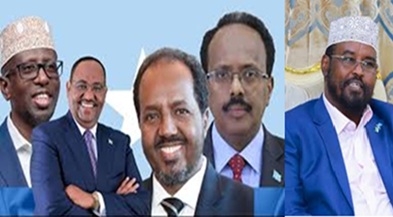
Sharif is one of several senior opposition figures who contested each of the last federal elections and lost. Farmajo is the only one among them who won the presidency. None of them sustained any public criticism of sitting governments in those governments’ early years. Criticism arrived near election time or after a personal falling out with whoever was in office. This holds across individuals and across administrations.
Said Abdullahi Deni of Puntland helped secure HSM’s 2022 election victory. By multiple accounts, the arrangement included an understanding that Deni would become prime minister. HSM appointed Hamza Abdi Barre instead. Deni’s estrangement from Mogadishu followed directly. His constitutional objections came after. In 2021, Deni also blocked Farmajo’s preferred electoral arrangements and contributed to the fifteen-month deadlock. That position had nothing to do with constitutional principle either.
Ahmed Madobe of Jubaland, whose career included membership in al-Ittihad al-Islami, the Islamic Courts Union, and Hizbul Islam, walked out of the NCC meeting in Mogadishu in October 2024, rejecting the proposed unified electoral framework and one-year term extension. He returned to Kismayo and organized his own electoral commission. Parliament responded on November 23, 2024 by passing a new electoral law with a provision declaring any non-compliant election invalid, a transparent attempt to legislate Madobe’s election out of existence before it happened.
Madobe proceeded anyway on November 25, winning a third term through an indirect vote in defiance of the federal two-term limit. Mogadishu issued an arrest warrant two days later. Jubaland suspended all relations with the federal government the following day. Large-scale military confrontations followed in December 2024, with Jubaland and its backers defeating Somali National Army units at Dolow, Ras Kamboni, and Kulbiyow. The arrest warrant and the military deployment were consequences of the break, not its cause. The man who managed to organize a self-serving election in weeks is now in the Future Council as a defender of federalism and constitutional order.
Mohamed Abdullahi Farmajo is also in the opposition, which completes a circle worth noting. He won the presidency in 2017 on promises of anti-corruption and constitutional completion and delivered neither. His government established no constitutional court and no functional electoral framework. When parliament removed his prime minister Hassan Ali Khaire in July 2020 by a vote of 170 to 8, the stated grounds were failure to advance the constitutional review, failure to produce an electoral framework, and failure to manage federal-state relations. The same government carried credible allegations of involvement in the bombing of opposition party offices in December 2017.
Farmajo replaced Khaire with Mohamed Hussein Roble, whose primary role became managing the election process against Farmajo’s own obstruction. When his term expired in April 2021, Farmajo extended it through a parliamentary vote, triggering armed clashes in Mogadishu. In December 2021, he attempted to unconstitutionally suspend Roble when Roble refused to accommodate his election manipulation. He left office in May 2022 having completed none of his mandated tasks. He is now in the opposition condemning HSM’s constitutional violations and mandate extension. The criticism is accurate. The messenger has no standing to deliver it.
Some of the opposition members now loudest about HSM’s land seizures in Mogadishu were close to his government long enough that silence during the seizures was a choice. The condemnations came when specific relationships broke down, not when the evictions began. In some cases the break came precisely because the expected benefit from those arrangements did not materialize.
The opposition’s approach to the HSM government from the beginning tells you what this opposition actually is. Between 2022 and 2026, Somalia’s Auditor General flagged over $100 million in questionable expenditures, including $66.7 million in unverified concession revenues from Mogadishu Port and Aden Adde airport that concessionaires refused to account for, and $46.5 million in extra-budgetary funds that never entered the Treasury Single Account. The original Auditor General was replaced in February 2023 with a politically connected individual of questionable qualifications, shortly after his office had begun producing damaging findings on embezzlement across government agencies. His replacement’s 2024 report nonetheless flagged over $1 million missing from the federal treasury and named three judicial institutions, including the Supreme Court, that refused to cooperate with the audit, suggesting the irregularities were too large to suppress entirely even under a compliant auditor.
State-owned land, including schools, hospitals, and public squares in Mogadishu, was reportedly sold to private developers with presidential connections. The government expanded NISA’s detention and surveillance powers. Journalists were routinely arrested. Service institutions were captured by patronage networks. In January 2026, the United States halted all assistance to the government after officials allegedly destroyed a WFP warehouse and seized donor food aid.
Somalia ranked 179th out of 180 countries on Transparency International’s 2024 Corruption Perceptions Index. The opposition said very little about any of this. Their public statements tracked the electoral calendar. When the NCC adopted OPOV in May 2023, Sharif called it premature. When Chapter 4 was amended in March 2024, he called it a power grab. When the electoral laws passed in November 2024, Jubaland called them illegal because its own MPs had not attended the session. Crisis Group observed that opposition politicians were primarily seeking an electoral system that gave them the best chances of success. That is an accurate description of what this opposition is doing.
The international community has not been a neutral party to this. The 2012 Provisional Constitution was drafted under pressure from donors to meet an externally imposed deadline. That truncation was acknowledged at the time. Those same partners spent the next fourteen years defaulting to political compromise when it conflicted with constitutional compliance. In 2021, the lever that moved Farmajo was visa restrictions and aid suspension targeting individuals seen as spoilers, not any argument grounded in constitutional procedure. The same partners are now in Halane facilitating talks that treat the validity of an amendment passed without quorum as a matter for political negotiation. They helped produce a constitution that no administration has ever been held to, and in doing so they have consistently signaled to Somali leaders that constitutional obligations are negotiating positions. They bear responsibility for that.
None of this is a defense of HSM. His first term from 2012 to 2017 drew the same criticisms now leveled at him by his opponents: rampant corruption, restrictions on the press, abuse of power, and a UN Monitoring Group accusation that his administration armed Al-Shabaab. He did not establish the constitutional court his government was obligated to create. He did not advance the electoral framework. When he lost power in 2017 he spent five years in opposition, during which he raised no sustained criticism of Farmajo in the early years of that administration. His objections arrived in 2020 and 2021, as the electoral dispute sharpened and his own presidential ambitions came back into focus. He condemned Farmajo’s 2021 mandate extension as unconstitutional, helped militarize Mogadishu in opposition to it, and forced the process that eventually produced his own election in May 2022. He is now doing what he condemned. The difference between HSM and the coalition arrayed against him is not one of conduct or conviction. It is one of position. He is in office. They are not.
The opposition cannot change any of this. HSM governs by default because the only alternative on offer is a group of people with a comparable record and no shared purpose beyond replacing him. The street protests did not grow. The Future Council has issued statements. It has not produced a political program or given ordinary Somalis a reason to take sides.
Somalia’s elections have always worked this way. A defined set of clan elders, operating under the 4.5 power-sharing formula, select delegates who choose parliamentarians who then convene in a secured hangar at Aden Adde airport to vote for a president. The general population plays no part. This is not a democratic election in any meaningful sense. It resembles nothing so much as the medieval practice of selecting a sovereign through the consent of established power holders, with clans substituting for feudal houses and the 4.5 formula substituting for hereditary title as the basis of inclusion. It produces leaders who are accountable to the factions that elevated them, not to the Somali public.
One-person, one-vote was the reform that could have changed that relationship. HSM used it as justification for extending his time in office rather than as a path to genuine accountability. The opposition, for its part, has shown no real interest in the structural change OPOV would require, because direct popular accountability would be as threatening to them as it is to him.
The current talks will produce an arrangement. The arrangement will produce elections. The elections will produce a president chosen by parliamentarians selected by elders under the 4.5 formula, as has happened every time since 2012. The system will call this a transfer of power. The conditions for the next crisis are already forming in the agreements being made to produce this one.
That is not a dilemma. That is the system working as designed.
Isha Qarsoon
Email: Ishaqarsoon1@gmail.com
____________________
Isha Qarsoon- is a platform dedicated to addressing critical issues pertaining to good governance, corruption, and social challenges. It writes on Somali governance, law, and political economy.
———
Related articles
No Adult in the Room: Somalia’s Zero-Sum Political Trap By Abdelkarim A. Haji Hassan
Somalia’s Governance Trap: Why the Next Generation May Face an Unreformable State By Isha Qarsoon