

By Abdelkarim A. Haji Hassan
Since the fall of the Somali state in 1991, the country’s political elite has been stuck in a perpetual cycle of power struggles, constitutional manipulation, and short-term politicking that has left the country paralyzed. More than thirty years of international support, state-building projects, and constitutional frameworks have failed to produce a government that commands legitimacy or delivers basic governance. Somalia suffers from a broken federal system, a failure of leadership and political vision.
The 2012 adoption of a federal constitution was meant to decentralize power, bring government closer to citizens, and heal the wounds of a fractured state following the 1991 civil war. One of the objectives was to empower Federal Member States (FMS). Although created in different timelines after 2012, there were Jubaland, Hirshabelle, Galmudug, and South West State. Puntland, the latter, already declared itself a semi-autonomous region by 1998. Somaliland unilaterally declared secession in 1991.
More than a decade later, federalism’s promise remains unfulfilled. Somalia’s federal model has devolved into anarchy of perpetual zero-sum politics rather than a system of cooperation where the rule of law prevails. Power is treated as a trophy to be seized and monopolized, never as a responsibility to be wielded for the public good. Political transitions, whether presidential elections or parliamentary, consistently degenerate into brinkmanship, fueled by regional leaders’ power play, systemic corruption, and the ever-present threat or actual use of force. Without credible mechanisms to enforce the rule of law, the nation stumbles from crisis to crisis, lacking any leader willing or capable of serving as the proverbial “adult in the room.”
Whether national or regional, elections became synonymous with a high-stakes crisis rather than orderly transitions of power. Deadlines are missed, agreements collapse, and negotiations frequently dissolve into threats or outright violence with no authority respected to impose order. All these, amid the absence of a judiciary, complicate matters more. Legislatures, the only institution that was supposed to direct the country, are co-opted or paralyzed. Governance in Somalia, thus, has become a perpetual cycle of instability where fleeting political gains consistently undermine the nation’s long-term stability.
This cyclical dysfunction is not just political elite drama; it has devastating consequences for the Somali people. Without leadership capable and willing to forge strategic compromises or articulate a unifying vision, critical reforms remain frozen, whether completing the constitution, implementing an agreed electoral process, or establishing a revenue-sharing framework.
Mogadishu
Somalia’s greatest obstacle is not structural or financial. It is the refusal of its political class to rise above a zero-sum mindset. The country does not lack institutions; it lacks competent leaders and accountability. It does not lack frameworks; it lacks political maturity.
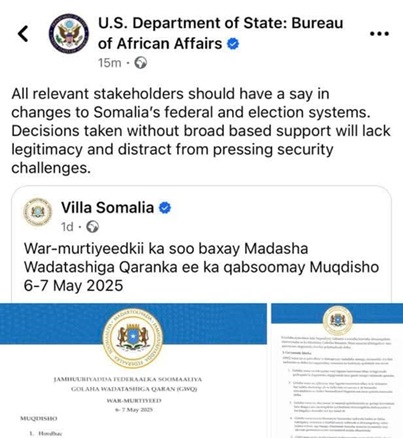
A recent example of Somalia’s entrenched political theatre and brinkmanship is the National Consultative Council (NCC) meeting orchestrated by President Hassan Sheikh Mohamud on May 6-7, 2025. Rather than serving as a genuinely inclusive forum for national dialogue, the meeting brought together a narrow coalition of leaders from South West, Galmudug, and Hirshabelle—regional states aligned with the president. Notably absent were Puntland and Jubaland, both critical Federal Member States, as well as key opposition figures. The composition of the gathering underscored the exclusionary tendencies that have plagued Somalia’s political process and revealed a “my way or the highway” approach that undermines the very foundations of federalism and national consensus-building.
This selective engagement is more than a political miscalculation, it represents a recurring pattern in Somalia’s governance culture, where temporary alliances and personal loyalties eclipse long-term state-building imperatives. The United States Department of State, in a rare and pointed statement, publicly urged that “all relevant stakeholders” must be involved in discussions surrounding electoral reforms and changes to Somalia’s federal system. This diplomatic intervention was, in effect, a public repudiation of President Hassan Sheikh’s short-term maneuvering and an implicit warning against the marginalization of key actors. It signaled growing international frustration with Somalia’s cyclical political exclusion and the absence of credible, consensus-driven reform.
Yet, despite external pressures and clear constitutional expectations, Somalia remains trapped in a leadership vacuum. No actor, federal or regional, appears willing or able to rise above parochial interests to foster genuine dialogue or national unity. Political elites continue to prioritize factional dominance over state legitimacy, opting for procedural manipulation rather than substantive reform. In the absence of a neutral arbiter or unifying national figure—someone capable of enforcing norms and mediating disputes—Somalia’s political arena remains rudderless.
Over the past 33 years of state collapse and political fragility, Somalia’s trajectory has remained mired in stagnation, largely due to the continued dominance of a narrow political elite. This group, comprised of individuals who have repeatedly failed to move the country beyond its entrenched political deadlock, has consistently manipulated the 4.5 clan-based power-sharing formula to maintain control over state institutions. Rather than fostering national reconciliation, institutional reform, and economic development, these elites have entrenched a system that prioritizes clan loyalty and personal gain over meritocratic governance and accountability. Their parasitic relationship with public resources, where state coffers are routinely exploited for private enrichment, represents a fundamental barrier to Somalia’s progress. As long as this self-serving political class remains in control, the cycle of conflict, corruption, and instability is unlikely to be broken.
International donors and regional partners continue to invest in Somalia’s recovery, but their efforts are consistently undermined by this toxic political culture. Technical assistance, peacekeeping, and elections support cannot substitute for leadership that is willing to transcend clan lines, uphold constitutional norms, and put the country’s future above personal or factional gain

In a room full of actors playing to their clan base, there is no adult at the table. And without one, development is hampered, services are nonexistent, and the public grows ever more disillusioned with the idea that politics can serve their interests. The absence of an “adult in the room” has thus become a defining feature of Somalia’s post-conflict political landscape, where every round of negotiations becomes yet another exercise in brinkmanship, rather than a step toward state building, institutional reforms, and economic development.
Nevertheless, Somalia’s path to stable statehood remains trapped in fragile limbo. No matter how enthusiastically President Hassan entertains the idea of one-person-one-vote (1P1V) and President Said Abdullahi Deni’s self-serving, authoritarian political isolation approach endures, one certainty persists: the flawed 4.5 clan power-sharing system will continue, with elections again staged at the Afisyoni complex—the repurposed military hangar at Aden Adde Airport ironically dubbed “the Tent.” This makeshift political arena represents not democratic progress but rather the theater of international crisis management, where Somalia’s sovereignty is routinely sidelined to maintain a façade of due process. Each electoral cycle becomes another exercise in kicking the can down the road—a series of externally compelled stopgaps that perpetuate rather than resolve the nation’s governance crisis.
Until a new generation of leaders emerges, willing to act as statesmen and take the leadership from authoritarian power brokers, the cycle will continue, and the promise of federalism will remain a hollow shell. However, this time, the danger of a total disintegration of the Federal system could not be ruled out, as Mogadishu-based diplomats and US analysts had already warned. And that would be a terrible legacy President Hassan Sheikh Mohamoud would leave behind.
Abdelkarim A. Haji Hassan
Email: abdelkarimhass@gmail.com