
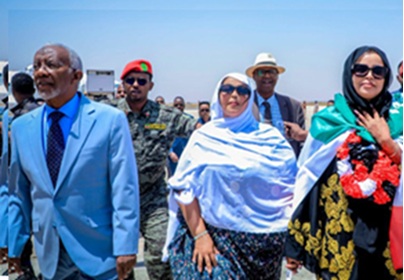
By Osman Hassan
Dr Ali Khalif Galaydh was steeped in the Darwish heritage of freedom loving. He was a paragon of “Somalinimo”, nationalism and staunch unionist and for all that earned the highest posts of government – above all becoming the Prime Minister of Somalia. He is the last person one would expect to renounce all that dear to him and one day embrace the secession that was hitherto an anathema to him.
Similarly, Miss Fahiima Quuje was the heroine of the liberation of Sool from the occupying separatists and later became an MP in the parliament of her NE State of Somalia. Who would have thought she would one day repudiate all that legacy and defect to the very enemy she fought. Yet both found themselves on the horns of a dilemma and in the end they choose the unthinkable
Most people’s kneejerk reaction is to brand and shame her as another “Horgal”, another infamous defector, another fortune hunters. She is none of that just as Dr Galaydh was not. Their backgrounds simply belie all that. It is therefore appropriate to reflect on at what point each could no longer solder on and threw in the towel, give up on their once cherished union and in favour of the secession that was hitherto their anathema. This paper traces that history and the lessons for their people.
Nevertheless, Fahiima’s defection to Somaliland is something no one who has stood firmly for the cause of SSC-Khaatumo could accept. It is deeply troubling that she would abandon the cause she fought for and defect to an administration that subjected the people of SSC-Khaatumo to killings, displacement, and repression. Such a decision is not only a serious political misjudgment but, in the eyes of those who have fought for the cause, a deeply wrong and unacceptable act.
Mogadishu is the bane of the unity of Somalia & not Hargeisa
The 1991 collapse of the Somali state marked a critical turning point in the history of Somali unity. The subsequent unilateral declaration of independence in the north (former British Somaliland) served as a definitive test of the support for the union. While one specific clan spearheaded the secessionist movement, all other northern clans actively resisted the split, maintaining a steadfast commitment to a unified Somalia in both in word and in deed to this day.
In contrast, Somalia’s presidents and Prime Ministers (invariably all southerners) have without exception abdicated their constitutional obligations to oppose the secession and defend the union, Hassan Sheikh Mohamoud (hereafter HSM) being the most manifestly indifferent to it. Far from taking concrete actions to end the secession, HSM is aiding and abetting it to the present day while on the on the other hand openly undermining the struggle of northern unionists to defend the union.
Villa Somalia’s actions amount to puling the rug from underneath the union and sending a message to northern unionists to fend for themselves- or worse surrender to their secessionist occupier. Dr Galaydh and Fihiime Quuje eventually yielded to these immense pressures at critical junctures of the struggle. Revisiting these historical turning points is essential to understanding their profound implications for the present-day Northeast (NE) State.
Shutting the door on Khatumo
For Dr. Galaydh, the then-president of the self-proclaimed Khatumo State, the turning point for the union occurred in July 2015. At that time, President HSM announced that the Galmudug regions would be the final state admitted into the federal system. This declaration sent an unmistakable message to Dr. Galaydh, who had been actively lobbying for Khatumo’s federal inclusion: the northern regions were being excluded from federal Somalia. To him, and to northerners, this decision was tantamount to Mogadishu’s unilateral termination of the union and the ultimate breakup of the country.

HSM’s action received the silent endorsement of the entire southern political establishment, as no major political figure dissented at the time or in the years that followed. Ironically, President HSM’s stance closely echoed Hargeisa’s 1991 unilateral declaration of secession. For a brief moment, Mogadishu and Hargeisa aligned, sharing a parallel perspective on the dissolution of the union.
It was then that Dr Galaydh made his memorable statement that they thought until then that the unity of Somalia was being undone in Hargeisa but realised then that it was in Mogadishu. With the door to unity closed, Dr Galaydh then made overtures to “Somaliland”, then headed by Ahmed Mohamed Mohamoud (Siilaanyo). The two leaders successfully brokered an agreement to amend the constitution, aiming to ensure equitable power-sharing among the northern clans. However, this hard-won compromise was ultimately vetoed by Siilaanyo’s successor
Dr. Galaydh faced significant backlash for crossing a red line by embarking on a unilateral and controversial negotiations with Hargeisa. Nevertheless, he has succeeded to expose the true colours of his counterparts without compromising his position. His demand for a Somaliland grounded in equity among all its clans, and his mission for an inclusive federal Somalia, were ultimately rebuffed by both Colonel Muse Bihi and HSM, a revelation that as a minimum served as an eye-opener for his people as to the malevolent realities in Mogadishu and Hargeisa which persist to the present day.
The war on Sool and the support for the aggressor
Fahiima, a Northeastern lawmaker, to defect to Somaliland is something no one who has stood firmly for the cause of SSC-Khaatumo could accept. It is deeply troubling that she would abandon the cause she fought for and defect to an administration accused of subjecting the people of SSC-Khaatumo to killings, displacement, and repression. Such a decision is not only a serious political misjudgment but, in the eyes of those who have fought for the cause, a deeply wrong and unacceptable act.
For Fahiima Quuje and her people, another defining test of their place within Somalia emerged during “Somaliland’s” eight-month war of attrition against the city of LasAnod. The conflict was purely one between two Somali clans, one of them a clear aggressor. Under the circumstances, the Federal Government of Somalia was constitutionally and morally obligated to intervene and halt the violence. At the very least, it should have sided with the victims—particularly since they were defending the unity of Somalia against a separatist entity. Barring direct intervention, it should have, at a minimum, offered public moral support to the wronged party.
None of that narrative however has resonated with HSM who, as he stated, saw the fighting purely as an internal matter for “Somaliland”, implying that it was another country and therefore outside his jurisdiction. Additionally, his diabolical downplaying of the scale of the atrocities committed by the secessionists, and his equally reprehensible blocking urgently needed humanitarian aid to the victims, are clearly politically motivated and show whose side he was on. When this is taken together with the lack of dissent from other southern political figures with his partisan actions, it all adds to a collective ambivalence towards the union among the southern political establishment, across regions and clans
Liberation Without Reward: The Betrayal of SSC-Khatumo
By liberating their territory, the people of the SSC region single-handedly kept the dream of a unified Somalia alive. Yet, their rightful expectation to exist as a fully recognized federal member state has been treated as a pipe dream. Following months of pleading, the region finally received only a hollow, symbolic federal status on paper. This token gesture merely serves President HSM’s political shenanigans to retain power, while the region continues to face systemic marginalization and a denial of its constitutional rights.
Compounding and legitimising this injustice is the absolute silence from the wider southern Somali political establishment. No former president, former prime minister, regional leader, or prominent politician has questioned HSM’s discriminatory, punitive, and unconstitutional actions against this nascent northeastern state. This continuing collective stand sends once again a clear, troubling message: the effective borders of the Somali federal project remain confined to the south.
History Repeating Itself
We are witnessing history repeating itself. The same president who slammed the door on Dr. Ali Khalif Galaydh and his Khatumo movement in 2015 is more or less doing the same containment strategy against its successor in 2026. For Fahiima Quuje, the relentless endless and humiliating denials of her peoples’ constitutional rights under the current administration have surpassed what Galaydh ever faced, and in the end shattered her resolve and forced her to defect to Hargeisa. Yet, this defection is akin to jumping from the frying pan into the fire . It begs the critical questions:
- What viable choices are left for her people?
- Where do they go from here?
The demise of the union of Somalia is the main casualty of the overthrow of the military government in 1991. It does not count for the federal government which is supposed to be its custodian. It matters even less for the fragmented decentralized autonomous clan-based enclaves. All have shelved it, pay lip service to it, and prioritise their own interests. The exception are the NE people who are dogmatically beholden to an unwanted nominal union as if they are God’s mandated people to defend it when the rest of Somalia have ditched it. That is mission impossible and self-defeating.
Getting your priorities right
The historic 6 February 2023 Las Anod Declaration promised true regional self-determination and representative governance. Those aspirations came closer to being realised when SSC-Khatumo liberated its occupied regions, setting the stage to fulfil the declaration. Unfortunately, those hopes were compromised when President Hassan Sheikh Mohamud (HSM), in collusion with the then SSC-Khatumo leadership, was allowed to hijack the August 2025 state formation elections. By securing the selection of handpicked loyalist candidates, the federal government effectively integrated the region into its own political agenda to retain power.
Rather than focusing on the urgent task of nation-building for the new Northeast state -cementing the cohesion of its clan partners and strengthening nascent institutions-the current leadership has prioritised alignment with Villa Somalia. This blind loyalty has yielded little to no tangible benefits for the local population. While unwavering loyalty to the Sayid was a trait of the Darwish, such devotion is not meant for the enemies of their people.
The consequences of these compromised elections and the perceived betrayal of the Las Anod Declaration are now becoming clear. The initial unity born of the uprising is fracturing, political cohesion between the two principal clan partners is wearing thin, and the State is drifting without strong, independent leadership. Recent high-profile defections to Hargeisa reflect growing disillusionment with the administration under Abdirisak Firdhiye. While these defections currently represent a small fraction, they could trigger a larger exodus if the administration fails to address the consequences of their neglect and failures. To avert a systemic crisis and realign with the original goals of the uprising, the SSC-Khatumo leadership must urgently prioritize the following actions:
- The NE should stop immediately acting as self-appointed defender of a fruitless moribund union that the rest of Somalia have ceased to care about it;
- The NE State should put the union on hold so long it is unwanted by the political establishment of southern Somalia;
- The NE State should be the first to embrace the union once Somalia has the patriotic leader it desperately- one who revives the union and unite his fragmented people;
- The NE State should give top priority to its own interests, putting its own house in order and attend to the needs of state-building;
- The NE State should focus on revitalising the State , cement the union of its principal clan partners, deepening and widening its governance throughout the territory including those that are still not liberated;
- A well-managed NE should ensure that is self-reliant and less dependent on begging humiliating handouts from HSM;
- The NE must henceforth judge its relations with the rest of Somalia on their own merit
- The NE must maintain the closes possible relations with their brethren in Puntland, irrespective of the long-standing hostility of their successive leaders towards the SSC people to having their own State, and worse going to the extent of them making unholy alliances with the secessionists to scupper the NE State down;
- A successful well run NE State should be able to exploit the benefits of its highly coveted strategic geographical position and its immense untapped natural resources awaiting to be exploited;
- Similarly, those who failed the NE should give way to those who can be trusted with its salvation and renewal;
- It is a do or die situation for NE.
Osman Hassan
Email: Osman.hassan2@gmail.com
—————–
Osman Hassan is a seasoned journalist and a former UN staff member. Mr Hassan is also a regular contributor to WardheerNews.
Leave a Reply