
By Abdikarim H. Abdi Buh
The most important thing about the new security partnership involving Turkey, Saudi Arabia and Pakistan may not be what the three countries have promised each other. It may be what their potential adversaries now have to calculate.
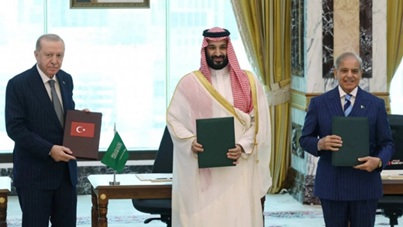
The signing of a trilateral defense and security agreement in Mecca marks a potentially important moment in the evolution of the Middle East and South Asian security order. On paper, it is a framework for cooperation in defense, intelligence, military training, technology, maritime security and the defense industry.
But geopolitics is rarely about the words on a document alone. It is about what those words make possible. Turkey, Saudi Arabia and Pakistan are three very different powers with distinct foreign-policy priorities. Yet they also possess something increasingly valuable in an unstable world: complementary strategic capabilities.
Turkey brings a sophisticated and rapidly expanding defense industry, extensive military experience and a growing ability to produce drones, armored vehicles, naval platforms, missiles and other advanced systems.
Saudi Arabia brings financial power, energy resources and extraordinary geographic importance. Sitting at the crossroads of the Gulf, the Red Sea and major global energy routes, Riyadh occupies territory that is central to the security of the international economy.
Pakistan brings decades of military experience, an established defense industry, access to the Arabian Sea and a nuclear deterrent. Its border with Iran adds another layer of strategic significance. Individually, these capabilities matter. Together, they could create leverage.
From Dependence to Strategic Options
For decades, much of the security architecture of the Middle East has depended heavily on external powers, particularly the United States and its military presence in the region. That model is not necessarily disappearing. But it is changing.
Regional powers are increasingly seeking multiple strategic relationships rather than relying entirely on a single security guarantor. Saudi Arabia’s expanding defense cooperation with Turkey and Pakistan should therefore not automatically be interpreted as an anti-American move. It may be something more pragmatic. Strategic insurance.
Riyadh can maintain its relationship with Washington while simultaneously developing new defense partnerships. Turkey can remain a NATO member while expanding its strategic relationships beyond the Western alliance. Pakistan can deepen cooperation with Gulf powers while preserving its own independent strategic calculations.
The message is not necessarily that the old alliances are ending. It is that new options are being added. And in geopolitics, options are power.
Iran Will Notice the Geography
The agreement does not need to name Iran as an adversary to have consequences for Tehran. Geography does much of the talking.
Saudi Arabia and Iran face each other across the Gulf. Pakistan shares a land border with Iran. Turkey sits at the intersection of Europe, the Middle East and Eurasia and possesses one of the region’s most capable indigenous defense industries.
Recent confrontations involving Iran and Israel have already demonstrated how quickly regional instability can threaten energy infrastructure, maritime routes and international commerce. The Strait of Hormuz remains one of the world’s most sensitive strategic chokepoints. Any prolonged disruption could reverberate through global energy markets.
Against this backdrop, deeper military coordination among Ankara, Riyadh and Islamabad inevitably changes the strategic equation. Tehran does not necessarily have to believe that these three countries are preparing for war.
It only has to recognize that there are now more variables to consider. And that is where deterrence begins. The question confronting any potential adversary becomes increasingly complicated: If I escalate, what happens next?
If the answer becomes harder to predict, the cost of escalation rises.
A Signature Is Not an Alliance
There is, however, a danger in exaggerating the significance of the agreement. A signature does not create an alliance. Implementation does. The real test will come in the months and years ahead.
Will the three countries conduct meaningful joint military exercises? Will intelligence-sharing mechanisms become institutionalized? Will they cooperate on air and missile defense? Will their militaries develop greater interoperability? Will defense companies establish joint production and technology partnerships? Will maritime-security cooperation move beyond political declarations?
If the answer to these questions is yes, the agreement could evolve into something far more consequential than a diplomatic statement. It could become security infrastructure. That distinction matters.
Many international agreements look impressive when they are signed and far less impressive once the cameras disappear. The credibility of this partnership will ultimately be determined by capabilities, institutions and sustained cooperation—not ceremonies.
Not an “Islamic NATO”
It may be tempting to describe the arrangement as an emerging “Islamic NATO.” That would probably be misleading.
NATO is a formal collective-defense alliance with deeply integrated institutions and treaty-based commitments. Turkey, Saudi Arabia and Pakistan have different foreign policies, different strategic priorities and different relationships with major global powers.
They do not need to become a single bloc. Their cooperation may actually be more effective if it remains flexible. They can work together where their interests overlap while maintaining independent foreign policies elsewhere.
Counterterrorism, maritime security, military technology, intelligence, training, defense production and protection of strategic trade routes are obvious areas of convergence.
The emerging model is therefore less about creating a single geopolitical camp and more about creating a network of strategic options. That may be more consistent with modern geopolitics.
Washington Should Pay Attention
For the United States, this development presents both an opportunity and a challenge.
A stronger regional capacity for counterterrorism, maritime security and defense cooperation could reduce the burden on American forces and allow Washington to share more responsibility with capable regional partners.
But greater strategic autonomy also means that regional states will increasingly make decisions based on their own calculations rather than waiting for Washington to provide every answer. That is not necessarily bad for the United States.
In fact, a region capable of taking greater responsibility for its own security could ultimately serve American interests. The challenge for Washington will be maintaining influence without assuming that influence must mean control.
China Has an Interest Too
China will also be watching closely. Beijing does not need to join the partnership to be affected by it. China has enormous interests in Gulf energy supplies, Red Sea shipping, South Asian trade and infrastructure connectivity. Greater regional stability could serve Chinese economic interests.
But if this partnership develops into a sophisticated security network, it could also contribute to a broader transformation of the regional balance of power.
China’s response may therefore be carefully calibrated: supportive of stability, attentive to energy security and cautious about any development that could intensify great-power competition.
The Real Test Will Come During the Next Crisis
Ultimately, the significance of this agreement will not be determined in Mecca. It will be determined during the next serious regional crisis.
Imagine a major confrontation involving missile attacks, drone strikes, terrorism or disruption of maritime trade. An adversary would then have to ask: What will Saudi Arabia do? What role could Pakistan play? How might Turkey respond?
Would intelligence be shared? Would military assistance follow? Could the crisis spread?
And, most importantly, could it still be contained?
That uncertainty can itself become a strategic asset. Deterrence does not always require the immediate threat of war. Sometimes it works by convincing an adversary that the consequences of escalation are too uncertain, too costly or too difficult to control.
Three Countries, Three Strengths
The emerging strategic triangle is therefore worth watching closely. Saudi Arabia brings capital, energy resources and Gulf geography. Turkey brings defense technology, military expertise and an increasingly powerful indigenous arms industry.
Pakistan brings military experience, strategic geography and nuclear deterrence. Three countries. Three different strengths. One emerging calculation.
Separately, they possess important capabilities. Connected through sustained cooperation, those capabilities could become strategic leverage. But there is another possibility.
The agreement could remain largely symbolic—a diplomatic expression of shared interests without developing into a genuine security mechanism. History provides plenty of examples of ambitious agreements that never moved beyond paper. That is why the next stage matters more than the signing ceremony.
If joint exercises, intelligence cooperation, defense production, maritime coordination and interoperable military capabilities become reality, the partnership will have crossed an important threshold.
It will no longer simply be an agreement. It will be a network. And if that network works, an adversary may no longer be calculating against one country. It may have to calculate against three. That is the deeper significance of the emerging partnership.
For years, the question across parts of the region has been: Who will protect us? A new question is now taking shape: Can we build enough strategic capacity to protect ourselves? The answer will not be found in the language of the agreement. It will be found in the first crisis that tests it.
That is when the world will discover whether Turkey, Saudi Arabia and Pakistan have merely signed a document—or whether they have begun building a new security architecture capable of changing the regional balance of power.
Abdikarim H. Abdi Buh
Email: abdikarimshak@gmail.com
Leave a Reply