
By Mohamed A Yasin
Somalia’s political crisis has produced a constitutional paradox that increasingly defies conventional political logic: a Parliament whose mandate expired months ago continues to sit, a presidency whose mandate has also expired remains in office, and negotiations between the Federal Government and the opposition—despite repeated rounds of internationally mediated talks—have yet to produce an agreement on how the country should proceed.
In the middle of this uncertainty, one question has become unavoidable: if there is no political agreement and no agreed timetable for a new Parliament, should the existing House of the People simply abandon its chamber and leave the country without a functioning legislature?
That is the dilemma facing Somalia. The 11th Parliament’s mandate expired on April 14, 2026. President Hassan Sheikh Mohamud’s mandate subsequently expired on May 15. Yet neither a new Parliament nor a new president has emerged because the country’s political leadership remains locked in negotiations over the electoral and constitutional arrangements that will determine the next phase of the transition.
International partners have repeatedly encouraged the government and opposition to reach a compromise. Meeting after meeting has been convened. Statements have been issued. Political delegations have traveled, consulted, and negotiated.
But the fundamental disagreement remains unresolved.There is still no political settlement capable of providing Somalia with a universally accepted electoral roadmap.
So What Was Parliament Supposed to Do?
The question becomes particularly important when viewed against the circumstances surrounding the vacant speakership. Former Speaker Sheikh Aden Mohamed Nur (Aden Madoobe) left the position after being elected President of Southwest State. His departure created a vacancy at the top of the House of the People at precisely the moment when Somalia’s constitutional order was already under extraordinary pressure.
Rather than leaving the institution without a permanent presiding officer, the 11th Parliament proceeded to elect a new Speaker.
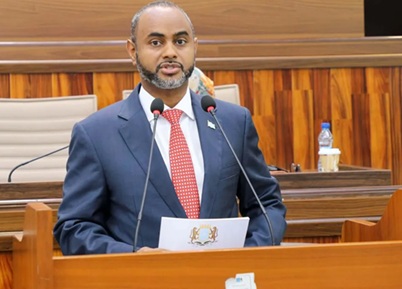
Abdulqadir Mohamed Nur Jama, a relatively young but experienced Somali political figure, emerged as the winner. Jama brings considerable experience in Somalia’s political, legal, security, and administrative affairs. He has previously served as Minister of Justice, Minister of Defense, and Minister of Ports and Transport, and has also served as Deputy Commander of the National Intelligence and Security Agency (NISA) and as a senior adviser to Speaker Mohamed Mursal Sheikh Abdirahman during the 10th Parliament.
His election has immediately generated controversy, particularly among opposition groups who argue that the 11th Parliament’s mandate had already expired and therefore question the legitimacy or necessity of electing a new Speaker.
That criticism deserves to be heard. But it also raises a larger question that has not been adequately answered:
What is the alternative?
Should the House of the People simply close its doors indefinitely?
Should MPs abandon their institutional responsibilities while politicians negotiate without a deadline? Should Somalia deliberately create a legislative vacuum while waiting for rival political camps to agree on an electoral formula?
Or should existing institutions continue performing essential functions until a political agreement produces legitimate successor institutions?
These are not merely procedural questions. They go to the heart of Somalia’s institutional survival.
An Expired Mandate Does Not Automatically Mean Institutional Anarchy
Somalia’s current predicament is unusual precisely because almost every major political institution is operating in a contested constitutional environment.
The President’s mandate has expired.
The Parliament’s mandate has expired.
The electoral process remains disputed.
The constitutional framework itself is contested.
And the opposition and government have yet to agree on the mechanism through which political authority should transition.
Under such circumstances, there is a legitimate distinction between constitutional legitimacy and institutional continuity.
The fact that Somalia has not yet agreed on the next political arrangement does not necessarily mean that every existing state institution should cease functioning overnight.
Indeed, doing so could create a far more dangerous situation. A functioning legislature—even one operating under a contested transitional arrangement—may provide a degree of institutional continuity that is preferable to an empty Parliament and an expanding political vacuum.
The alternative could be political paralysis without any institutional mechanism capable of managing it.
The Opposition’s Criticism
Opposition leaders have criticized the decision to elect Jama, arguing that the outgoing Parliament should not be making major institutional decisions after its mandate expired. Their concern is understandable. If Parliament’s mandate has ended, any action it takes inevitably raises questions about constitutional authority.
But criticism becomes more compelling when accompanied by a practical alternative. So far, the central political problem remains unresolved: there is no agreed successor institution.
The opposition has not yet produced a universally accepted mechanism through which the country can move from the expired 11th Parliament to a legitimate 12th Parliament while negotiations continue.
That is the uncomfortable reality. It is easy to say that Parliament should not elect a Speaker. It is considerably harder to explain what should replace the institution while the government and opposition remain unable to agree.
Somalia cannot be governed indefinitely through political objections alone. At some point, every political actor must present a workable pathway through the crisis.
Why Jama’s Election Matters
Jama’s election therefore carries significance beyond the question of who occupies the Speaker’s chair. He inherits a Parliament operating under extraordinary political circumstances.
At the same time, he enters the office at a moment when Somalia desperately needs institutional reform, modernization, and greater public confidence in its legislative institutions.
Jama is young, educated, and has accumulated considerable experience in Somali political and security affairs. Those qualities could prove valuable if he chooses to use the speakership not simply as a ceremonial position, but as an opportunity to modernize the House of the People.
Somalia’s Parliament has long faced criticism over weak legislative oversight, limited transparency, inadequate research capacity, poor public engagement, and the perception that MPs frequently follow political instructions rather than independently scrutinizing government policy.
The new Speaker has an opportunity to challenge that culture. He could strengthen parliamentary committees. He could improve legislative research and drafting. He could expand public access to parliamentary proceedings.He could modernize parliamentary administration and digital systems. He could strengthen financial and administrative accountability.
And, perhaps most importantly, he could seek to restore the idea that Parliament exists not merely to endorse political decisions but to scrutinize the executive and represent the Somali people.
But How Long Can He Serve?
This is perhaps the biggest uncertainty surrounding Jama’s election. Nobody can say with confidence how long the 11th Parliament will remain in place. If the government and opposition reach an agreement tomorrow, the political landscape could change rapidly.
If negotiations continue for months, however, the question of institutional continuity will become even more pressing. The Speaker therefore enters an office whose duration is uncertain, but whose responsibilities are immediate. That reality should encourage restraint.
The new Speaker should not interpret his election as a mandate to perpetuate the 11th Parliament indefinitely. Nor should the government use the existence of a functioning legislature as an excuse to postpone an eventual political settlement.
Instead, the speakership should be understood as part of a broader effort to keep the state functioning while Somali political leaders negotiate a legitimate path forward.
Somalia Cannot Afford Another Institutional Vacuum
The most dangerous outcome of the current crisis would not necessarily be the election of a controversial Speaker. It would be the collapse of institutional authority altogether.
Somalia has spent decades trying to rebuild state institutions after the collapse of the central government in 1991. The country has paid an enormous price for political fragmentation, institutional weakness, and competing claims to legitimacy.
Today, Al-Shabaab continues to exploit governance gaps. Federal and state authorities remain politically divided. International partners continue to play a major role in Somalia’s security and institutional development.
Against that backdrop, deliberately allowing Parliament to become completely dysfunctional would be difficult to justify without a clear alternative.
Political leaders must therefore distinguish between challenging the legality of an institution and destroying its functionality without providing a replacement.
The first is legitimate political debate. The second risks creating precisely the vacuum that Somalia’s enemies have historically exploited.
A Difficult Moment Demands More Than Criticism
Somalia’s opposition has every right to challenge the election of a new Speaker. But the country needs more than criticism. It needs solutions. If opposition leaders believe the 11th Parliament should no longer exercise legislative authority, they should explain precisely what mechanism should replace it.
If they believe a caretaker arrangement is necessary, they should present a detailed proposal. If they believe an immediate election is possible, they should explain how it can be organized, financed, and secured.
And if they believe the government and opposition should continue negotiations, they must also address how state institutions will function while those negotiations continue. Somalia cannot remain suspended indefinitely between an expired political order and an unborn one.
The Bigger Test
The election of Jama may ultimately prove to be either a footnote or an important moment in Somalia’s institutional history. Much will depend on what he does with the office.
If he uses it to modernize Parliament, strengthen oversight, improve legislative professionalism, and defend institutional independence, his tenure could leave a meaningful legacy regardless of how long it lasts.
If, however, the speakership becomes another instrument of political competition, the opportunity will have been lost. For now, Somalia remains caught between an expired mandate and an unresolved future.
The government’s mandate has expired. Parliament’s mandate has expired. The political negotiations have yet to produce an agreement. But the Somali state cannot simply expire with them. That is the uncomfortable truth at the center of the current crisis.
Until the country’s political leaders agree on a legitimate successor to the existing institutions, some form of institutional continuity remains necessary.
The real challenge, therefore, is not whether Somalia should have a functioning Parliament while negotiations continue. It is whether the country’s political leaders can finally agree on how to replace the current political order without allowing the state itself to fall into a vacuum.
That is the question that deserves an answer.
Mohamed A Yasin
Email: moyasin680@gmail.com
Leave a Reply