
By Abdinoor Ibrahim Noor
Preface
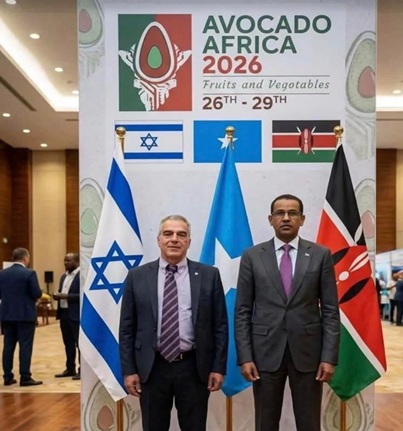
On the final days of May 2026, a single photograph accomplished what years of geopolitical commentary could not: it stripped bare the fundamental dishonesty at the heart of Mogadishu’s foreign policy posture toward Israel. Ambassador Jibril Abdulle the Federal Republic of Somalia’s ambassador to Kenya, stood shoulder to shoulder with an Israeli diplomat at the sixth edition of the Avocado Africa Conference an agricultural trade event organized under the auspices of the Israeli Embassy in Kenya. Behind them hung the flags of three nations: Israel, Somalia, and Kenya. The image circulated rapidly across social media platforms and news outlets, provoking outrage, bewilderment, and uncomfortable questions that the Somali federal government cannot easily dismiss.
What follows is an examination of this incident—not merely as a diplomatic gaffe, but as a window into the structural contradictions that define Somalia’s engagement with the broader Middle Eastern conflict, its instrumentalization of Islamic solidarity, and the precarious position of an ambassador caught between private statecraft and public ideology.
The Weight of a Photograph in Diplomatic Practice
Diplomacy is, at its core, a theatre of symbols. Flags, handshakes, seating arrangements, and joint photographs are not incidental to international relations; they constitute its grammar. When two representatives of sovereign states agree to be photographed together at an officially hosted event, they are communicating something deliberate to domestic and international audiences alike. The image conveys mutual acknowledgment, if not outright cooperation.
For most bilateral relationships, such a photograph would be unremarkable. Between Somalia and Israel, however, it is incendiary. The Federal Republic of Somalia has never extended diplomatic recognition to the State of Israel. This is not an oversight or a bureaucratic delay—it is a principled position that successive governments in Mogadishu have maintained since independence. Somalia joined the Arab League in 1974 and accepted the collective boycott of Israel that accompanied membership. It was among the earliest states to recognize Palestinian independence in 1988. As recently as November 2023, Prime Minister Hamza Abdi Barre stood before an audience at the National Theatre in Mogadishu and declared, without equivocation, that Hamas was a liberation movement and not a terrorist organization.
Against this backdrop, Ambassador Abdulle’s appearance at an Israeli-hosted event in Nairobi is not a trivial lapse in protocol. It is a seismic rupture in the carefully constructed narrative that Mogadishu has sold to its people, its Arab patrons, and the wider Muslim world for over half a century.
The Geopolitical Moment: Why Timing Transforms Meaning
Context transforms the meaning of any diplomatic act, and the context surrounding this photograph could scarcely be more damaging for Mogadishu. Consider the sequence of events that preceded it.

On December 26, 2025, Israel became the first United Nations member state to formally recognize Somaliland as an independent country—a move that struck at the very foundation of Somalia’s claim to territorial integrity. Mogadishu responded with fury, calling the recognition a “naked invasion” and mobilizing every available diplomatic channel to condemn Tel Aviv. The Arab League issued a formal condemnation. The Organization of Islamic Cooperation followed suit. A coalition of sixteen Arab and Islamic nations released a joint statement affirming their solidarity with Somalia’s sovereignty.
Then, in May 2026, Somaliland’s envoy to Israel announced that Hargeisa would open an embassy in Jerusalem—a city whose status remains among the most contested questions in international law. President Hassan Sheikh Mohamud responded on May 27, just days before the Avocado Conference, with a speech at Alliance Mosque in Mogadishu that left no room for ambiguity. He called the Jerusalem plan “a great misfortune” and “a disgrace,” invoking the religious sanctity of Al-Aqsa and the collective obligation of Muslims to reject Israeli sovereignty over the holy city. He described Israel in terms that left no doubt about Mogadishu’s official posture: it was an adversary, an occupier, an entity whose very presence in Somali-claimed territory constituted aggression.
Three days later, his own ambassador was photographed grinning beside an Israeli diplomat in Nairobi. The dissonance is not subtle. It is grotesque. And it demands explanation.
The Authorization Question: Incompetence or Complicity?
The most consequential detail to emerge from this affair is the allegation—reported by Horseed Media and corroborated by sources described as close to the Ministry of Foreign Affairs—that President Mohamud was aware of Ambassador Abdulle’s participation in the conference and had reportedly given his authorization. If this claim withstands scrutiny, it transforms the incident from a case of ambassadorial indiscipline into something far more troubling: evidence of systematic duplicity in Somali foreign policy.
There are, broadly speaking, two interpretive frameworks through which to understand this situation. The first is that Ambassador Abdulle acted unilaterally, exceeding his mandate and engaging with Israeli officials without clearance from Mogadishu. Under this reading, the ambassador is guilty of a serious breach of duty—a diplomat who allowed personal judgment or opportunism to override the explicit foreign policy of his government. The remedy, in such a case, is straightforward: recall, dismissal, and public condemnation.
The second framework is more uncomfortable. If the President indeed authorized the engagement, then Somalia is operating what intelligence professionals call a “dual-track” policy: maintaining a public posture of hostility toward Israel for domestic and regional consumption, while quietly pursuing pragmatic engagement through back channels. This is not unprecedented in international relation many states maintain unofficial contacts with adversaries through intermediaries or multilateral settings. But it is extraordinarily risky when the public posture is as absolutist as Mogadishu’s has been. The Somali government has not merely avoided Israel; it has built an entire diplomatic strategy around opposing Israel, particularly in the context of the Somaliland recognition crisis. To be caught engaging with the very state you have declared an enemy while simultaneously condemning a breakaway region for doing the same is a credibility catastrophe from which recovery is difficult.
Consequences: A Multi-Layered Crisis
The Domestic Arena
The Somali public’s attachment to the Palestinian cause is genuine and deeply rooted. It is not merely a function of government propaganda or elite manipulation; it reflects sincere religious solidarity, historical memory of colonialism, and identification with a dispossessed people. Any government in Mogadishu that appears to compromise on this issue does so at enormous political risk.
The opposition—already emboldened by disputes over constitutional amendments, regional elections, and the ongoing conflict with al-Shabaab—now possesses a potent weapon. The photograph will be deployed relentlessly in political discourse as evidence that the Hassan Sheikh administration says one thing to mosque congregations and does another in the conference halls of Nairobi. In a political culture where accusations of betrayal carry existential weight, this is not a minor embarrassment. It is a vulnerability that could reshape the calculus of upcoming elections and factional negotiations.
The Somaliland Dimension
Perhaps the most devastating consequence of this photograph is the gift it hands to Hargeisa. Somaliland’s leadership has spent months defending its sovereign right to establish relations with whichever states it chooses, including Israel. Mogadishu’s primary counter-argument has been moral and religious: that no territory bearing the Somali name and flying a flag inscribed with the Islamic declaration of faith should engage with an occupying power that oppresses Muslims.
That argument now lies in ruins. Somaliland’s President Abdirahman Irro can point to the Nairobi photograph and ask a simple question: if your own ambassador attends Israeli events with presidential blessing, on what moral authority do you condemn us? The hypocrisy is not a matter of interpretation; it is captured in pixels and distributed across the internet. Every future Somali statement condemning Somaliland-Israel ties will be met with this image as a rebuttal.
The Arab and Islamic Bloc
Somalia’s standing within the Arab League and the Organization of Islamic Cooperation has been built, in part, on its reputation as an unwavering opponent of normalization with Israel. This reputation has yielded tangible dividends: solidarity statements, financial support, and diplomatic backing against Somaliland’s secessionist project. The Nairobi incident jeopardizes these relationships.
Arab and Islamic states that rallied behind Mogadishu in December 2025—issuing condemnations of Israel’s recognition of Somaliland—did so on the understanding that Somalia’s opposition to Israel was genuine and consistent. If it emerges that Mogadishu was simultaneously conducting back-channel engagement, these states may reconsider the depth of their commitment. Diplomatic solidarity is, after all, a transactional commodity; it flows toward those perceived as sincere, not toward those exposed as performers.
The Turkish Factor
Turkey occupies a singular position in Somalia’s security architecture. Ankara operates its largest overseas military installation in Mogadishu, has trained thousands of Somali troops, and signed a decade-long defense agreement in 2024 granting it patrol rights over Somalia’s coastline and a share of exclusive economic zone revenues. Turkey’s own relationship with Israel has deteriorated sharply, particularly since the onset of the Gaza conflict in October 2023. President Erdogan has made opposition to Israeli policy a centerpiece of his regional identity.
For Ankara, the spectacle of a Somali diplomat engaging with Israeli officials—potentially with presidential knowledge—raises uncomfortable questions about the reliability of its Mogadishu partnership. Turkey’s strategic interest in the Horn of Africa is partly motivated by a desire to deny Israel a foothold in the region, particularly along the approaches to the Bab el-Mandeb strait. If Somalia cannot be trusted to maintain its anti-Israel posture consistently, Turkey’s calculations regarding the value of its Somali investment may shift.
What Steps Could Somalia Take Against the Ambassador?
The Vienna Convention on Diplomatic Relations of 1961 establishes the legal framework governing the relationship between a sending state and its diplomatic agents. While much of the Convention addresses the obligations of receiving states toward foreign diplomats, it implicitly affirms the absolute authority of the sending state over its own representatives. An ambassador serves at the pleasure of the head of state who appointed him; his mandate can be expanded, restricted, or terminated at any moment.
The Federal Government of Somalia has several options available, each carrying distinct political signals:
Formal Recall: The most immediate and conventional response is to recall Ambassador Abdulle to Mogadishu “for consultations.” This language is deliberately ambiguous in diplomatic practice it can signal anything from mild displeasure to a prelude to dismissal. Somalia employed this mechanism in December 2020, when it recalled its ambassador from Nairobi over allegations of Kenyan interference in Jubaland’s internal affairs. A recall would remove Abdulle from the scene, buy time for the government to assess the political damage, and signal to domestic and international audiences that the matter is being taken seriously.
Outright Dismissal: If the political pressure proves unmanageable, the government can terminate Abdulle’s appointment entirely. This would mirror the precedent set by Libya in August 2023, when Prime Minister Abdul Hamid Dbeibah fired Foreign Minister Najla al-Mangoush after her secret meeting with Israeli Foreign Minister Eli Cohen became public. The Libyan case is instructive: Mangoush later insisted that the meeting had been authorized by her superiors, but the political firestorm was so intense that she was dismissed regardless and forced to flee the country. Similarly, in 2016, the Egyptian parliament expelled lawmaker Tawfiq Okasha by a vote of 465 to 16 after he hosted the Israeli ambassador for dinner—despite Egypt maintaining full diplomatic relations with Israel since 1979. The lesson is clear: in the Arab and Islamic political context, engagement with Israel without explicit public mandate carries career-ending consequences, regardless of whether private authorization existed.
Internal Investigation and Prosecution: Beyond dismissal, the Somali government could refer Abdulle for formal investigation under domestic civil service or national security legislation. Diplomatic immunity, as codified in the Vienna Convention, protects an ambassador from the jurisdiction of the host state—not from the legal authority of his own government.
If Abdulle is found to have violated explicit directives from the Ministry of Foreign Affairs, or if his actions are characterized as prejudicial to national security, he could face administrative sanctions, loss of pension, or criminal proceedings upon return to Mogadishu.
Public Sacrifice with Private Protection: The most cynical—and perhaps most likely—outcome is a performative dismissal designed to satisfy public anger while privately protecting Abdulle from serious consequences. If the President did indeed authorize the engagement, punishing the ambassador too severely risks provoking him to speak publicly about the authorization he received.
Governments facing this dilemma typically arrange a quiet exit: the ambassador is recalled, his appointment is terminated without fanfare, and he is offered a comfortable retirement or reassignment far from public scrutiny. The scandal fades from the news cycle, and the underlying policy contradiction remains unresolved.
Concluding Reflections
The Nairobi photograph is not, ultimately, about avocados or agricultural trade. It is about the unsustainable tension between Somalia’s ideological commitments and its practical needs; between the rhetoric of Islamic solidarity and the realities of a fragile state navigating a region where Israeli influence is expanding rapidly. Kenya, Ethiopia, Uganda, and now Somaliland have all cultivated relationships with Tel Aviv. Somalia cannot indefinitely maintain its posture of absolute rejection while its neighbors—and apparently its own diplomats—move in the opposite direction.
The federal government faces an unenviable choice. It can sacrifice Ambassador Abdulle to preserve the fiction of unwavering opposition to Israel, knowing that the underlying contradictions will resurface at the next opportunity. Or it can begin the far more difficult work of articulating a coherent foreign policy that acknowledges the complexity of the Horn of Africa’s geopolitical landscape—a policy that may require engaging with uncomfortable realities rather than performing outrage for domestic audiences.
What it cannot do is pretend that this photograph does not exist. The flags have been unfurled. The handshake has been captured. And the questions it raises will not be answered by a press release or a ministerial dismissal alone.
Abdinoor Ibrahim Noor
Email : abdinoor.fareey@gmail.com
—————–
Abdinoor is a senior policy analyst and international relations scholar specializing in Global South geopolitics, Arab world affairs, and Pan-African international relations.
Leave a Reply