
Dr. Abdurahman Baadiyow
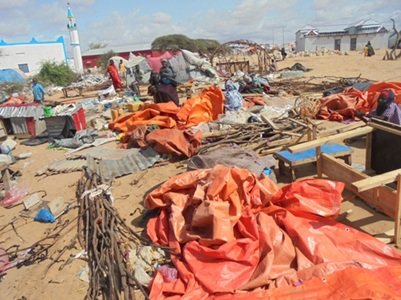
I am a mother, over eighty years old, living in Mogadishu. The house they demolished was not merely a building; it was the home where I was born, where I grew up, where I lived, and where I carried the memories of my entire life. Every wall held a memory. Every corner belonged to a chapter of my life. It was my home, my history, my identity, and my refuge. I have all the documents proving that it belongs to me. Yet one night, at midnight, they knocked on my door. Imagine an elderly woman, alone and vulnerable, facing such a moment in the darkness of night, with nothing but her weakness and the documents in her hands. They told me, “You must vacate this house.” I asked them, “Why? This is my home. I was born here. I have all the documents proving that it belongs to me.” But my words fell on deaf ears, and my documents were treated as though they meant nothing. Even my age, my vulnerability, and the fact that I was an elderly woman offered me no protection. I refused to leave the home that had sheltered me for a lifetime. Then came the threat: “If you insist, we will demolish it.” And they did.
They demolished the house where I was born, the place that had carried the memories of an entire lifetime. Perhaps they saw only walls and a piece of land. They did not see what I saw. They did not see my childhood, my memories, my tears, my joys, and the years of my life contained within those walls. They did not understand that when you destroy an elderly woman’s home, you do not simply destroy a building; you tear away a piece of her life, her memory, her security, and her dignity.
But the tragedy did not end with the destruction of my home. What came next was even more painful. I was told that if I wanted my land after destruction back, I would have to buy it again. I asked, “How much?” They answered, “Fifteen thousand dollars.” Fifteen thousand dollars, for the land of my destroyed home where I was born, the home I say is already mine, and for which I possess documents proving my ownership. Think about the cruelty of that moment: an elderly woman being told to buy back what she believes she already owns. Imagine what that does to the heart of an eighty-year-old mother. I had already lost my home, and now I was being told that I needed money to reclaim it. So I ask myself: Where do I go? Should I go to the courts? But where are the courts? To whom can I complain? Who will listen to me? Who will protect me? I am over eighty years old. I am sick. I am alone. I have neither the strength, nor the influence, nor the money to confront those who possess power. I have nothing but my documents and my voice. Yet even my documents could not protect me, and even my voice seemed to have nowhere to go.
Then I realized something even more painful than losing my home: I am voiceless. Not because I cannot speak, but because I do not know where to take my voice. I do not know which door to knock on, which institution will hear me, or which authority will stand beside me. What does it mean to be a citizen if you do not know where to turn when your rights are violated? What does the rule of law mean if the vulnerable cannot reach it? What does the state mean if an eighty-year-old woman in Mogadishu cannot find a single door to knock on in search of justice? We spend years talking about politics, presidents, elections, federalism, power-sharing, positions, and ministries. We fight over who governs, who controls power, and who occupies which office. But perhaps we have forgotten the most important question: What does the state mean to the ordinary citizen who has no power? Perhaps we have been asking the wrong question all along. The true test of a state is not who sits in the presidential palace, nor how many ministries and institutions it has. The true test is whether an elderly woman standing alone before injustice can find someone to protect her.
We speak endlessly about institution-building, as though institutions were simply buildings, offices, stamps, titles, and government signs. But an institution has no meaning if it cannot protect a human being. A court that the vulnerable cannot reach is nothing more than a building. A law that cannot restrain the powerful is nothing more than words written on paper. A government that cannot protect the rights of its citizens has failed in its most basic duty. Institutions must exist for people, not for those who possess influence, wealth, or power. Our political elites and government must confront a truth that can no longer be avoided: we cannot continue building political systems around the question, “Who gets power?”, while refusing to ask the far more important question, “How is that power used?” We cannot speak endlessly about democracy, political representation, reconciliation, and state-building while ordinary citizens have nowhere to turn when they are wronged. We cannot celebrate elections, political agreements, and the distribution of government positions while an elderly citizen does not even know where to submit a complaint. And we cannot honestly claim to build a state while leaving the vulnerable to confront the powerful alone. State-building without justice is not state-building; it is simply the construction of power.
And so, when every human door appears closed, this elderly mother is left with only one door to knock on: the door of Allah. She raises her trembling hands and says: “O Allah, You see what is happening to me. You know my pain. You know that this was my home. You know that I was born there. You know that I have the documents proving my right. When no one listens to me, You listen. When no one protects me, You are my Protector. I have nowhere left to go. To You I turn. From You I seek help. To You I bring my grievance, and from You I ask for justice.” What could be more heartbreaking than an elderly citizen having nowhere to turn except to Allah? The deepest tragedy is not simply that her house was demolished. It is that a woman who has lived more than eighty years in Mogadishu cannot identify an institution that she believes will hear her and protect her rights. And her story is not hers alone. It is the story of thousands who have no money, no influence, no political connections, and no powerful person willing to speak for them. They are hundreds of thousands who have been displaced recently in Mogadishu. They are citizens, but they are powerless. They have rights but cannot enforce them. They have voices, but no one listens. They are voiceless.
We speak not because we know every detail of this case, nor because we have already decided, in legal terms, who is right and who is wrong. We speak because the principle is greater than any single dispute: every citizen deserves access to a fair, accessible, and impartial institution where they can seek justice when they believe their rights have been violated. This is not a favor. It is not charity. It is not a privilege reserved for those who have money or connections. It is a fundamental right of citizenship. So what kind of state do we want to build? A state in which the powerful can take what they want while the vulnerable are left with nothing but prayer? Or a state in which an eighty-year-old woman can stand before an institution and say, “This is my home. These are my documents. I am asking for justice.” And someone answers her: “Mother, we hear you. We will listen to you. We will protect your rights.” That is the state we should build. That is the justice we should demand. But if a citizen eventually finds no door to knock on except the door of Allah, then we must stop and ask ourselves the questions we would rather avoid: What have we done to our state? What have we done to justice? And what remains of the meaning of citizenship?
This mother is voiceless, but we must not become people without conscience. Her home may have been demolished, but her dignity must not be demolished with it. She may be weak before those who possess power, but her weakness must never become a justification for denying her justice. Let us speak for those who have no voice. Let us stand beside the vulnerable. Let us demand a state in which the law stands above power, justice stands above influence, and human dignity stands above every political calculation. For when the vulnerable are abandoned, they do not merely lose their voice; society itself loses its voice.
When justice becomes inaccessible to the weak, the state loses its moral meaning. And when justice becomes a privilege available only to the powerful, citizenship itself becomes an empty word. We must speak for the voiceless, not because they are powerful enough to reward us, but because they are human beings deserving of justice. We must speak truth to power. We must speak it to the Mayor of Mogadishu, to the government, to the courts, to public officials, and to the President of the Republic. We must speak, not with hatred, not with personal revenge, and not for political gain, but because justice demands that the powerful be held accountable for how power is exercised.
Dr. Abdurahman Baadiyow
Email: abdurahmanba@yahoo.com
———-
Dr. Abdurahman Baadiyow is a Professor of Modern Islamic History and a Senior Adviser for the Somali President on Peace and Reconciliation.