
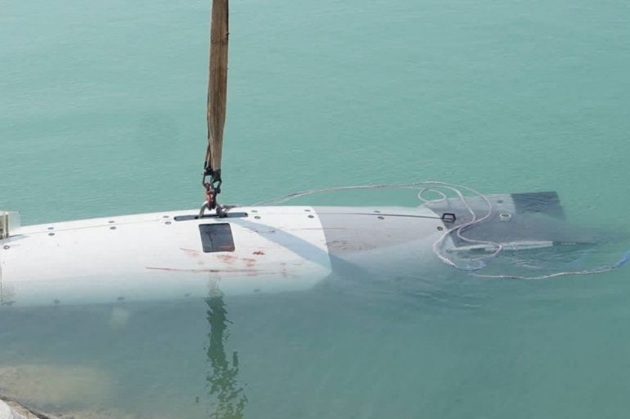
Tehran / Washington (WDN) — Iran’s Revolutionary Guard says it has seized a U.S.-made autonomous underwater vehicle near the entrance to the Strait of Hormuz, highlighting the increasingly sophisticated technological dimension of the confrontation between Tehran and Washington.
Iranian state media identified the device as the Dive-LD, an autonomous underwater system developed by U.S. defense technology company Anduril. The platform is designed for seabed surveys, mine detection and maritime intelligence-gathering.
Iranian forces said they captured the system near the approaches to the Strait of Hormuz, one of the world’s most strategically important waterways.
The United States, however, disputed the significance of the seizure. The Pentagon said the device had malfunctioned more than a day before Iran claimed to have captured it and described it as an older system that was not carrying classified information or sensitive intelligence equipment.
Anduril confirmed that one of its systems had been lost, noting that the equipment is designed to operate in dangerous environments where loss of a platform is a recognized operational risk.
According to company information, the Dive-LD can operate for up to 10 days without returning to a base and is designed to reach depths of approximately 6,000 meters. The system has been reported to cost roughly $2.5 million.
Technology Does Not Guarantee Victory
The incident illustrates a broader reality of modern warfare: having superior technology and overwhelming military capabilities does not necessarily guarantee political or strategic victory.
The United States possesses vastly greater military resources than Iran, including advanced aircraft, naval forces, intelligence systems and precision weapons. But a conflict with Iran would not simply be a contest of equipment.
Iran would be fighting on and around its own territory, with a political narrative centered on national survival and resistance to foreign intervention. That creates a fundamentally different calculation.
A foreign military can destroy infrastructure, strike military targets and deploy overwhelming force. But defeating a state determined to defend its territory can require far more than battlefield superiority.
For Iran, the most powerful weapon may ultimately be neither a missile nor a drone, but the willingness of its population and security forces to endure the costs of war. The underlying message is simple: if the country is attacked, defend it—even at the cost of your life.
That mentality can make military intervention extraordinarily difficult. A technologically superior force may win individual battles while still struggling to achieve the political objective that justified the war in the first place. History has repeatedly demonstrated the difference between winning battles and winning wars.
The Strait of Hormuz Raises the Stakes
The capture of the underwater system is particularly significant because of its location. The Strait of Hormuz is a critical passage for global energy supplies, making the waters surrounding it strategically important to both Iran and the international community.
The increasing use of autonomous underwater systems demonstrates how modern militaries are attempting to gather intelligence and conduct dangerous missions without exposing personnel directly to hostile environments. But the loss of such a system also shows that technological advantages have limits.
Iranian forces were able to identify and seize an American platform operating in waters they consider strategically vital, regardless of whether the device was lost because of a malfunction or deliberately captured.
The Bigger Lesson for Washington
The episode should therefore be viewed within a broader strategic question facing Washington: How much military force is enough to compel a determined state to surrender its political objectives?
Deploying additional troops may increase America’s ability to strike targets and protect its forces. It does not automatically eliminate Iran’s capacity or willingness to resist.
Iran’s geography, military infrastructure, regional networks and nationalist politics would make any prolonged confrontation vastly more complicated than a conventional demonstration of American military superiority.
The United States may possess the stronger military. But military strength alone does not determine the outcome of a war. When a population believes it is fighting to defend its homeland, the political and human costs of intervention can rise dramatically.
The captured Dive-LD may therefore be a relatively small incident in a much larger confrontation. Yet it offers a revealing glimpse of the broader challenge: advanced technology can provide military advantages, but it cannot guarantee victory against a determined nation fighting on its own ground.
WardheerNews