
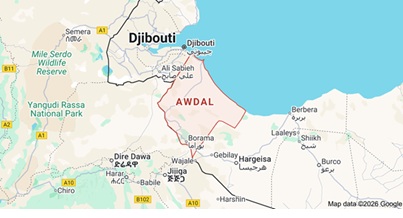
Hargeisa –(WDN)— Somaliland authorities have launched security operations in the Awdal and Salal regions, seizing weapons and military vehicles from groups involved in recent clan fighting, in a renewed effort to prevent armed militias from re-emerging and reigniting conflict.
The military displayed some of the vehicles and weapons recovered during the operations, warning that civilians and clan groups will not be permitted to maintain illegal stockpiles of weapons or operate military vehicles outside the authority of the state.
Military commanders said they had been instructed to take firm action against anyone who openly carries weapons or attempts to revive the recent clan conflict in western Somaliland.
The operations follow the breakdown of a recently negotiated peace agreement between the communities involved in the fighting. The agreement called for a ceasefire, the withdrawal of armed groups and an end to actions that could trigger a renewed confrontation.
Under the arrangement, security forces were tasked with helping maintain peace and preventing armed groups from using weapons to restart hostilities.
The conflict in western Somaliland began in November 2025, after a dispute over a planned public presentation in Zeila concerning the Xeer Ciise, a traditional customary legal code of the Issa community. The proposed event was opposed by other communities living in the area, eventually contributing to a broader confrontation.
The latest military operations are intended to remove weapons from the hands of rival groups and demonstrate that peace agreements will be backed by state authority rather than left to the goodwill of armed factions.
A Different Approach to Clan Conflict
The crackdown also highlights a fundamental difference between Somaliland’s approach to armed clan disputes and the situation in much of Somalia, where weapons are widely available and clan-based armed groups can operate with considerable freedom.
In Mogadishu, for example, firearms are widely visible and weapons are reportedly traded openly in parts of the capital’s markets. Across Somalia, political and clan disputes frequently become intertwined with armed mobilization, making it difficult for the state to establish a monopoly over the use of force.
Somaliland’s authorities, by contrast, have sought to maintain a policy that tribal militias cannot simply roam the country carrying heavy weapons or operate independently of the state.
That policy has been a major element of Somaliland’s relative security and stability over the years. Whatever the political disputes surrounding Somaliland, its authorities have generally treated the uncontrolled proliferation of clan militias as a direct threat to state authority and public security.
The current operations in Awdal and Salal therefore carry significance beyond the immediate dispute. They represent an attempt to prevent a temporary clan confrontation from developing into a permanent armed structure in which communities maintain their own military forces.
The challenge, however, is not simply to confiscate weapons. Lasting peace will depend on whether the authorities can combine disarmament with credible political dialogue, impartial law enforcement and mechanisms for resolving the underlying grievances that produced the conflict in the first place.
Somaliland’s government has repeatedly warned that it will not tolerate attempts to restart clan warfare or the illegal possession of weapons and military vehicles. For communities that have already experienced violence, the message is straightforward: peace agreements cannot survive if armed factions remain free to rearm.
The success of the latest campaign will ultimately be measured not by the number of weapons displayed at military headquarters, but by whether those weapons remain out of the hands of clan militias—and whether Awdal and Salal can finally move beyond the cycle of confrontation that has threatened their communities.
WardheerNews