
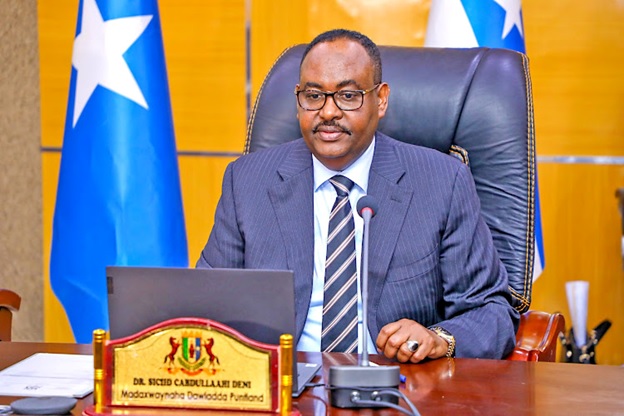
Garowe –(WDN)— Puntland President Said Abdullahi Deni has spoken publicly for the first time about the airstrikes reported along the coast of Nugaal, expressing regret over how the operations were carried out and insisting that suspected criminals must be dealt with through the law rather than force outside established legal procedures.
Speaking at a public gathering in Jariiban, Mudug region, Deni addressed the deteriorating security situation in Puntland, including the strikes reported in recent days against locations allegedly linked to suspected Somali pirates. “We are not satisfied with what happened. I am deeply saddened by it,” Deni said, stressing that anyone accused of committing a crime should be subjected to a lawful process rather than being dealt with through extrajudicial measures.
His remarks come amid growing uncertainty over who carried out the strikes, who authorized them and what intelligence was used to identify the targets. The attacks have generated considerable concern among coastal communities, particularly after reports that civilians and fishermen may have been caught up in the operations.
Deni’s intervention adds a new political dimension to an already murky episode. While Puntland has previously voiced concern over the reported strikes, the president’s latest comments appear to draw a clear line between combating piracy and the methods used to pursue suspected perpetrators. His message was that criminal activity cannot be an excuse for abandoning due process.
But Deni also acknowledged a deeper problem confronting Puntland: the involvement of local young people in activities allegedly linked to piracy. He urged traditional elders and community leaders to take greater responsibility for addressing the issue before it becomes more difficult to contain.
“If we fail to deal with the young men, it will become a problem,” Deni warned, emphasizing that those involved are members of the local communities and require a clear strategy rather than simply military action.
The president argued that responsibility cannot rest solely with security agencies. Families, elders and community leaders, he said, must work together to prevent young people from becoming involved in piracy and other forms of insecurity.
His comments come at a particularly sensitive moment. The reported strikes have raised unanswered questions about the presence and activities of foreign military assets along Puntland’s coastline. Puntland has demanded greater clarity over the operations, while Turkey has said it has no information regarding the reported strikes. That denial has only added to the uncertainty surrounding the incident.
For coastal communities, however, the issue is becoming increasingly immediate. Fishing families fear that military operations targeting suspected pirates could turn legitimate fishing grounds into dangerous zones, particularly if intelligence is inaccurate or civilian vessels are mistaken for hostile targets.
Deni’s remarks therefore appear to send two messages simultaneously: Puntland will not tolerate piracy, but neither will it accept the use of force as a substitute for justice.
The unanswered questions remain significant. Who ordered the strikes? Who supplied the intelligence? Who identified the targets? Were the operations authorized by Somali authorities? And, most importantly, were the people hit actually pirates—or innocent civilians caught in the crossfire?
Until those questions are answered, the mystery surrounding the Nugaal coastline strikes is unlikely to disappear. For now, Deni has made his position clear: crime must be confronted, but justice must not be bombed out of existence.
WardheerNews