
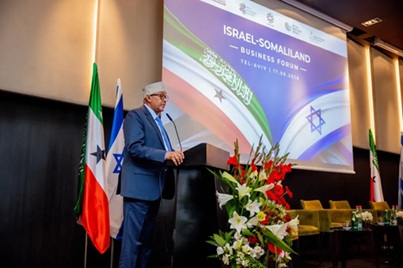
Hargeisa/TEL AVIV(WDN) – In a development that is sending shockwaves through Somali political circles, Somaliland President Abdirahman Mohamed Abdullahi Irro and his delegation formally participated in the inaugural Somaliland-Israel Business Forum in Tel Aviv, a landmark event that many observers view as another step in the rapidly expanding relationship between Somaliland and Israel.
According to a statement issued by Somaliland authorities, the forum was jointly organized by the Institute of Export and the Economic Affairs Department of Israel’s Foreign Ministry. More than 200 Israeli business leaders, investors, and representatives of major corporations attended the gathering, underscoring the growing strategic, military and economic interest between the two sides.
The event focused on expanding trade, encouraging foreign direct investment, and building long-term economic partnerships. Discussions covered a wide range of sectors, including infrastructure, energy, water management, agriculture, healthcare, telecommunications, and technology.
Participants highlighted Somaliland’s strategic location along one of the world’s most important maritime corridors, linking the Red Sea and the Gulf of Aden. Israeli investors were presented with opportunities in a territory that has increasingly sought direct international engagement despite lacking widespread international recognition.
Particular attention was given to technology transfer and innovation. Israeli expertise in water management, agriculture, startup development, and advanced technologies was repeatedly cited as an area where Somaliland could benefit from sustained cooperation.
In his address to the forum, President Irro emphasized Somaliland’s commitment to welcoming foreign investment and strengthening international economic partnerships. He portrayed Somaliland as an emerging gateway for trade and investment in the Horn of Africa, stressing its willingness to build mutually beneficial relationships with international partners.
For many Somalis, however, the significance of the forum extends far beyond business. The gathering is being viewed by supporters and critics alike as evidence of how far relations between Somaliland and Israel have advanced in recent years. What once consisted largely of speculation and informal contacts is increasingly being replaced by visible diplomatic, military and strategic engagement conducted in public view.
The timing is particularly sensitive. As Somaliland expands its international partnerships, Somalia’s Federal Government continues to grapple with one of the most severe political crises since the adoption of the federal system. Political tensions between Mogadishu and several federal member states remain unresolved, while disputes over elections, constitutional amendments, power-sharing, and security continue to dominate national politics.
Critics of the former President Hassan Sheikh Mohamud argue that the federal government has become increasingly confrontational toward political opponents rather than pursuing consensus-building and compromise. They point to recurring disputes with opposition groups and federal member states as evidence of a governing style that prioritizes centralization over political accommodation.
Some opposition figures warn that continued political polarization risks weakening the federal framework itself. They argue that Somalia’s future stability depends on dialogue between Mogadishu, federal member states, and opposition leaders rather than prolonged political confrontation.
Among sections of the Somali public, concerns are growing that persistent internal divisions could create opportunities for external actors and regional administrations to pursue increasingly independent political and economic agendas. The visible expansion of Somaliland’s international engagements is often cited as evidence of that trend.
Whether those fears prove justified remains uncertain. What is clear, however, is that the Somaliland-Israel Business Forum represents more than a commercial event. It reflects shifting political and economic realities in the Horn of Africa at a time when Somalia’s internal cohesion is being tested as never before.
As Somaliland deepens its external partnerships and the federal government struggles to build political consensus at home, many Somalis fear that the future of the Somali federation is entering one of its most consequential and uncertain chapters.
The contrast is striking: while Somaliland is showcasing itself to international investors in Tel Aviv, Somalia’s political elite remain locked in battles over elections, governance, and the very nature of the federal state. How those competing trajectories unfold may shape the future of the Horn of Africa for years to come.
WardheerNews