
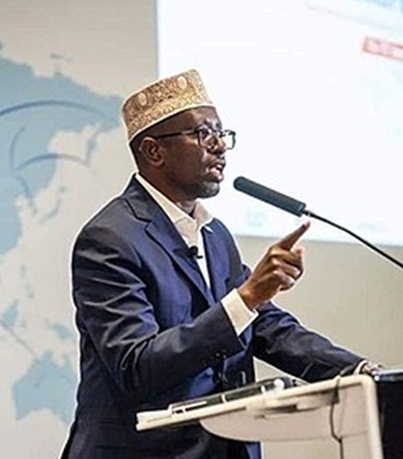
Mogadishu (WDN)- Somalia’s political landscape witnessed another extraordinary moment as former President Sharif Sheikh Ahmed launched one of his most blistering public attacks yet against former President Hassan Sheikh Mohamud, exposing the depth of mistrust and bitterness that has come to define the country’s increasingly polarized political environment.
Speaking before supporters and political allies, Sharif abandoned the cautious language that often characterizes high-level political disagreements and instead delivered a stunning rebuke directed personally at Hassan Sheikh.
The former president accused Hassan Sheikh of being unwilling to embrace the political reconciliation efforts that many Somali leaders have been advocating in recent months. According to Sharif, the president viewed political opponents not as rivals to negotiate with, but as adversaries to be crushed.
In one of the most striking moments of his speech, Sharif suggested that Hassan Sheikh was hostile to the peace initiatives that various political actors had been attempting to advance and alleged that the president wished harm upon opposition figures who challenged his authority.
Then came the remark that instantly reverberated across Somalia’s political circles. “You are the one who will die, Hassan Sheikh. We are not the ones who will die before you. By God’s will, you will go before us,” Sharif declared, drawing immediate attention from supporters, critics, and political observers alike.
The statement was remarkable not only for its intensity but also because it reflected how dramatically relations between Somalia’s political heavyweights have deteriorated. What once might have been handled through closed-door negotiations has increasingly spilled into public view, with political disagreements becoming more personal and confrontational.
Analysts say the exchange underscores the growing frustration among opposition leaders who accuse the government of sidelining dialogue and prioritizing political confrontation over consensus-building. Government supporters, meanwhile, argue that the administration has been attempting to maintain stability amid a highly complex political and security environment.
Regardless of political affiliation, few observers could ignore the extraordinary nature of Sharif’s comments. In a country where political rhetoric is often carefully calibrated, the former president’s words stood out for their raw emotion and unmistakable message: Somalia’s political divisions have reached a level where former allies and rivals are no longer disguising the depth of their animosity.
The remarks come at a critical moment as discussions continue over elections, constitutional disputes, power-sharing arrangements, and the future direction of the Somali state. With opposition groups seeking a united front and international partners encouraging dialogue, many had hoped for a lowering of political temperatures. Instead, Sharif’s extraordinary outburst served as a stark reminder of how deep the country’s political wounds remain.
Whether his comments further inflame tensions or force a more honest reckoning between Somalia’s competing political camps remains to be seen. What is certain, however, is that the former president’s words have added another dramatic chapter to one of the most consequential political rivalries in modern Somali politics.
WardheerNews