

By Mohamed A Yasin
Mogadishu’s official claims of economic growth, investment and institutional performance stand in stark contrast to insecurity, displacement, political fragmentation and a profound crisis of public confidence.
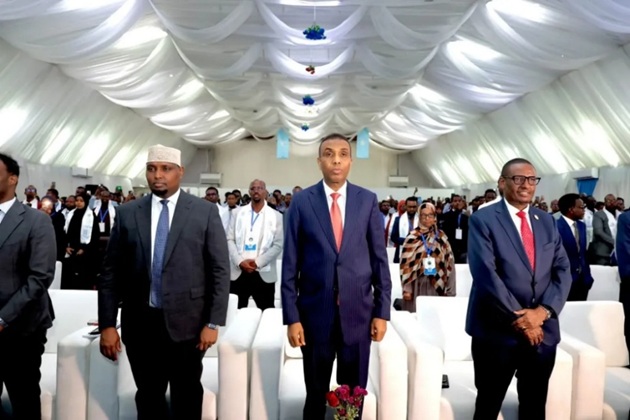
Somalia’s Prime Minister, Hamza Abdi Barre, appears to be reading from a script that bears little resemblance to the reality facing millions of Somalis. At the opening of the Third National Somalia Monitoring and Evaluation Conference (SNMEC 2026) in Mogadishu, the Prime Minister presented a picture of government performance, economic growth and institutional progress that critics would struggle to recognise in their daily lives. According to the state news agency, SONNA’s report of the conference, he highlighted economic growth, social services, teacher recruitment, expanding healthcare facilities and investment.
He also praised the Ministry of Planning for introducing the electronic National Integrated Monitoring and Evaluation System (e-NIMES), describing it as a tool that would improve the monitoring of government programmes and institutional performance. But a dashboard is not a country. Nor does the collection of electronic data automatically demonstrate that government policies are working. The fundamental question is whether the figures being presented reflect measurable improvements in the lives of ordinary Somalis.
For much of the past three decades, Somalia has remained among the world’s most corruption-affected and fragile states. The latest Transparency International Corruption Perceptions Index 2025 gives Somalia just 9 out of 100, placing it 181st among 182 countries assessed. This is not a record consistent with claims of substantial institutional transformation. Against this background, the Prime Minister’s optimistic account raises a more pressing question: where is the evidence that Somalia is becoming safer, more accountable and more attractive to investment?
Investment claims versus the reality on the ground
The Prime Minister cited investment as evidence of progress. Yet the investment environment tells a more complicated story. Somali businesspeople have for years pursued commercial opportunities beyond their country’s borders, including in Kenya, Ethiopia, the United Arab Emirates and other regional and international markets. The scale of this outward investment deserves more systematic examination, but it raises an uncomfortable question: why do Somali entrepreneurs often find more predictable conditions for doing business abroad than at home?
The obstacles are well documented. The US State Department’s 2024 Investment Climate Statement on Somalia identified endemic corruption, an inadequate legal and regulatory framework, weak civil courts, difficulties enforcing contracts and threats from Al-Shabaab as major barriers to investment. It also noted that the militant group extorts businesses in areas under its influence.
Investment depends on security, predictable laws, functioning institutions, reliable infrastructure and confidence that property and commercial interests will be protected. A country struggling with corruption, political uncertainty and an active insurgency cannot simply declare itself an attractive investment destination. It must demonstrate that investors can operate safely and that public institutions are capable of protecting their interests.
The government’s claims of economic progress should therefore be tested against independent evidence: the volume of productive investment entering Somalia, the number of sustainable jobs created, the security of businesses and the extent to which economic opportunities reach ordinary citizens.
A federal government increasingly isolated
The Prime Minister’s presentation also overlooks the country’s deepening political fragmentation. Relations between Mogadishu and several federal member states have deteriorated sharply, undermining the cooperation required to implement national policies.
The UN Secretary-General’s October 2026 report to the Security Council documents continuing political tensions over constitutional amendments and the electoral framework, including strained relations between the Federal Government and federal member states. It specifically records persistent disputes involving Puntland and Jubaland. The Security Council Report’s November 2026 assessment likewise describes a worsening political and constitutional crisis, noting that Puntland and Jubaland severed relations with the Federal Government in 2024.
This is not a minor administrative disagreement. Federalism requires consultation, constitutional cooperation and functioning relations between the national government and the member states. A federal administration that cannot maintain effective working relationships with key constituent states cannot credibly present itself as exercising coherent national leadership.
The gap between official rhetoric and political reality is particularly damaging when the government speaks of national development planning. Development plans require cooperation across the country. Without political consensus, institutional coordination and a functioning federal compact, national programmes risk becoming documents produced in Mogadishu rather than policies implemented throughout Somalia.
Displacement and the cost of government policy
The government’s record must also be judged by its treatment of the most vulnerable citizens. Under President Hassan Sheikh Mohamud’s administration, forced evictions and disputes over public land in Mogadishu have generated widespread criticism. Poor families have reportedly lost their homes as valuable urban land has been cleared, transferred or redeveloped for commercial interests.
The scale of the problem is documented in the European Union Agency for Asylum’s June 2026 report on displacement in Mogadishu. Citing Norwegian Refugee Council data, the report states that more than one million people in Mogadishu experienced forced evictions between 2017 and 2025, with the figure exceeding 1.3 million for the period 2015–2024. These figures include repeated evictions and should not be interpreted as a count of unique individuals.
The EUAA’s assessment also records 143,548 evictions in Mogadishu during 2025, including 63,132 people evicted from government properties. Its account of recent eviction incidents describes allegations of inadequate notice, consultation, compensation and alternative housing. It also documents concerns raised by opposition figures and human rights groups over the alleged unlawful sale of cleared public properties.
These findings provide a sobering measure of the human cost of urban redevelopment. Critics argue that government-led evictions and the handling of public land have contributed to mass displacement, swelling the ranks of internally displaced people already struggling with poverty, drought and insecurity.
For families who have lost their homes, government claims of development and institutional progress ring hollow. Development cannot be measured solely by new buildings, investment announcements or electronic reporting systems. It must also be measured by whether citizens enjoy secure homes, access to essential services and protection from arbitrary displacement.
The administration has also faced accusations of concentrating political and economic influence within the President’s inner circle and family network. Such allegations require independent investigation and transparent scrutiny. Public institutions must serve the country, not the private or political interests of those who hold office.
The security crisis that no dashboard can conceal
Perhaps the most urgent contradiction in the Prime Minister’s address concerns national security. Somalia continues to face a serious threat from Al-Shabaab. The UN Secretary-General’s latest report acknowledges significant security improvements in Mogadishu but makes clear that Al-Shabaab remains the principal security threat, operating across south and central Somalia. A July 2026 Congressional Research Service assessment further notes that the group retains the capacity to conduct terrorist attacks in Mogadishu.
The government’s challenge is therefore not simply to report security operations or announce improvements. It must explain how those gains can be sustained, why the insurgency continues to threaten national stability and what strategy will prevent the group from exploiting political divisions.
After years of international military assistance and substantial expenditure on security, the public needs more than assurances. It needs evidence of an effective national security strategy, a disciplined and properly equipped army, functioning intelligence coordination and accountable security institutions. A country cannot claim meaningful progress while its citizens remain uncertain about their safety and the ability of the state to protect them.
Can e-NIMES measure what the government refuses to confront?
The Prime Minister’s praise of e-NIMES raises another important issue. Electronic monitoring systems can improve transparency, coordination and the collection of performance data. But technology is only as credible as the information entered into it, the institutions responsible for verification and the political willingness to publish inconvenient findings.
A digital dashboard cannot manufacture accountability. It cannot compensate for weak institutions, conceal the absence of political cooperation or turn unverified claims into evidence of national progress.
The comparison is particularly relevant given the controversy surrounding the Federal Government’s electoral institutions. Opponents have questioned the credibility, independence and transparency of the government’s electoral arrangements. An electronic system, whether designed to monitor development projects or electoral processes, cannot earn public trust simply because it is digital. Its legitimacy depends on independent oversight, verifiable information and public confidence.
The same standard must apply to e-NIMES. Who verifies the data? Are project results independently assessed? Are failures and delays published alongside achievements? Can citizens, parliamentarians and independent auditors scrutinise the information? Without credible answers, the system risks becoming another instrument for presenting official success rather than measuring actual performance.
Somalia needs accountability, not another performance presentation
The Third National Monitoring and Evaluation Conference should have been an opportunity to confront the country’s development failures honestly. Instead, the Prime Minister’s remarks risk reinforcing the perception that the government is more comfortable celebrating reported achievements than addressing the conditions that undermine them.
Somalia needs functioning federal institutions, credible public financial management, transparent procurement, independent oversight, security for its citizens and an investment climate that encourages Somali capital to return home. It also needs development programmes that protect displaced families and deliver measurable improvements in health, education, water and livelihoods.
The test of government performance is not how many indicators appear on a digital dashboard or how confidently ministers present statistics at national conferences. It is whether people are safer, whether families retain their homes, whether businesses can invest with confidence, whether public money is accounted for and whether government services reach communities beyond the capital. Until those realities change, the Prime Minister’s account of national progress will remain difficult to reconcile with the country Somalis actually experience.
Mohamed A Yasin
Email: moyasin680@gmail.com
Leave a Reply