
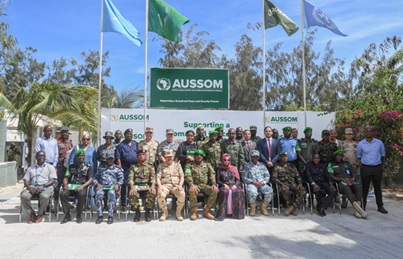
Constitutional deadlock and political interference in regional affairs are fracturing Somalia’s security forces, undermining the fight against Al-Shabaab and threatening to render international military assistance increasingly ineffective.
MOGADISHU/ NEW YORK (WDN)– The United Nations Security Council is meeting today to examine the deteriorating security situation in Somalia and the future of the African Union Support and Stabilization Mission in Somalia (AUSSOM). The meeting comes at a particularly dangerous moment, as the country’s unresolved constitutional and electoral disputes are increasingly undermining the very security institutions that international partners have spent years trying to build.
Assistant Secretary-General for Africa Martin Kimani and AUSSOM Head El Hadji Ibrahima Diene are expected to brief Council members on the mission’s operational challenges, funding requirements, the fight against Al-Shabaab and the future of Somalia’s security transition.
Yet the fundamental question confronting the Security Council is whether extending international military support can deliver meaningful security improvements when Somalia’s own political leadership is actively undermining national security cohesion.
A security mission cannot compensate for political failure
No matter how long AUSSOM remains deployed in Somalia, there will be little prospect of sustainable progress unless the country’s political crisis is resolved. International forces cannot indefinitely compensate for the absence of political consensus, institutional legitimacy, and a unified national security strategy.
The Federal Government, under President Hassan Sheikh Mohamud, has increasingly deployed national security forces in political confrontations involving South West State, Jubaland, and most recently, Hirshabelle. Instead of concentrating national military resources on defeating Al-Shabaab, the government has become embroiled in struggles over regional administrations, electoral arrangements, and political control.
The March 2026 military takeover of Baidoa, following the breakdown of relations between Mogadishu and South West State, illustrated the dangerous consequences of using federal forces in regional political disputes. Similar tensions have persisted in Jubaland, while the latest confrontation in Hirshabelle’s Hiiraan region has exposed even deeper divisions.
This is a fundamental distortion of the Somali National Army’s constitutional responsibility. A national military should defend the country and its citizens, not become an instrument for resolving political disagreements or enforcing the interests of competing political factions.
Cracks are emerging within the national security forces
Perhaps the most alarming development is the growing evidence that political confrontation is penetrating the ranks of Somalia’s security institutions.
The latest crisis in Hiiraan has exposed the vulnerability of military command structures to clan and regional loyalties. Following the disputed Hirshabelle leadership elections in October, Hawadle traditional leader Ugaas Yusuf Ugaas Hassan called on members of his community serving in the Somali National Army and other security institutions to return to Beledweyne rather than participate in operations against their own communities.
Subsequent reports indicated that groups of federal security personnel had abandoned or left their assigned positions to rally behind their traditional leadership. The precise number of personnel involved remains unclear, but the reported defections represent a serious warning about the cohesion of the national army.
The development demonstrates the danger of deploying soldiers into political conflicts involving their own communities. When military personnel are forced to choose between orders from a contested political authority and loyalties to their families, communities, and traditional leaders, the national chain of command becomes increasingly fragile.
The implications are particularly serious for frontline operations against Al-Shabaab. Every soldier diverted from counterinsurgency operations, every military unit divided by political loyalties, and every confrontation between federal and regional forces creates opportunities for the insurgency to regroup and expand.
Al-Shabaab benefits from a divided state
Somalia’s political leadership appears to be overlooking a basic strategic reality: Al-Shabaab does not need to defeat a unified national army if political divisions are already weakening its ability to operate as a cohesive force.
The insurgency has repeatedly exploited disagreements between Mogadishu and regional administrations, local grievances, and weaknesses in security coordination. The current confrontation in Hirshabelle is particularly dangerous because Hiiraan has been an important theatre in the campaign against Al-Shabaab, with local forces and community militias playing significant roles in counterinsurgency operations.
The withdrawal or disengagement of local security personnel from frontline positions could create gaps that the insurgents are well positioned to exploit.
The European Union Agency for Asylum has documented how political fragmentation, tensions between federal and regional authorities, and weaknesses within government forces have created opportunities for Al-Shabaab to consolidate its influence.
AUSSOM faces financial uncertainty and diminishing returns
The Security Council’s deliberations also come amid growing uncertainty over the financial sustainability of AUSSOM and the United Nations Support Office in Somalia (UNSOS), which provides essential logistical assistance to African Union forces and Somali security personnel.
According to the Security Council Report’s November 16 briefing, UNSOS has faced serious funding constraints, including a 25 per cent reduction in expenditure against its approved 2025/26 budget of $520.6 million. Its support package requires approximately $2.2 million each month for Somali forces operating alongside AUSSOM.
Funding shortages previously forced the temporary suspension of fuel and ration deliveries between May and July 2026. Although logistical support resumed following a British contribution of approximately $1.4 million, the longer-term financial outlook remains uncertain.
AUSSOM troop-contributing countries have requested sustained international support for another 18 to 24 months to facilitate an orderly security transition and strengthen Somali institutions.
Washington, which had initially opposed continued financing beyond the existing mandate, reportedly shifted its position on November 15 and agreed to support a one-year extension of both AUSSOM and UNSOS. However, the United States has made clear that this should not be interpreted as an open-ended financial commitment.
The constitutional crisis remains the missing piece
The fundamental obstacle to Somalia’s security recovery is political, not simply military or financial. The unresolved dispute over constitutional amendments, presidential and parliamentary mandates, and the electoral framework has fractured relations between the Federal Government and major federal member states. Puntland and Jubaland remain opposed to Mogadishu’s political approach, while South West State and Hirshabelle have experienced serious internal confrontations involving federal political and security interests.
The Supreme Court’s November 5 ruling on the expiry of the presidential and parliamentary mandates has further complicated the situation. The government’s rejection of the ruling has deepened the constitutional confrontation and undermined confidence in the institutions responsible for resolving political disputes.
Without an inclusive political settlement, Somalia cannot realistically expect to build a professional, nationally integrated security establishment capable of operating independently of political and clan rivalries.
The Security Council must confront the political reality
Today’s Security Council meeting should therefore go beyond discussions about troop numbers, logistical requirements and financial commitments. International partners must confront the political circumstances that are undermining the effectiveness of their security investments.
The African Union, United Nations, United States, United Kingdom, European Union and other partners should make clear that sustainable security assistance requires an inclusive constitutional settlement, respect for federal arrangements and an end to the politicisation of national security institutions.
This does not mean abandoning Somalia or withdrawing assistance from the fight against Al-Shabaab. It means ensuring that international support strengthens national institutions rather than inadvertently sustaining political practices that weaken them.
Somalia’s international partners have invested billions of dollars in military training, security operations, institution-building, and state reconstruction. Yet those investments risk producing diminishing returns when national security forces are diverted into domestic political confrontations and increasingly divided along regional and clan lines.
The country is approaching a critical crossroads. Unless President Hassan Sheikh and the opposition reach a political settlement, and federal and regional leaders restore cooperation, the continued deployment of international forces will not resolve the underlying crisis.
AUSSOM can help Somalia fight Al-Shabaab, but it cannot rescue a country whose political leadership is undermining its own national army. Extending the mission without confronting the constitutional crisis risks prolonging an expensive international security operation while the foundations of the Somali state continue to weaken.
WardheerNews
Leave a Reply