
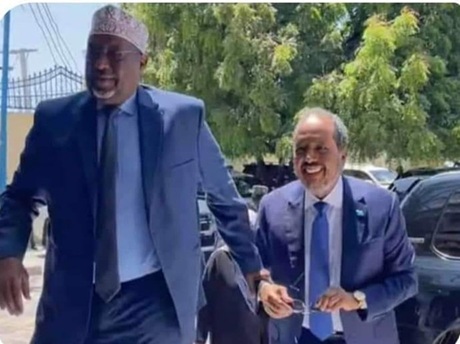
Mogadishu (WDN) – The former President Hassan Sheikh Mohamud and the leadership of Somalia’s House of the People have held a series of high-level political meetings over the past 48 hours aimed at reopening the Federal Parliament and organizing the election of a new Speaker of the Lower House amid the controversy surrounding the legitimacy of the federal parliament.
According to sources familiar with the discussions, the meetings concluded with an agreement to reconvene both chambers of the Federal Parliament within the next two weeks. The Standing Committee of the House of the People is also expected to be summoned in the coming days to accelerate preparations for the parliamentary session.
The first item on the agenda is expected to be the election of a new Speaker of the House of the People, a contest that has already triggered intense political maneuvering behind the scenes as aspiring candidates position themselves for one of the country’s most influential offices.
However, the planned reopening of Parliament comes at a time of deep political controversy and growing constitutional uncertainty. Opposition leaders and constitutional critics argue that the mandates of Somalia’s federal institutions have already expired. They maintain that the term of the Federal Parliament ended on 14 April, while the presidential mandate expired on 15 May, raising fundamental questions about the legality of any parliamentary proceedings conducted after those dates.
Under this interpretation, a Parliament whose constitutional term has lapsed lacks the legal authority to convene, elect a new Speaker, pass legislation, or exercise its constitutional functions. Consequently, they argue that any Speaker elected under such circumstances would face immediate questions regarding legitimacy and constitutional validity.
The dispute highlights the broader political crisis that has engulfed Somalia in recent months, as negotiations between the Federal Government and opposition groups over elections and constitutional arrangements have repeatedly failed to produce consensus. Despite these objections, preparations for the Speaker’s election appear to be moving forward.
Sources indicate that President Hassan Sheikh Mohamud is expected to decide in the coming hours which candidate will receive the formal backing of the Federal Government. At least three politicians who played prominent roles in recent political developments in South West State are reportedly seeking the position.
Among the names attracting growing attention is Abdulqadir Jama, who recently secured a parliamentary seat in Baidoa. His arrival in Parliament has fueled widespread speculation that he is positioning himself for a bid to become Speaker of the House with the support of the former President Hassan.
Political observers also note that the influence of the current Speaker, Aadan Mohamed Nur Madobe, continues to loom large over the contest. Many analysts believe that any candidate capable of securing the support of both former President Hassan Sheikh Mohamud and Aadan Madobe would enter the race with a significant advantage.
Yet the political arithmetic may prove less important than the constitutional questions now surrounding the process. For opposition groups, the issue is no longer merely who becomes Speaker, but whether the institutions conducting the election retain legal authority in the first place. Several opposition figures have warned that proceeding with major constitutional decisions after the expiration of institutional mandates risks deepening Somalia’s already fragile political crisis.
The controversy also comes against the backdrop of a stalled national dialogue, deteriorating relations between the Federal Government and several regional administrations, and continuing disagreements over the electoral framework that will govern Somalia’s next political transition.
What was initially expected to be a routine parliamentary reopening is now shaping up to be a major test of political legitimacy. Whether the reopening of Parliament is viewed as a necessary step to preserve continuity of government or as an unconstitutional extension of expired institutions will likely depend on the outcome of the ongoing political struggle between the Federal Government and its opponents.
One thing is clear: the election of a new Speaker is no longer merely an internal parliamentary matter. It has become the first major battleground in a widening dispute over constitutional authority, political legitimacy, and the future direction of Somalia’s state-building process.
As the country moves deeper into uncharted constitutional territory, the coming weeks could determine whether Somalia finds a consensual path forward—or slips further into a crisis of legitimacy that threatens the foundations of its federal institutions.
WardheerNews