
By Ali Haji Warsame
A Referee Sent Home, and A Nation Watching
In June 2026, Omar Abdulkadir Artan, a 34-year-old referee from Somalia, landed in Miami, USA, with a diplomatic passport and a valid US visa. He was Somalia’s first-ever FIFA World Cup referee and the reigning CAF Men’s Referee of the Year. He had worked for ten years for this moment.
However, US border officials pulled him aside, held him for about eleven hours of interrogation, and sent him back to Istanbul, Turkiye, where he had started his journey. The US border security claimed that Mr Artan was denied entry for “vetting concerns.” A US official later claimed he was suspected to have links to “terror organisations”, a claim never proven and firmly denied by Artan. Somalia is one of nearly forty countries on the Trump administration’s travel ban list, and Artan became its most visible victim. He was punished not for anything he did, but for the passport he carried.
FIFA, despite all its talk about football uniting the world, did little or nothing at all to help. It simply said host countries decide who enters. So, referee Artan flew home alone, his World Cup dream shuttered before it began, but what happened next said just as much about Somalia and its people as it did about Washington.
From Deportation to a Hero’s Welcome
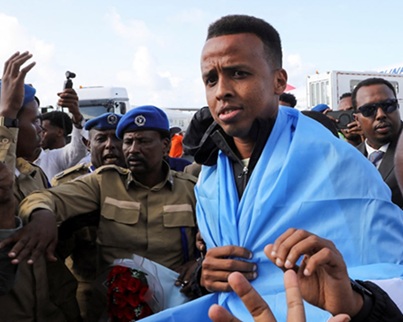
Referee Artan did not go home quietly. In Mogadishu, he was welcomed like a champion and national hero. The public embraced him, and government officials met him at the airport. Crowds wrapped him in the Somali flag, and thousands packed a stadium just to see him. Many Somalis in the diaspora, over two million, used him as their profile in their social media accounts, and world football figures reacted with him. The whole continent of Africa stood with him, and big world football players backed him.
In a country too often known abroad for war and hardship, his return became a moment of pride. He told the crowd he would keep chasing his dream and urged young Somalis to never give up on theirs. He has not shown any signs of remorse or revenge, and he has shown courage, determination, and calmness, which are symbol of self-confidence and integrity. Two months later, UEFA made a bold and clearly political move: it appointed referee Artan to officiate the 2026 UEFA Super Cup between Paris Saint-Germain and Aston Villa in Salzburg, Austria.
On 12 August 2026, he became the first non-European, and the first African, ever to referee a UEFA Super Cup final. Afterwards, he wrote on the match ball that this had become his World Cup. It was a rare moment where European football stood up, quietly but firmly, against an American injustice. It also showed that talent and integrity travel further than any ban.
“Garbage”: Harsh Words, and a Somalis Answer
Artan’s story did not happen alone. It was part of a wider pattern of harsh language from the Trump administration toward Somalis, a community made up mostly of American citizens: taxpayers, doctors, nurses, business owners, and elected officials. Somalis in Minnesota and in the USA at large have been called “garbage,” accused of “contributing nothing,” and insulted in ways rarely used against any other community, along with claims that Somalia is contributing nothing but poverty and disorder.
Statistically, Somali-descents in the US are estimated as 260,000. In the State of Minnesota alone, estimates range from 61,000 to 107,000, with 83,000-84,000 in the Twin Cities. Nationally, only 8.4% are non-citizens (over 90% are citizens). In Minnesota, more than 58% were born in the USA, and above 87% of the foreign-born are naturalised, one of the highest naturalisation rates of any immigrant group in U.S. history.
Bruce Corrie, an economist, estimates that Somalis’ economic contribution is around $500M in annual household income, $67M in state/local taxes, and $8B in economic activity supported statewide, even bigger than several Minnesota counties’ economy.
True to their culture of wit and resilience, Somalis mostly answered with humour rather than anger. Social media turned the insults into jokes and pride. One popular joke smartly and sarcastically described that Minnesota was promised to them “three thousand years” ago. Alongside the jokes came real pride in Somali doctors, engineers, and community leaders across America. It is a very Somali response: when insulted, laugh, work harder, and let their achievements speak.
1 July: The Diaspora’s Loudest Celebration Yet
Fast forward, the same pride was on full display around Somalia’s Independence and Unity Day on 1 July 2026, marking sixty-six years since British Somaliland and Italian Somaliland (then a UN Trust Territory) came together to form the Somali Republic. In London, young Somalis turned Oxford Street and the London Eye into unofficial Somali landmarks for the day. Somali flags were worn as capes, folklore songs and buraanbur filled the streets, and a generation raised in Peckham, Camden and Woolwich chose to be openly and proudly Somali in the heart of a European capital. Similar celebrations took place in Minneapolis, Toronto, Stockholm, and Nairobi.
For a diaspora often talked about rather than listened to, 1 July has become a yearly moment to tell their own story. I have personally attended the raising of the Somali flag at the centre of Birmingham, in front of the biggest library in Europe, and it was a moment of joy and pride.
What stands out most about the Somali diaspora is how much has survived the journey, the war, the refugee camps, the years of rebuilding a life abroad, and the hostility along the way. Restaurants like Sabiib in West London serve suqaar, canjeero, and meat to Somali elders and curious Londoners alike. Somali-owned shops have built thriving markets around cardamom coffee, honey, and sweet, caramel-style treats in cities like Minneapolis and Columbus. The Somali language is still sung and recited in poetry, still taught to children born thousands of miles from Somalia. A people who temporarily lost a functioning state did not lose their culture.
A View from the UK: Strong Abroad, Let Down at Home
Having lived and worked among this diaspora in the UK for many years, I have watched Somalis build careers, run successful businesses, and take up posts in local councils, hospitals, schools and universities, all while still sending money home to support families and villages. Their resilience is not accidental, but hard-earned, built in refugee camps, and passed down from parents who lost everything once and refused to lose it again. Yet, this same diaspora has been let down again and again by the political leaders back home in Somalia.
While young Somalis abroad were proving themselves on football pitches, in hospitals and in universities, politicians at home spent much of the last two decades arguing over election rules, clan shares and personal power. Elections have been delayed, disputed, and manipulated far more often than they have been fairly held.
Corruption still remains widespread, with public money too often diverted away from real services, and Somalia is consistently ranks near the bottom of Transparency International’s Corruption Index. The country still depends heavily on foreign aid rather than its own revenue. Perhaps most damaging of all, Somalia still has no single, fully unified national army to protect the country and safely secure its borders. Security remains split between non-inclusive federal forces, regional forces and international partners, a gap that groups like Al-Shabaab continue to exploit.
On top of this, the ongoing tug-of-war between the Federal Government and the Federal Member States over power and resources has eaten up energy that should have gone into building roads, schools and hospitals. The contrast is hard to ignore: young Somalis proving what the country can achieve on the world stage, while leaders at home still cannot agree on how to hold a fair election.
The Youth Are the Absolute Majority, and the Real Hope
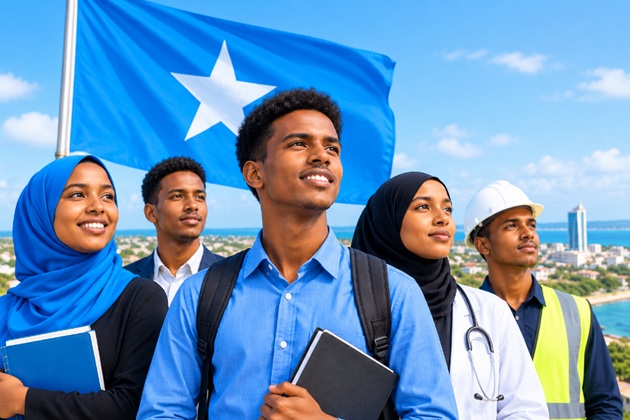
Somalia’s challenges are real and well-known, including, among other things, broken politics, weak institutions, corruption, nepotism, misuse of public resources, aid dependence, a divided security sector, and constant friction between federal and regional governments. No one can simply wash these away, but they are not the whole story, and they are not the final word.
Somalia is one of the youngest countries on earth. The median age in the country is 16 years, and about 46.% of the population. About seventy percent of its people are under thirty, a generation so large that, measured across a single lifetime, it adds up to well over a billion cumulative weeks of youthful energy still ahead of it. This is not a small group waiting on the sidelines.
At home and abroad, the youth are the absolute majority, and they are already showing what is possible: Omar Artan officiating a UEFA final months after being turned away at a US border; young Hafids from the West who have memorised the entire Qur’an and compete in international forums. Somali professionals rising in medicine, law, finance, and technology across the Western world; and a growing number of Somali-heritage politicians winning seats from the US, Canada, Finland, the UK, to Sweden. Turning this potential into a stronger Somalia will not happen on its own or overnight. It requires deliberate choices.
The Final Word
In conclusion, I would like to wrap up this conversation with what is needed to happen, especially in the following four areas which stand out as most urgent:
- Hold credible, transparent elections on an agreed and everlasting model, so power peacefully changes hands through the ballot box, not through disputes and delay.
- Build one unified, professional, and all-inclusive Somali national army, selecting the best of the best from federal and regional militia forces under agreed-upon command, to close the security gaps that armed groups exploit. Use the forces stated in the national security architecture, who are conscripted from the whole country.
- Fight corruption seriously, with independent oversight of public funds, so resources reach schools, hospitals, and roads instead of patronage networks and personal pockets of the politicians.
- Establish public institutions that ensure transparency and accountability in the Federal Government and Federal Member States, to safeguard and effectively manage the country’s meagre resources.
- Involve the diaspora directly in nation-building, not just through remittances, but through investment, skills transfer, and real roles in policy and public service. The best guarantee for their survival and contribution is proving our capability to rule ourselves at home.
None of this is easy, and none of it will happen overnight, but a country with this many young people, this much talent already proven on the world stage, and this much resilience running through its diaspora has every reason for hope.
The task now is for Somalia’s leaders, at home and abroad, to finally build a nation that matches the ambition of its youth. If they do, the achievements we celebrate today- a referee’s whistle in Salzburg, a flag raised on Oxford Street, a young Hafids reciting the Qur’an from memory- will be remembered not as rare exceptions, but as the first signs of what Somalia’s majority generation was always capable of.
Ali Haji Warsame MBA MA CPA CGMA
Email: ali.warsame@hiilinstitute.org
———-
Ali Haji is the executive Director of Hiil Institute for Governance, the former Puntland Minister of Education and WardheerNews contributor.
—–
References
- Al Jazeera. “US confirms it denied entry to Somali referee set to take part in World Cup.” 8 June 2026. aljazeera.com
- Al Jazeera. “Somali denied World Cup ‘proud’ to referee PSG vs Villa in UEFA Super Cup.” 11 August 2026. aljazeera.com
- CNN. “Omar Abdulkadir Artan: Somali World Cup referee denied entry to US.” 8 June 2026. cnn.com
- NPR. “Somali World Cup referee denied U.S. entry, hailed as hero at home.” 10 June 2026. npr.org
- NBC News. “Referee barred from entering U.S. for World Cup gets a hero’s welcome in Somalia.” 10 June 2026. nbcnews.com
- ESPN. “‘This was my World Cup’: How referee barred from U.S. made it to UEFA Super Cup.” August 2026. espn.com
- UEFA.com. “Top African referee Omar Artan to officiate 2026 UEFA Super Cup after being unable to participate in FIFA World Cup 2026.” 16 June 2026. uefa.com
- UEFA.com. “Omar Artan: ‘Don’t ever stop dreaming.'” August 2026. uefa.com
- Global News. “‘Filthy, disgusting’: Trump’s tirade against Somalia, Rep. Ilhan Omar continues.” 9 December 2025. globalnews.ca
- CBS News. “Ilhan Omar Speaks Out Against Trump Administration Travel Ban.” cbsnews.com
- Ministry of Foreign Affairs & International Cooperation, Somalia. “Independence Day.” web.mfa.gov.so
- CT Somali. “Somali Independence Day: History, Celebrations, and Global Unity.” ctsomali.ca