
By Osman Ali Hassan
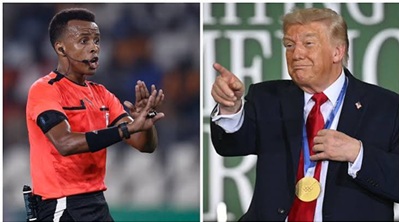
To chat of Omar Abdulkadir Artan is to write of a man who has spent his entire adult life running. Not from the chaos that birthed him, but toward a standard of truth so rigorous that it exists only in the white lines of a football pitch. Omar was born in Mogadishu in 1992, a year after the state of Somalia collapsed into a maw of clan warfare and famine. In the years that followed, there was no reliable law in his homeland, no referee for the brutal match of survival that played out on his streets. The only rules that mattered were the ones written by men with machine guns. And yet, young Omar looked at that shattered world and decided he would become the embodiment of order.
Omar began officiating in the ruins, learning the laws of the game in a country where the rule of laws had been suspended. By 2018, he had earned his FIFA badge, a piece of plastic that declared him an arbiter of fairness for the entire planet. He ran the lines at the Africa Cup of Nations, took control of the Confederation of African Football (CAF) Champions League final, and was named the Confederation of African Football’s best male referee in 2025. He was scheduled to become the first Somali ever to officiate at a World Cup, a historic appointment to the 2026 tournament co-hosted by the United States, Canada, and Mexico. That dream ended not on a pitch in Miami or Los Angeles, but in an interrogation room at Miami International Airport, where a sovereign power decided that a man who embodies the universal rule of law was, himself, inadmissible.
On the other side of this tragedy stands the man who built the walls that stopped Omar Abdulkadir Artan. Donald Trump’s relationship with race and religion is not a series of gaffes; it is a coherent, lifelong political architecture built on the exclusion of the other. Before he was a politician, he was a defendant in a federal housing discrimination suit, accused of refusing to rent apartments to Black applicants in Brooklyn, who were marked with a “C” for “colored”. Before he was a president, he was the public face of the Central Park Five, taking out full-page newspaper ads calling for the execution of five Black and Latino teenagers, a call he refused to retract even after their exoneration. His political ascent was powered by the engine of Latino immigrants and the birther lie, the vicious suggestion that the first Black president was a foreign usurper. This is not merely prejudice; it is a reflexive hatred of a changing America.
When Trump descended the golden escalator in 2015 to announce his candidacy, he did so by branding Mexican immigrants as rapists and criminals. When he sat in the Oval Office, he reportedly asked why the United States wanted more immigrants from “shithole countries” like Haiti and the nations of Africa. This language is not the slip of a tired mind; it is the deliberate, strategic weaponization of disgust. He has called for a ban on Muslims entering the country, mocked congresswomen in hijabs, and described Somali Americans as a plague destroying the state of Minnesota. In his worldview, identity is destiny, and the only good immigrant comes from a white, European nation like Norway. To be from Somalia—a nation ravaged by colonialism and civil war—is to be, in Trump’s lexicon, a contaminant.
This is the specific poison that ended Artan’s World Cup. The immigration authorities offered no official cause for his denial, but the context is a blinding light. Somalia sits on the latest iteration of Trump’s travel ban list. The policies that stopped the referee are the physical manifestation of the president’s long-stated belief that certain dark-skinned people are inherently suspect, a security risk not by their actions but by their origin. Artan was not a refugee seeking asylum; he was a world-class professional traveling with a diplomatic passport provided by his government and a valid visa vetted by the US system. He was considered “inadmissible” after a “vetting process,” a phrase that in the Trump era has become a euphemism for racial presumption. Imagine the Kafkaesque horror of it: a man whose entire career is built on the adjudication of rules, a man who is paid to enforce the laws of a game watched by billions, is told by a border guard that he is not allowed to enter because he fails an unspecified character test. It is the ultimate irony. Artan, the referee, was judged by a system that refuses to show its cards, found guilty without a charge, and deported. The man who spent his life bringing order to chaos was met by the chaos of American racism.
Compounding the cruelty of this specific incident is the growing evidence of Trump’s dwindling, aging mindset. To observe the Trump in the spring of 2026 is to watch a man unmoored from the rails of reality. At nearly eighty years old, he reportedly falls asleep in cabinet meetings and his public speaking has devolved into free-associative rants that lack even the twisted logic of his earlier years. Medical experts and political commentators, including former Labor Secretary Robert Reich, have pointed to these signs as evidence of a profound mental decline, a condition that makes his control over the nuclear codes a global terror.
Yet the aging of Trump is not merely a physical or cognitive decay; it is an emotional and temporal calcification. He is a man frozen in the 1960s, a time of unchecked American power and visible racial hierarchies. He longs for a past that never existed, a time when cities were “hellscapes” controlled by Black criminals and brown immigrants were silent laborers. He cannot process the reality of a Somali man who holds authority over Europeans. In Trump’s fossilized mind, authority flows only one way: from the white, English-speaking power center outward to the silent periphery. To see a Black man from Mogadishu holding a whistle and a red card, controlling the tempo of a game watched by millions, is to trigger a deep, existential panic.
Omar Abdulkadir Artan, by his very existence, is the antidote to that panic. Consider the profile of the man Trump stopped at the border. He is a meritocratic warrior. He rose through the ranks of the Somali Football Federation, officiating in a domestic league that operates despite the threat of terrorist bombings. He was chosen as one of only three center referees from the entire African continent for the U-20 World Cup, and the only one from Sub-Saharan Africa. When he received the CAF Men’s Referee of the Year award in 2025, he stood on a stage in Rabat, Morocco, as the representative of a new Africa, an Africa of professional excellence rather than desperate migration. His refereeing style is reportedly characterized by a quiet, implacable authority. He does not argue with players; he explains. He does not seek revenge; he applies the rule book. In the chaos of a derby match, when twenty-two players are screaming for a foul, Artan is the one human being on the pitch who has absolute emotional control. He is the one person who has taken a vow of neutrality. This is the exact opposite of Donald Trump, who has never been neutral about anything in his life, who views every interaction through the lens of greed, tribal loyalty and personal grievance.
The contrast between the two men is the story of the twenty-first century compressed into two biographies. Trump represents the force of entropy, the gravitational pull back toward a world of clan warfare. He is the tribal chieftain who demands that his followers hate the outsider, that they build walls, that they see the Somali refugee not as a potential doctor or referee, but as an invader. His policies are designed to subtract complexity from the world, to reduce it to a simple binary of “us” versus “them.” He cannot understand the role of the referee because the referee is the ultimate cosmopolitan figure: a person whose loyalty is not to a nation or a race, but to a text—the Laws of the Game. Artan’s loyalty is to the offside rule, to the fair challenge, to the principle that a foul in the first minute deserves the same punishment as a foul in the last. This is a radical, almost utopian form of governance. It suggests that human beings can create systems that transcend their own biases, that a Black Somali can judge a white European fairly, and that a white European can accept that judgment.
Yet the airport in Miami proved that the utopia is fragile. When Trump’s political will manifested as a travel ban, it overruled FIFA’s meritocracy. The American border guard, acting as the agent of a sovereign state with a racist head of state, had more power than the Confederation of African Football. This is the brutal lesson of 2026: the referee only has authority on the pitch. Once the game is over, once Artan steps off the plane and into the terminal, the laws of the nation-state reassert their bloody primacy. Trump, who sees the world as a collection of hostile tribes, engineered a system where a man’s passport matters more than his character. Artan, who sees the world as a field governed by rules, was crushed by the weight of that tribalism.
In his statement following the deportation, Artan displayed a grace that is almost incomprehensible given the circumstances. He said he was in “good spirits,” that he was “focused on the next challenges,” and that he wished his colleagues well at the World Cup. There was no rant, no conspiracy theory, no call for violence. He accepted the decision of the authority, even if it was wrong, and looked to the future. This is the deportment of a true referee who represents a culture and sprit of Somalism. The whistle-blower understands that sometimes the call is bad, sometimes the VAR fails, sometimes the goalkeeper punches you in the back. But you stand up, you dust yourself off, and you run toward the next play. Trump has never displayed this grace. When he loses, it is a conspiracy. When he is judged, the judge is corrupt. When he is told no, he burns the house down.
The 2026 World Cup will proceed without Omar Abdulkadir Artan. The matches in the United States will be officiated by other men, likely from Europe or South America, whose passports do not trigger the algorithmic suspicion of the US Customs and Border Protection. The loss is not merely Artan’s; it is the loss of the sport itself. Football pretends to be a global meritocracy, a beautiful game where a kid from the neighborhoods of Mogadishu can rise to the top. But the Artan affair reveals the lie: the pitch might be flat, but the world outside the stadium is full of walls. Trump, the dwindling king of resentment, has ensured that the merit badge of CAF Referee of the Year means nothing against the raw power of the presidential proclamation.
And yet, to end this essay on despair would be to concede the match to Trump. Artan is not defeated. He is only thirty-four years old. He has his FIFA badge, his health, and his reputation for integrity intact. He will return to the CAF Champions League, he will run the line at the next Africa Cup of Nations, and he will wait. He represents a patience that Trump, in his frantic, senile rage, cannot comprehend. Trump’s timeline is the blink of an eye; he wants the wall built yesterday, the ban enforced immediately, the past restored now. Artan’s timeline is the long arc of the game, the ninety minutes plus stoppage time, the season, the career. He knows that the rules eventually bend toward justice, that the red card comes for the persistent offender, that the team that relies on diving and time-wasting rarely wins the fair play award.
The collision between Trump’s racism and Artan’s dignity is not a story about politics; it is a story about the soul. One man driven by hatred and othering, and sees a threat to be expelled. The other looks at a stranger and sees a player to be managed, a human to be judged fairly under a common code. Trump’s aging mindset is a siege mentality, a closing of the gates as the world grows dark. Artan’s youthful fortitude is an open field, a running track that leads toward the horizon.
The president of the United States used the machinery of state to stop one Somali referee from running onto a pitch. But he cannot stop the idea of that referee. He cannot deport the principle of the whistle. In every refugee camp, in every bombed-out neighborhood in Mogadishu, a child is watching a grainy video of a World Cup. That child might not see Artan on the screen this year, but they will see a referee. They will see a person in control. They will see that the laws of the game apply to everyone. And that child will grow up, and they will run, and they will carry a whistle. And no travel ban, no angry tweet, no declining mental faculty in a distant White House will stop them. The referee will always return to the pitch. The game must go on.
Osman A. Hassan
Email: abayounis1968@gmail.com
———–
Osman is WardheerNews contributor who writes about East Africa and Horn of Africa affairs