
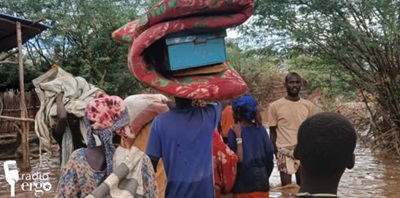
(ERGO)– More than 2,800 students in Qallaafe zone in Ethiopia’s Somali Region have been out of school since April after flooding from the Shabelle River forced families from their homes and destroyed schools, farms, businesses, and water sources.
The floods closed 18 free primary and secondary schools in Qallaafe and surrounding villages in Shabelle zone, leaving children facing an uncertain future.
Among those affected is Omar Sheikh Abdi Khayre, who fled from Shubo village to nearby Goobyaal area after floodwaters swept through his community.
Three of his children attending Shubo Primary and Intermediate School have not returned to class since the disaster struck in April. There is no school where they are currently living.
“The children are frustrated because their education has stopped,” Omar told Radio Ergo. “They have lost their routine and now spend their days like rural children with nothing to do.”
Omar, a father of 18 children from three households, said his family is surviving on maize and porridge distributed by the Somali Regional administration. He is uncertain how long the assistance will continue.
The floods destroyed their farmland, food stocks, a small grocery shop that provided additional income, and killed three goats and a donkey used for transport.
“I had two and a half hectares of farmland. Two hectares were planted with sesame and maize, while the remaining land produced beans and vegetables. The floodwaters took everything. I also lost food stocks and livestock. Twenty-one sacks of sesame, maize, and beans were swept away,” he said.
The 60-year-old farmer said the flooding struck at night after rising river water breached the barriers that residents had built in an attempt to protect their homes and farms.
Although he hopes to resume farming once the water recedes, he fears recovery could take months as river levels remain high. He is also worried that floodwaters could reach the area where his family is currently sheltering.
Many displaced families told Radio Ergo they are drinking contaminated floodwater because wells and other clean water sources have either been damaged or remain inaccessible.
Among them is Ibrahim Ali, who also fled Shubo and now lives in Goobyaal, about 10 kilometres from his former home. The father of 17 children said his family were sleeping under trees after escaping with little more than the clothes they were wearing.
“I am deeply worried. I used to live in a proper house, but today I live under a tree. My family is suffering. What we need most are mosquito nets, plastic sheets for shelter, food, and basic household items. We are struggling to survive and cannot cook three meals a day,” he said.
Ibrahim said seven of his children had been unable to continue their education since the floods displaced the family.
“The floods took our food, our belongings, and killed some of our livestock. We left behind everything our children used to eat and wear. A family that once had hopes and plans for the future has lost its livelihood, education, and home. It is deeply discouraging,” he said.
Most of the affected families are farmers living along the banks of the Shabelle River. Their homes, typically built from mud, grass, and corrugated iron sheets, were highly vulnerable to flooding.
The head of Qallaafe zone Disaster Risk Management Office, Mohamed Radi Nur, said the flooding that began on 15 April had affected more than 5,000 households and displaced around 1,600 families across 33 villages.
He said local authorities, working with humanitarian partners, had distributed maize and porridge to 500 displaced households while efforts continued to reach those still awaiting assistance.
“As a district administration, we have made extensive efforts to support affected communities. We distributed 250 quintals of maize to seven villages and recently received 1,068 sacks of porridge from the regional government. Additional relief support is expected in the coming days,” he said.
Mohamed noted that some villages remained cut off by floodwaters, forcing aid workers to use boats to reach isolated communities. A recent assessment by his office found that the floods destroyed 2,315 hectares of farmland, killed 348 livestock, damaged two health facilities, 18 schools, and five water wells.
Thousands of families in Qallaafe whose livelihoods have been disrupted are also very worried about the interruption of their children’s education, with uncertainty over when they can return to school.
Source: Ergo