
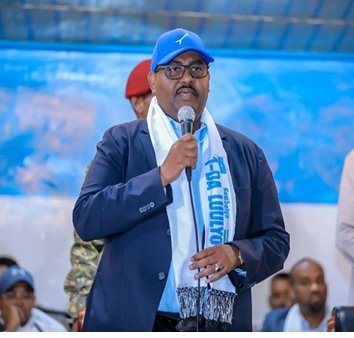
Garowe (WDN) – Puntland President Said Abdullahi Deni has sought today to calm growing public concern over the recent dispute surrounding Bosaso Port, insisting that his administration has not introduced any new taxes, but rather adjustments to port service fees charged to commercial shipping.
The president’s remarks come after weeks of controversy that saw businesses suspend operations, traders protest increased costs, and public frustration mount over the management of Puntland’s main commercial gateway. While many residents welcomed Deni’s detailed explanation, others questioned why it came only after the dispute had escalated into one of Puntland’s most serious economic standoffs in recent years.
Many observers argued that had the president addressed the public when the controversy first emerged, the crisis might not have reached its current level. They contend that the delay created a vacuum that allowed competing narratives to circulate widely, fueling tensions between the government, the business community, and the public.
Addressing residents, President Deni firmly rejected claims that the Puntland Government had imposed new taxes. “The Puntland Government has not introduced any new taxes,” Deni said. “Any tax increase follows a legal process. It must be incorporated into the national budget, debated, and approved by Parliament. While government revenues remain insufficient to meet the services our people require, taxation must always take into account prevailing economic conditions and the capacity of our business community.”
The president explained that the current dispute centers on port service charges, not taxation. According to Deni, Bosaso Port is operated by a private company that has invested heavily in modernizing the facility. He pointed to significant infrastructure improvements, including the expansion of docking capacity, dredging of the navigation channel to accommodate larger vessels, and ongoing plans for further modernization and expansion.
He revealed that throughout his seven years in office, the Puntland Government had repeatedly asked the port operator to postpone implementing contractual fee increases in order to ease financial pressure on local businesses.
“During the entire period that these projects were underway, we consistently requested that the company delay implementing the agreed fees because of the difficult economic circumstances facing Puntland,” he said. “For seven years, we prevented those contractual increases from taking effect in order to support business growth and reduce the burden on our traders.”
Deni stressed that the recently implemented increase concerns service fees paid by commercial vessels, the vast majority of which are foreign-owned, rather than taxes imposed directly on Somali importers. “What has been adjusted is not a tax,” he said. “It is a service fee charged to cargo vessels bringing goods into the country. Nearly all of these vessels are foreign-owned and, like ships operating in other regional ports, they are expected to pay reasonable port service charges.”
The president argued that Bosaso Port cannot continue charging rates significantly below those of neighboring ports while simultaneously financing major infrastructure upgrades designed to improve efficiency and expand trade.
He also confirmed that additional phases of Bosaso Port’s modernization project are planned, describing the expansion as essential to strengthening Puntland’s role as a regional commercial hub and supporting long-term economic growth.
Despite the president’s assurances, the dispute has highlighted the delicate balance between financing critical infrastructure and protecting businesses already struggling with rising operating costs and broader economic pressures.
Whether Deni’s intervention succeeds in easing tensions remains to be seen. However, many political observers believe the episode underscores the importance of timely government communication during periods of economic uncertainty, arguing that early engagement with both the business community and the public could have prevented misinformation from escalating into a wider political and commercial crisis.
WardheerNews