
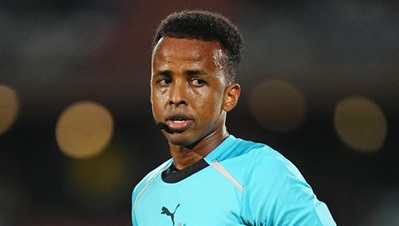
Salzburg, Austria (WDN) — Somali referee Omar Abdulkadir Artan has etched his name into European football history after taking charge of the 2026 UEFA Super Cup between Paris Saint-Germain and Aston Villa at Stadion Salzburg on Wednesday night.
The landmark appointment made Artan the first non-European referee to officiate the UEFA Super Cup, placing a Somali official at the center of one of European football’s most prestigious fixtures.
The match brought together Paris Saint-Germain, the 2025/26 UEFA Champions League winners, and Aston Villa, the 2025/26 UEFA Europa League champions. PSG ultimately prevailed 2–1 to retain the Super Cup title. For Somalia, however, the significance extended far beyond the final score.
A Historic Night for Somalia and Africa
Artan’s appointment marked an extraordinary breakthrough for African refereeing. UEFA selected the 34-year-old Somali official following consultations with the Confederation of African Football (CAF), highlighting the growing cooperation between the two continental governing bodies.
Artan was joined by two African assistant referees: Liban Abdoulrazack Ahmed of Djibouti and Stephen Eleazar Onyango Yiembe of Kenya. Slovenian referee Rade Obrenovič served as fourth official, while Italy’s Marco Di Bello was the Video Assistant Referee (VAR), with Spain’s Guillermo Cuadra Fernández serving as assistant VAR.
The all-African core of the on-field officiating team represented a striking demonstration of how football can transcend geographical boundaries and create opportunities beyond the traditional centers of the sport.
From FIFA Setback to European Glory
The significance of Artan’s achievement was magnified by what happened only weeks earlier.
The Somali referee had been selected for the 2026 FIFA World Cup but was unable to participate after being denied entry to the United States while traveling for the tournament.
Reports surrounding the incident cited U.S. authorities’ concerns arising from background screening, including alleged associations with suspected members of terrorist organizations. Those allegations were not independently established, and Artan was ultimately unable to take part in the World Cup.
Instead of ending his World Cup dream, however, the setback was followed by one of the most remarkable appointments of his career.
UEFA announced in June that Artan would referee the Super Cup, explicitly describing him as one of Africa’s leading referees. UEFA President Aleksander Čeferin said football brings people together and emphasized UEFA’s respect for Artan and his refereeing achievements.
The appointment transformed a major disappointment into an extraordinary professional opportunity. Artan has been on the FIFA international refereeing list since 2018 and has steadily established himself among Africa’s most prominent officials.
His career reached another major milestone in 2025 when he was named CAF Men’s Referee of the Year, recognition that confirmed his status among the continent’s elite referees. UEFA also noted his experience officiating major CAF competitions, including the 2025/26 CAF Champions League final.
His selection for the UEFA Super Cup therefore represents not simply a symbolic gesture but recognition of a referee whose career has reached the highest levels of international football.
A Moment of Pride for Somalia
Artan’s achievement carries particular significance for Somalia, a country whose name is rarely associated with the biggest stages of European football.
For decades, Somalia’s international sporting profile has been overshadowed by political instability, conflict and limited sporting infrastructure. Artan’s rise offers a dramatically different image: a Somali professional trusted to control a match involving two of Europe’s most prominent clubs.
His performance in Salzburg was closely followed by Somali supporters at home and across the diaspora. The symbolism was impossible to miss. A Somali referee stood at the center of a European final, surrounded by some of the world’s most famous players and watched by millions of football fans.
The match itself produced an entertaining contest. PSG took the lead through Khvicha Kvaratskhelia, before Aston Villa equalized through 17-year-old Brian Madjo, who became the youngest scorer in UEFA Super Cup history. PSG eventually regained the lead through Désiré Doué, whose goal was confirmed following a VAR review.
PSG’s 2–1 victory made the French champions back-to-back UEFA Super Cup winners, joining an exclusive group of clubs to achieve consecutive victories in the competition.
Yet for many Somali viewers, the most memorable figure of the night was not wearing either club’s shirt. He was wearing the referee’s uniform.
Beyond One Match
Artan’s achievement represents more than an individual career milestone. It demonstrates the possibilities that can emerge when African sporting institutions and European football authorities cooperate to create pathways for talent from outside the traditional football power centers.
His appointment was made possible through the growing cooperation between UEFA and CAF, and it could help establish a precedent for greater African representation in major European competitions.
For young Somali athletes and officials, the message is equally powerful: the highest levels of international sport are not necessarily beyond reach.
Artan’s journey—from FIFA World Cup selection, through a deeply controversial setback, to the center of the UEFA Super Cup—has become an extraordinary story of resilience.
On Wednesday night in Salzburg, Omar Abdulkadir Artan did not merely officiate a football match. He made history. And in doing so, he gave Somalia a rare and powerful moment of sporting pride on one of the world’s biggest stages.
WardheerNews