
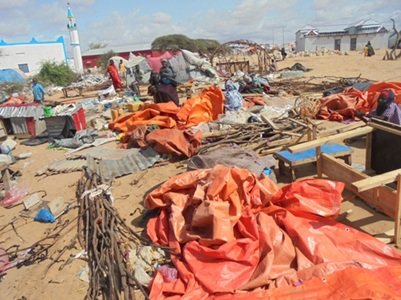
Mogadishu (WDN) — Somalia’s Union of Councils of Scholars has spoken out over the growing number of complaints surrounding land seizures, home demolitions and disputed property ownership in Mogadishu. But for many residents, the statement raises a more troubling question: Are the clerics genuinely challenging the authorities responsible for the crisis, or are they providing political cover for the government?
The scholars have called for disputes to be taken to the courts, for ownership documents to be verified and for citizens to avoid taking the law into their own hands. On paper, those are reasonable principles. On the ground, however, many Mogadishu residents argue that they bear little resemblance to the reality they face.
Critics say Somalia’s judicial institutions remain too weak and dysfunctional to provide meaningful protection in many property disputes. They question where an ordinary citizen is supposed to turn when a bulldozer arrives before dawn, accompanied by heavily armed security forces, to demolish a home before the owner has had a meaningful opportunity to challenge the decision.
For residents facing such circumstances, simply being told to “go to court” can sound less like justice and more like an instruction to surrender.
A Crisis Far Bigger Than a Legal Dispute
Land in Mogadishu is not merely a commercial commodity. For thousands of families, it represents their home, livelihood, security and accumulated wealth.
Critics of President Hassan Sheikh Mohamud’s government accuse state authorities and politically connected interests of using government power to facilitate the seizure, transfer or redevelopment of valuable land. These allegations require no independent investigation and documentary verification, but the scale and persistence of public complaints have made the issue impossible to dismiss as isolated disputes.
Some opposition voices and civil-society actors have also linked government land policies to large-scale displacement in the capital, with claims that more than 760,000 residents have been displaced or otherwise affected by land-related demolitions and dispossession. That figure should be independently verified, but the broader phenomenon of displacement is visible enough to have become a major source of public anger.
For families who lose their homes, the question is not whether a title document can eventually be examined by a court. The immediate question is who will protect them when the demolition machinery arrives?
The scholars’ appeal for calm and legal proceedings would carry greater weight if Somalia had a judiciary capable of consistently providing swift, independent, and credible remedies. Instead, critics argue that the statement risks appearing detached from the realities experienced by ordinary citizens.
The public is asking a much harder question: Where is the moral authority of the scholars when citizens allegedly lose their homes through the use of state power?
Rather than simply advising victims to preserve documents and seek judicial remedies, critics expected the clerics to demand an immediate moratorium on disputed demolitions, independent investigations into land transfers, public disclosure of government land records, and accountability for officials who abuse their authority.
They expected the religious leadership to stand visibly beside vulnerable citizens—not merely issue statements urging them to remain patient. The criticism goes further. Some sections of the public increasingly view the clerics as another institution unwilling to confront President Hassan Sheikh’s administration directly.
Their critics argue that the scholars’ carefully worded appeals ultimately place the burden on victims while avoiding direct accountability for those accused of using government authority to dispossess them.
That perception has led some residents to describe the scholars as functioning less as an independent moral voice and more as an extension of the government’s political messaging—an image critics have also applied to senior government officials, including Defence Minister Ahmed Macallin Fiqi.
Whether that perception is fair or not, it is politically damaging. Religious scholars who are expected to speak for justice risk losing public credibility if citizens believe they are protecting those in power rather than challenging abuses of power.
Citizens Need Protection, Not Just Advice
There is an important distinction between calling on citizens to “take the law into their own hands” and calling on them to peacefully organize, document abuses, demand accountability, and defend their constitutional rights.
No responsible institution should encourage citizens to confront armed forces violently. But neither should citizens be expected to remain silent when they believe their constitutional rights are being violated.
The scholars could have urged affected communities to organize peacefully, establish documentation committees, seek independent legal assistance, petition parliament and local authorities, demand public hearings, engage civil society and journalists, and insist that disputed demolitions be suspended until ownership is independently determined. That would be a meaningful defense of the rule of law. The land crisis presents a test not only for President Hassan Sheikh’s government, but also for Somalia’s religious, judicial, and political institutions.
If the government believes its land policies are lawful, it should publish the relevant records, explain the legal basis for disputed acquisitions, identify the beneficiaries of transferred land, and allow independent scrutiny.
If the judiciary is functioning effectively, it should demonstrate that citizens can obtain urgent protection before their homes are destroyed—not after the bulldozers have left.
And if the clerics truly intend to defend justice, they must do more than tell victims to seek remedies that may not exist in practice. The people of Mogadishu do not need lectures about the rule of law. They need the rule of law to work.
They need protection before the bulldozer arrives, accountability after abuses occur, and institutions strong enough to ensure that political power cannot determine who keeps a home and who loses one.
Until that happens, every statement about land disputes will be judged against the reality on the streets of Mogadishu—and against the growing perception that those who should speak for the victims are instead speaking around the government.
WardheerNews
Leave a Reply