
Nick Ferris reports, Independent
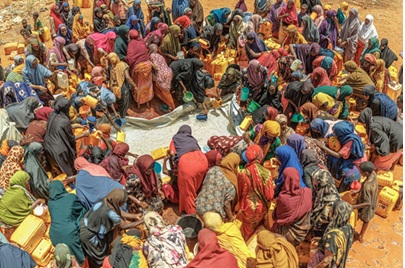
The start of 2026 has not been easy for the residents of Madina Camp, on the outskirts of the city of Baidoa, in Somalia’s South West State.
According to Adan Adan Abdi, a sub-camp leader of around 50 people, there is an “urgent need” for both food and water, with thousands having migrated from rural areas to camps such as his amid a catastrophic drought that has devastated Somalia.
“The situation across these camps is the same: The hardship is severe, and people are extremely hungry and thirsty” he says. Families have been going day to day without food to cook, he adds, while the only work available at the moment is to head deep into the bush to collect firewood to sell at the market.
Pointing to a water truck that has just delivered water from the Juba Foundation, a local NGO, he adds: “The water we received today is the only assistance we have seen. As you can see now, people are fighting to get water from the water trucks.”
Abdi’s story – collected exclusively for The Independent via the NGO Mercy Corps – is one of many that have emerged from a climate-driven humanitarian disaster that has swept across Somalia this year, after the country was hit by two consecutive failed rainy seasons.
An estimated 6.5 million people in the country are now facing “crisis” levels of hunger or worse, which is an increase of 1.7 million people since January. While Somalia has always been water-scarce, the current pattern of droughts hitting every two or three years is not like anything that has been experienced before.
“Drought has become a persistent pattern in Somalia over the past 30 years, eroding the resilience of communities and institutions,” explains Abdiaki Ainte, the director of climate and food security in the Somali Prime Minister’s Office. “In the past, drought was concentrated in certain regions. Today, it is spreading across much larger parts of the country, including areas that were not traditionally drought-prone.”
For 22-year-old Nurta Sidow Qasim, crisis-level hunger has resulted in the loss of her infant twins, a daughter called Khadija. After falling sick with malnutrition, Khadija was admitted to hospital, but treatment would prove insufficient: “The staff gave me tablets, syrup and rehydration salts,” Nurta says. “But before I could start the treatment, she passed away.”
Now Nurta fears for the life of her surviving twin, Mohamed, who remains weak, and who she has been feeding black tea and sometimes powdered milk as a result of food shortages. “The children are in very difficult conditions,” she says. “We are in urgent need of assistance. We need everything.”
Funding cuts from international aid partners, which meant that just 29 per cent of humanitarian funding requirements were met last year, have also contributed to the current crisis.
Aid from the UK is set to be cut further in the coming months after the government failed to name Somalia in its list of countries whose aid will be “protected” during its programme of cuts. The US has also been slashing funding for Somalia, with just $3 million (£2.3m) provided in humanitarian aid during the first three months of 2026, compared to $462m over the same period in 2025.
“Aid cuts are deeply concerning at a time when vulnerability remains high,” Ali Mohamed Omar, Somalia’s State Minister for Foreign Affairs, tells The Independent. “The Somali government is strengthening national disaster response systems and expanding social protection. But the scale of climate shocks means continued international partnership remains essential.”
Middle East War turbocharging problems
Famine is thankfully set to be avoided for the time being in Somalia, government sources have confirmed, as a result of a healthy late Spring rains that have been forecast as well as the effective coordination of government authorities, NGOs and communities to prioritise the needs of those most in need.
But experts are now issuing dire warnings that the challenges that Somalia faces around receiving the foreign aid that so many millions depend on are set to be turbocharged by wars ongoing in Lebanon and Iran.
Some of these impacts are practical, with the World Food Programme telling The Independent that supply chain delays stemming from the closure of the Strait of Hormuz as well as the closure of Oman’s Salalah Port have already significantly disrupted aid flows to Somalia, which is a country that depends on imports for 70 per cent of its food supply.
Although the Strait and the port have now reopened, experts are warning that it will take many months for regional trade, and prices, to recover.
Fuel costs in Somalia more than doubled within days of the war starting, while some staple cereals now cost up to 40 per cent more than they did last year. There have also been major delays to the delivery of key nutritional, medical, and sanitation consignments, and there are big concerns around Somalia’s 30 per cent dependence on fertiliser imports from the Gulf.
“Conflicts like this don’t stay contained,” Mercy Corps CEO Tjada D’Oyen McKenna has warned. “When fuel and fertiliser markets are disrupted, the ripple effects move quickly through food systems — and the people who feel it first are families in fragile countries who were already struggling to put food on the table.”
In Baidoa, where Nurta and Adan are, the price of rice has risen from $0.75/kg to $1/kg, according to data tracked by Mercy Corps.
Read more: Millions facing hunger and water crisis in Somalia as world focuses on war in Middle East
Source: Independent