
Mogadishu (WDN) — The federal government has launched a new military operation between Jowhar and Balcad, one that closely mirrors the earlier Baydhaba campaign, raising as many political questions as security expectations.
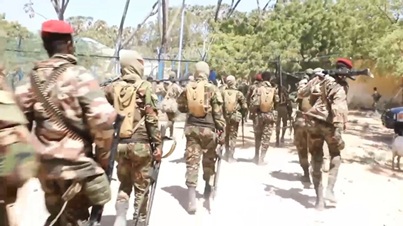
At the center of the operation are the Gorgor Commandos, the same elite forces that previously led operations in Baidhabo, that illegitimately replaced the President of South West State. Their redeployment has fueled skepticism among political observers, who see a familiar pattern: military action unfolding alongside unresolved political tensions. The Gorgor battalions are seen as President Hassan’s army not national army.
Officials frame the current operation as a security effort aimed at reopening the Balcad–Jowhar road—a vital corridor that has remained under significant Al-Shabaab influence for years. Yet, given the precedent of Baydhaba, where military pressure coincided with political upheaval, some question whether this is purely about security or something more.
The geography alone highlights the contradiction. Balcad sits just 30 kilometers from Mogadishu, while Jowhar lies only about 60 kilometers further north. Despite this proximity to the capital, large portions of the road remain effectively controlled by Al-Shabaab. The group is reported to collect taxes along the route and even decide which trucks are permitted to proceed to Jowhar, the administrative capital of Hirshabelle State.
Gorgor units, supported by mine-resistant armored vehicles capable of transporting roughly 20 soldiers, have already been deployed to Balcad. These forces are trained, equipped, and funded by Turkey—a partnership that, while once broadly welcomed, is increasingly viewed through a more critical lens by segments of the Somali public who question Ankara’s perceived political alignment with the current administration.
Reports suggest that many of the troops spearheading this operation are the same units redeployed from Baydhaba. Their stated mission is to secure the Balcad–Jowhar corridor, a road so insecure that government officials have routinely resorted to air travel.
At the same time, additional Gorgor forces have been airlifted into Jowhar itself, establishing positions within the city in what officials describe as an effort to stabilize the area and reassert federal control.
As in previous operations, the campaign is expected to be supported by drone surveillance and strikes, reportedly supplied by Turkey, targeting Al-Shabaab positions between Balcad and Jowhar—areas widely considered among the most dangerous in the region.
Yet the broader context continues to raise doubts. Despite persistent security failures, the federal leadership is pushing ahead with plans for a one-person, one-vote (OPO) electoral model in Hirshabelle State—a proposal many analysts regard as unrealistic under current conditions. Critics argue that the political objective may be less about electoral reform and more about reshaping regional leadership, particularly the position of President Ali Gudlaawe.
In that light, the operation risks being interpreted not just as a campaign against Al-Shabaab, but as part of a wider political strategy—one where security operations and political outcomes are increasingly difficult to separate.
WardheerNews