

Mogadishu (WDN)- The visit of Israeli Foreign Minister Gideon Saar to Hargeisa on January 6, 2026, has intensified scrutiny of Somalia’s deteriorating foreign policy and intelligence failure. The trip comes days after Israel formally recognized Somaliland’s independence on December 26, a move rejected by more than 20 countries and international organizations, including the European Union, the Arab League, the Organization of Islamic Cooperation, and numerous African and Middle Eastern states.
Mr. Saar’s appearance in Hargeisa stands as a stark indictment of the Federal Government of Somalia’s inability to safeguard its territorial integrity through effective governance and diplomacy. The development also exposes the weakness and incoherence of Mogadishu’s foreign and intergovernmental engagement under President Hassan Sheikh Mohamud, whose administration has failed to mobilize a meaningful internal, regional or international response to the recognition.
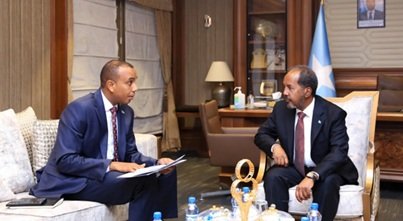
Domestically, President Hassan continues to resist inclusive political dialogue at a moment of deepening national crisis. He has so far declined to engage meaningfully with the Future Forum, an umbrella initiative bringing together Puntland, Jubaland, and opposition leaders aimed at breaking the political deadlock and preventing further fragmentation of the country.
Concerns over unilateralism and constitutional overreach were underscored by Abbas Ahmed, a former senior advisor to President Hassan on federal affairs (2022–2024), in an open letter to President Hassan published by WardheerNews. Mr. Abbas called for the immediate nullification of what he described as unconstitutional amendments introduced by the president, arguing that any political or electoral process that contradicts the 2012 Provisional Federal Constitution must be suspended.
He further urged the president to heed the Future Forum’s call to convene all national political stakeholders before January 20, 2026, prioritize the Somaliland–Israel recognition issue, and publicly commit to not seeking a third term. Without these corrective steps, he warned, Somalia risks accelerating toward deeper political fragmentation and constitutional collapse.
Sources speaking to WardheerNews report that amid the mounting political crisis, President Hassan remains determined to push forward a unilateral One Person, One Vote electoral process—widely viewed by as constitutionally questionable and politically engineered to secure his return to office for a third term. Opponents caution that such a move could inflame federal tensions and further erode trust between Mogadishu and the federal member states.
As tensions escalate over the fast-approaching federal elections and the implications of Somaliland’s recognition by Israel, Prime Minister Hamse Abdi Barre, whose authority has been reduced largely to ceremonial functions, is reportedly planning a personal trip to Saudi Arabia to perform Umrah. Citizens interviewed by WardheerNews described the timing as emblematic of a leadership disconnected from the gravity of the moment, warning that Somalia is being steered toward institutional breakdown and political instability.
Somalia now stands at the brink of a constitutional and political crisis. Observers note that a narrow window remains to reverse course—if President Hassan heeds calls for dialogue, demonstrates political restraint, and engages with stakeholders in good faith to preserve national cohesion and stability.
WardheerNews