
By Abdijaliil Osman
Axmed Shire Xuseen survived the frontline against al-Shabaab. He did not survive the road home. His last plea is a question every Somali now has to answer.
A video has been moving across Somali phones this week. I watched it once. It’s very panful to watch. I will not link to it here, and I would ask you not to forward it. Axmed Shire deserves to be remembered for how he lived, not circulated for how he died.
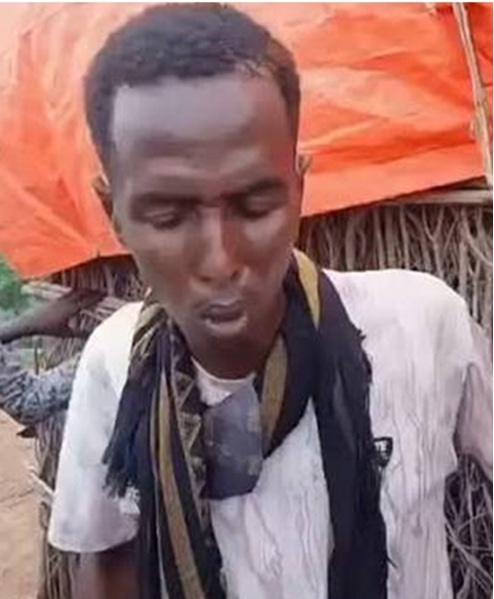
In it, a young man held by armed men speaks slowly, the way people speak when their body is already failing them. He says he is sick. He is hungry, he tells them, and on his way to his family. Then come the words that have not left me since:
“Abtiyaalow, ha i dilina.”
Uncles, please do not kill me.
Abti is the word for a mother’s brother. We also use it for older men we hope will treat us as their own. It is a word of kinship and trust. Axmed chose it in what may have been the final minutes of his life because he believed it still carried weight among Somalis.
They killed him anyway.
The road home from Buurane
According to reports from Somalia media, Axmed Shire Xuseen was a soldier of the Somali National Army who had been serving at the front in Buurane, Middle Shabelle. He had reportedly been ill for some time. He took leave and set out for Buulobarde in Hiiraan to be with his family while he recovered.
Near Ceelbaraf, an armed militia stopped him on the road together with two fellow soldiers who were also on leave. The other two were eventually released. Axmed was held, filmed while pleading for his life, and killed. When his body reached Buulobarde, relatives said it showed signs of severe torture. Nabadoon Xuseen Jurus, a traditional elder from Hiiraan, told Caasimada that his eyes had been gouged out.
Local reports describe the killing as aano qabiil, clan revenge. If that account holds, then what separated the two soldiers who went home from the one who did not was not rank, conduct or courage. It was ancestry.
He had accepted death. Not this one
Anyone who puts on the uniform of the Somali National Army accepts a hard bargain: they may be asked to die for Somalia. In Middle Shabelle that bargain is tested constantly, by an enemy that relies on ambushes, roadside bombs and suicide attacks. Axmed kept his side of it. He went to the front, and he came back alive.
What he never agreed to was dying at the side of a road at the hands of men who share his faith, his language and his flag. There is a special cruelty in surviving the enemy only to be executed by your own. A soldier killed by al-Shabaab is mourned as a martyr of the nation. When fellow Somalis kill a soldier because of his lineage, he becomes something harder to name.
He becomes evidence.
Every law we claim told them to let him go
Somalis often say we live under three systems of law: the law of the state, the law of Islam and the xeer of our ancestors. On that road near Ceelbaraf, all three failed together.
The Qur’an (al-Ma’idah, 5:32) teaches that whoever takes an innocent life has, in effect, killed all of humanity, and whoever saves one life has saved all of humanity.
A hadith recorded by al-Tirmidhi and al-Nasa’i goes further still: the end of the entire world would weigh less before God than the unjust killing of a single believer. People like to say one life is worth a million. Our own faith sets the price far higher.
The xeer is no less clear. Somali customary law recognises biri-ma-geydo, “those spared from the spear”: people who must not be harmed even in open clan warfare, including women, children, the elderly and others who carry no weapon and pose no threat. The ICRC and the Somali Red Crescent documented these rules in Spared from the Spear in the late 1990s, and in 2011 Somalia’s own government described biri-ma-geydo to the UN Human Rights Council as the nation’s indigenous Geneva Conventions. Axmed was sick, unarmed and travelling in peace. He asked for mercy in the language of family. By the standard of the very tradition his killers claim to defend, he was untouchable.
The state’s law needs little explanation. Murder is murder. Killing a serving soldier is also an attack on the republic he swore to defend. That is what should shock us. Brutality is not the whole horror. The deeper horror is that every protection Somali society has ever built, divine, customary and constitutional, gave way at the same moment on a single stretch of road.
Read more: He Called Them “Uncles.” They Killed Him Anyway
Abdijaliil Osman
Email: abdijalilosman@gmail.com
————–
Abdijaliil Osman is a London-based journalist and the founder, CEO and host of The Abdijaliil Show, one of the most-watched Somali platforms, with more than 700,000 YouTube subscribers. A former producer for BBC Focus on Africa, he writes on Somali governance, African geopolitics and the digital economy.