
By Abdullahi A. Nor
President Hassan Sheikh Mohamud says Somalia is finally preparing to move beyond clan-based recruitment and replace political connections with merit, competence and qualifications. It is a message that would be difficult to oppose—if it were coming from a government with a convincing record of practicing what it preaches.
Instead, the president’s latest remarks raise an uncomfortable question: How can a government accused by its citizens and political opponents of institutionalizing nepotism, patronage and the misuse of public resources now present itself as the solution to the very problems it has helped deepen?
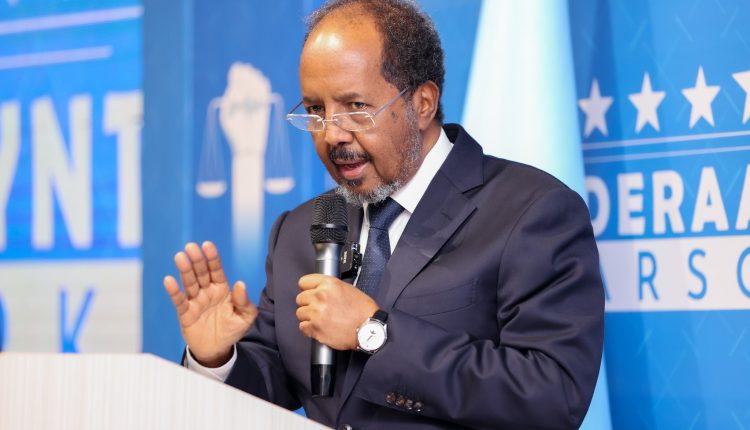
Speaking at the launch of the “Abuur” program at Somali National University in Mogadishu, Hassan Sheikh said government employment should be based on education, ability and performance rather than family connections.
“A person seeking a government job should get it through knowledge and ability, not through who your relatives are or whom you know,” the president said.
He promised that Somalia would move from the culture of “who do you know?” to “what do you know?” It is an admirable principle. But principles mean little when political practice tells a different story.
The President’s Contradiction
Hassan Sheikh speaks as though nepotism is a problem that his administration has discovered rather than the one his government is reinforcing. Many including his opponents have repeatedly accused the administration of filling government positions through political loyalty, family connections and patronage rather than transparent competition.
Similar allegations have been made about appointments within the security sector, where critics argue that political and personal loyalties have taken precedence over professional qualifications and institutional standards.
These are serious allegations and should be investigated through credible, independent mechanisms. But the president cannot expect the public to listen to lectures about meritocracy without asking a simple question: What happened to meritocracy during his own years in power?
If the government genuinely wants to replace who you know with what you know, it should begin by opening its own appointment books to public scrutiny.
Who was appointed? Why was that person selected? What qualifications did the person possess? Were other candidates considered? Was there a competitive process? And, perhaps most importantly, would the same person have received the position if he or she had no political, family or personal connection to those in power?
The Land Question Cannot Be Ignored
The contradiction becomes even more striking when considered alongside the controversy surrounding land and public property in Mogadishu. Hassan Sheikh’s administration has faced persistent political criticism and allegations concerning land allocations, demolitions, displacement and the transfer or redevelopment of valuable public property.
Those allegations should not be treated as proven without documentary evidence and independent investigation. But neither should they simply disappear because the president has begun speaking about corruption and merit-based government employment.
A government cannot credibly demand public confidence in its anti-corruption message while questions about public land and the use of state authority remain unresolved.
If the government believes its land policies are lawful, transparency should be the answer: a) Publish the records, b) identify the legal basis for disputed allocations, c) explain who received the properties, d) disclose the decision-making process, e) allow independent institutions to investigate and f) Let the public see the evidence.
That is how a government demonstrates that accusations are politically motivated rather than simply declaring them to be so.
A Government Cannot Fight Nepotism with Nepotism
The deeper problem is institutional. Nepotism is not simply about giving a job to a relative. It is about creating a political culture in which access to public employment, contracts, land and economic opportunity depends on proximity to power.
Once that culture becomes entrenched, government institutions cease to function primarily as public institutions. They become networks of political loyalty. The danger is particularly severe in Somalia because government employment is one of the country’s most important sources of economic opportunity for educated young people.
A graduate who spends years studying only to discover that government positions are effectively reserved for people with the right connections will quickly lose faith in the state. That is not merely unfair. It is corrosive to nation-building.
What Would Real Reform Look Like?
If President Hassan Sheikh is serious about his latest promise, the solution is straightforward: a) Create genuinely competitive recruitment systems, b) publish vacancies publicly, c) establish independent selection panels, d) publish qualification requirements, e) conduct standardized examinations, f) publish results where appropriate, g) introduce transparent appeals mechanisms.
h) audit government appointments and i) apply the same standards to presidential advisers, ministers, security officials and senior civil servants.
Most importantly, the system must apply to everyone—including the president’s political allies and relatives. That is the difference between a speech about reform and actual institutional reform.
The President Should Start with His Own Government
There is nothing wrong with Hassan Sheikh telling Somali graduates that merit should matter. In fact, Somalia desperately needs precisely that principle. But the president should recognize that credibility is earned through conduct, not speeches.
If his administration has genuinely moved toward merit-based recruitment, it should be able to demonstrate that transformation with evidence. If government jobs are now being awarded through competitive examinations, publish the procedures.
If nepotism has been eliminated, publish appointment data. If corruption is being fought, publish investigations and prosecutions. If public land is being administered lawfully, open the records.
And if the government believes its critics are spreading false allegations, give independent institutions the information necessary to establish the truth.
Somalia Deserves Better Than Political Lectures
Somalis have heard promises of reform from successive governments. What the country needs now is not another declaration that “who you know” should become “what you know.” It needs institutions that make the first impossible and the second unavoidable.
President Hassan Sheikh is right about one thing: Somalia cannot build a modern state on clan connections, political patronage and personal loyalty. But that principle applies first to the government making the promise.
The president cannot simultaneously demand an end to nepotism while failing to convincingly address allegations that his own administration has benefited from patronage and political favoritism.
He cannot credibly condemn corruption while unresolved questions remain about the use of public resources and land. And he cannot ask young Somalis to trust a merit-based state unless his government is prepared to demonstrate that merit—not proximity to power—is actually what determines opportunity.
The president’s words are easy to applaud. His record is what must now be examined. If Hassan Sheikh truly wants to move Somalia from “who do you know?” to “what do you know?”, he should begin with his own administration.
Publish the appointments. Open the records. Audit the land. Investigate the allegations. Let the evidence speak. That would be a far more convincing anti-corruption campaign than another presidential speech.
Abdullahi A. Nor
Email: abdulahinor231@gmail.com