
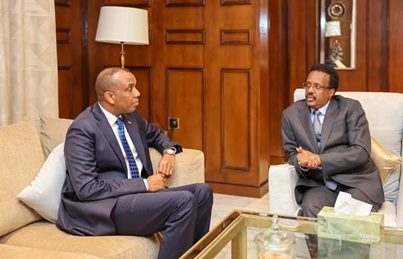
Mogadishu (WDN) — Somalia’s political landscape may be entering a new phase of negotiations after Prime Minister Hamza Abdi Barre paid a late-night visit to former President Mohamed Abdullahi Farmaajo at his residence in Mogadishu, with the two reportedly discussing the country’s deepening political crisis and the search for an electoral agreement.
The meeting comes at a particularly sensitive moment, as the Federal Government and opposition groups prepare for another round of discussions aimed at resolving long-running disagreements over Somalia’s next elections.
According to sources familiar with the meeting, the Prime Minister and the former president discussed the country’s political situation, with electoral arrangements reportedly featuring prominently in their conversation.
The meeting also comes ahead of an expected gathering during this month, August, between senior government officials and opposition leaders, where the competing sides are expected to revisit the framework for the next national election.
A Possible Opening for Compromise
For months, repeated attempts to bring the government and opposition together have produced little progress. Previous negotiations frequently stalled over disagreements about the electoral model, with the Federal Government insisting on a one-person, one-vote system while opposition groups questioned whether the necessary political, administrative and security conditions existed to implement it.
The political landscape may now be shifting. Sources say a significant portion of the opposition has moved closer to accepting the principle of direct elections, but has demanded that the process be administered by a joint or broadly representative electoral commission capable of winning the confidence of all major political stakeholders.
That demand could provide the basis for a compromise. There is growing speculation that the government and opposition may soon agree on the establishment of a mixed electoral body tasked with negotiating and implementing the practical arrangements required for the next election.
If such an agreement is reached, it could represent one of the most important breakthroughs in Somalia’s prolonged political standoff.
The Road to a Hassan Sheikh–Opposition Meeting
Political sources told WardheerNews, that there is a growing optimism that an agreement on the election model and electoral commission that could pave the way for a direct meeting between President Hassan Sheikh Mohamud and senior opposition leaders. Such a meeting would carry considerable political significance after months of confrontation and failed negotiations.
The opposition delegation is expected to include former President Sharif Sheikh Ahmed, Puntland President Said Abdullahi Deni, and Jubaland President Ahmed Mohamed Islam (Ahmed Madobe) under the umbrella of the Samato Bixinta Council. Farmaajo, meanwhile, is expected to represent his Nabad iyo Nolol political organization.
The participation of Farmaajo adds another important dimension to the political calculations. As a former president and one of Hassan Sheikh’s principal political rivals, his involvement could help broaden the opposition’s negotiating position while also providing an additional channel for dialogue with the Federal Government.
A Narrowing Political Divide
The developments suggest that the political divide may no longer center exclusively on whether Somalia should hold direct elections. Instead, the emerging debate appears increasingly focused on how those elections should be organized, who should oversee them, and what guarantees are required to ensure that the process is accepted by both government and opposition forces.
That shift could prove crucial. For months, the two sides appeared trapped in fundamentally opposing positions. The government’s insistence on one-person, one-vote was viewed by much of the opposition as insufficient without agreement on the institutions and rules governing the process.
If the opposition is now prepared to accept direct elections in principle while the government is willing to consider a more inclusive electoral commission, the distance between the two camps may have narrowed considerably.
Prime Minister Hamza’s decision to meet Farmaajo privately is also significant because Somalia’s political disputes have increasingly become intertwined with personal rivalries among the country’s former and current leaders.
Farmaajo remains an influential political figure with a substantial constituency, particularly among those critical of the current administration.
His participation in any future political settlement could therefore be important not only for the electoral process but also for building broader political legitimacy around whatever agreement eventually emerges.
The challenge will be transforming private consultations into a national political agreement that extends beyond the interests of individual leaders.
A Fragile Opportunity
Despite the renewed optimism, significant obstacles remain. Previous attempts at dialogue have repeatedly collapsed after initial signs of progress. Questions surrounding the composition of the electoral commission, constitutional authority, the electoral timetable, federal-state relations and the distribution of political power could all return to the negotiating table.
The credibility of any future agreement will ultimately depend on whether the major political actors believe that the electoral process is genuinely impartial. For Somalia, the stakes are enormous.
A negotiated electoral framework could reduce political tensions, strengthen confidence in state institutions and prevent the country from entering another prolonged constitutional crisis.
But failure could once again deepen the confrontation between Villa Somalia and its opponents, with potentially serious consequences for the country’s already fragile political and security environment.
For now, however, the meeting between Hamza and Farmaajo offers a small but potentially significant signal that Somalia’s political leaders may be searching for a way out of the impasse.
The next test will be whether that private conversation can help produce something Somalia has struggled to achieve for years: an electoral agreement broad enough for both government and opposition to accept—and a political transition whose legitimacy is not disputed before the first ballot is cast.
WardheerNews