
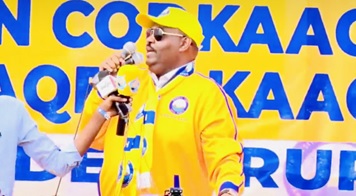
Garowe (WDN) — Puntland President Said Abdullahi Deni has delivered an unusually clear message on presidential tenure, declaring that he will not seek a third term and insisting that the next Puntland president must be chosen through a free and timely election.
Speaking in Galkayo on Thursday evening, Deni said the Puntland Constitution had allowed him to serve two terms, both of which he had won through elections, and that he would respect the constitutional limit.
“The Constitution allowed me to lead Puntland twice, and I was elected both times. I still have two years remaining. Whoever wants the presidency should come forward and compete in a free election held on time. Our party will have a candidate, and we will build that candidate,” Deni said.
The declaration effectively removes one of the most persistent questions surrounding Puntland’s political future: whether the incumbent president might seek to extend his tenure beyond the constitutionally permitted two terms.
Deni’s statement is significant because speculation had intensified in recent months over the possibility of reopening or amending Puntland’s constitutional framework to allow him to seek another term.
Opposition groups had expressed concern that any attempt to alter the constitutional rules governing presidential tenure could pave the way for a third-term bid. By publicly ruling out such a possibility, Deni has sought to close that chapter of the political debate—at least for now.
His message was particularly direct: those seeking the presidency should prepare to compete rather than seek changes to the rules governing the contest. That position places constitutional limits and the electoral timetable at the center of Puntland’s political succession. Deni’s declaration also carries significance beyond Puntland.
Somalia has entered a period of intense political debate over presidential mandates, constitutional authority and the rules governing the country’s next elections. Against that backdrop, an incumbent regional leader voluntarily declaring that he will not seek a third term presents a markedly different political message.
The contrast is especially striking because Puntland has historically portrayed itself as an institutionally distinct and relatively stable component of Somalia’s federal system, where constitutional rules and political succession remain central to its claims of political legitimacy.
Deni’s announcement therefore gives his administration an opportunity to argue that political power should ultimately be governed by rules rather than by the ambitions of individual officeholders.
The Race for 2029 Begins Early
Although Deni has ruled himself out, his statement does not mean the political contest is over. In many respects, it could mark the beginning of a new one.
The president made clear that his Kaah political party will field its own candidate in the next election. The question now is who Deni and the ruling party will ultimately choose to carry their political banner into the 2029 contest.
That decision could trigger an intense internal competition within Kaah, particularly among figures who see an opportunity to inherit the political machinery and support base built during Deni’s tenure.
The identity of the eventual Kaah candidate could also determine whether Puntland experiences a smooth political transition or enters another period of intense competition between the ruling party and opposition forces.
A Test of Puntland’s Political Culture
For Puntland, the significance of Deni’s announcement ultimately goes beyond one politician’s decision not to seek another term. The real test will be whether the political system can successfully manage succession without constitutional manipulation, institutional confrontation or attempts to prolong individual political power.
Deni has now placed himself on record: he says he has served the two terms permitted under Puntland’s constitutional framework and will leave the presidency when his mandate ends. The next challenge belongs to Puntland’s political class.
If the 2029 election is held on time, contested freely and followed by a peaceful transfer of power, Puntland will have demonstrated that political continuity does not require the indefinite continuation of one leader.
For now, however, the political spotlight has shifted from whether Deni will seek a third term to a more consequential question: who will inherit the political project he has built—and can Puntland preserve its tradition of constitutional succession when the competition for power becomes intense?
Nevertheless, as President Deni is the only Puntland president to have served two terms, his accomplishments—or lack thereof—will ultimately define his legacy. His record in office will not only shape how he is remembered by the people of Puntland but could also significantly influence the political standing and prospects of any successor he chooses to support.
WardheerNews