
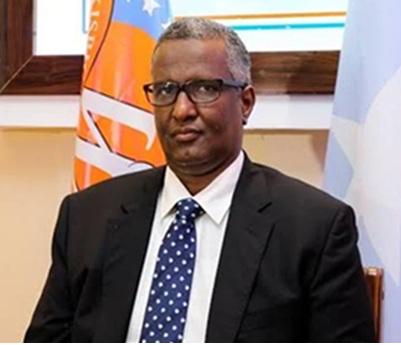
Mogadishu (WDN) — Opposition leader Abdirahman Abdishakur Warsame has launched a scathing attack on President Hassan Sheikh Mohamud’s electoral strategy, accusing the Federal Government of attempting to organize elections around predetermined political outcomes rather than allowing voters to freely determine Somalia’s next leadership.
Warsame, a prominent figure in the opposition-led Future Council, argued that the government’s current approach reflects a political formula that could be summarized as: “Bring your own decoy candidate.”
In a brief statement published on social media, Warsame accused President Hassan Sheikh of seeking to reproduce in other parts of the country what he described as the model used in Baidoa, while simultaneously attempting to influence upcoming elections in Galmudug and Hirshabelle.
He also linked the government’s efforts to the planned election of a new Speaker of the House of the People, despite his contention that the current parliament’s constitutional mandate has already expired.
According to Warsame, all of these efforts form part of a broader political strategy designed to ensure that the preferred candidates of the incumbent administration emerge victorious. “The election Hassan Sheikh would like to win is the one he conducted in Baidoa, the one he wants to implement in Galmudug and Hirshabelle. Its slogan is: ‘Bring your own decoy candidate.’”
Warsame went further, arguing that President Hassan Sheikh’s political project will ultimately fail to secure his continued hold on power. His greater concern, he said, is what the President will leave behind.
“I am not worried about whether he will leave office,” Warsame said in substance. “What concerns me is the damage he has inflicted on the state—damage that will be difficult to repair—and the negative political culture through which he has undermined values, ethics, integrity and humanity.”
The remarks reflect a broader argument increasingly advanced by opposition leaders: that Somalia’s current political crisis is not simply a dispute over the next election, but a struggle over the country’s political culture and the credibility of its institutions.
Warsame also accused the President of political inconsistency, portraying his administration as one that repeatedly changes its position depending on circumstances. He referred to what he described as a striking contradiction in the President’s political behavior, saying:
“You see a person who, as he himself has said, is one person in the morning, another person in the afternoon, and a third person in the evening.” Warsame argued that such political behavior can have consequences that outlast an individual presidency.
In his view, political institutions can recover from the departure of a leader, but political norms and public trust are much harder to rebuild once they have been weakened.
The Bigger Battle Over Somalia’s Political Future
The statement comes as Somalia remains locked in a bitter dispute over elections, constitutional authority, federal-state relations and the future of the country’s political system.
The Federal Government has repeatedly defended its electoral agenda as necessary to advance direct elections and strengthen democratic participation. Opposition groups, however, have accused the administration of using state institutions and electoral processes to consolidate political power and influence the outcome of upcoming contests.
Warsame’s latest intervention therefore places the dispute in a broader context.
For the opposition leader, the central question is not simply who will win the next election, but whether Somalia’s political institutions will be allowed to produce leaders through a genuinely competitive process.
The accusation that elections are being designed around expected winners is particularly serious in a country where political legitimacy remains fragile and where disagreements over electoral rules have repeatedly triggered political crises.
Ultimately, Warsame’s warning is about what happens after the ballots are counted. A president may leave office, he argues, but the political habits established during that presidency can remain embedded in institutions long after the individual has departed.
That, he suggests, is the more enduring danger facing Somalia: not merely the possibility of one political leader staying too long, but the normalization of a political system in which institutions, elections and public offices are perceived as instruments for producing predetermined outcomes.
For Somalia, the stakes extend well beyond the next election. The country’s political future may depend on whether competing leaders can restore confidence that elections are contests to determine the will of the people—not mechanisms through which political elites decide the winner before voters ever cast their ballots.
WardheerNews