
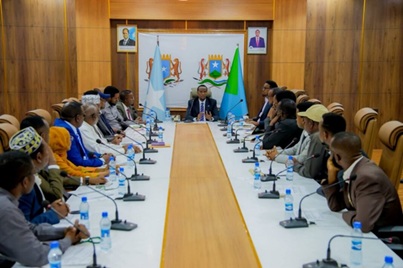
Jowhar (WDN) — In a country where reality is often harsher than rhetoric, the gap between political messaging and conditions on the ground in Hirshabelle State is becoming increasingly difficult to ignore.
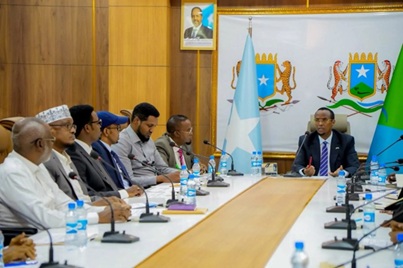
President Ali Abdullahi Hussein Guudlaawe this week chaired a cabinet meeting in Jowhar, officially focused on preparations for elections. On paper, the agenda was routine. In reality, it exposed a deeper contradiction at the heart of governance in the region.
The president’s administration, like much of Hirshabelle’s leadership, operates largely from Mogadishu. Traveling to Jowhar, the designated capital of the state requires a flight, not a road journey. The reason is simple and widely understood: the route is not secure.
The 90-kilometer stretch between Mogadishu and Jowhar, via Balcad, remains heavily contested. Large portions of it are effectively under the control of Al-Shabaab. Along this corridor, the group does more than operate, it governs. It collects taxes, regulates transport, and determines which vehicles are allowed to pass. Even fuel tankers originating from Mogadishu are not immune; if the group decides to halt them, it can do so without resistance.
This is not an isolated security lapse. It is a structural reality. Beyond Jowhar, the situation deteriorates further. President Guudlaawe and his cabinet are largely confined to the city, unable to travel freely within their own territory due to the persistent threat posed by Al-Shabaab. The authority of the state, in practical terms, shrinks dramatically once one moves beyond urban perimeters.
Despite this, under the directive of President Hassan, the administration is pressing ahead with plans for a nationwide one-person, one-vote electoral system, an ambitious political project that assumes a level of territorial control and institutional capacity that does not currently exist.
For many observers, this is where the disconnect becomes stark.
How does a government organize universal suffrage in areas it cannot physically access?
How does it guarantee voter security along areas and region (s) it does not control?
How does it administer an election where parallel systems of authority already exist?
These are not abstract questions. They go to the core of state legitimacy. Much of Hirshabelle, particularly rural areas surrounding Jowhar—remains under significant influence from Al-Shabaab, and that security gains made during previous months have eroded. In this environment, calls for electoral mobilization risk sounding less like policy and more like performance.
The messaging, however, remains firm. President Guudlaawe has urged citizens to rally behind what he describes as a transformative electoral moment, promoting the slogan: “One person, one vote.” But on the ground, the reality tells a different story.
In a region where officials cannot safely travel by road between key cities, where supply lines depend on the tolerance of an armed group, and where governance is geographically limited, the promise of universal elections raises more questions than confidence.
The Somali public, increasingly connected and informed, is not unaware of these contradictions. The era in which narratives could outpace facts has largely passed. Today, citizens see both the speeches and the conditions they are meant to describe.
And in Hirshabelle, those two realities are drifting further apart.
WardheerNews