
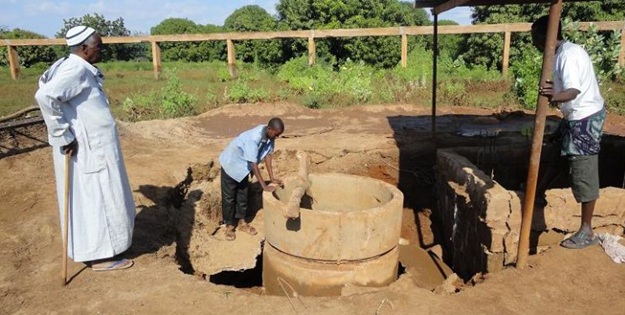
(ERGO) – The drying up of a natural water source in a small town in a mountainous part of Puntland’s Bari region has left more than 10,000 people – including local and conflict-displaced families – facing a critical water shortage.
The source in Tasjiic, 90 km south east of Bosaso, dried up in August. The affected communities, including poor families and pastoralists, can’t afford water sold by tankers from Waaciye, 40 km away, that sells for $6-8 per 200-litre drum.
Saytun Mahad Mohamed, 48, said her family of 10 relies on 20 litres of water from neighbours. When they can’t get any, they go for long hours without water.
“The water shortage has affected us severely. We are struggling to get drinking water, and there is no water for bathing or washing clothes,” she said.
“We are suffering from a severe drought. We beg people who have managed to fetch even a small amount of water to give us a container so that we can survive.”
Her husband, who worked in the frankincense trade in the Almiskad mountains, has been unemployed for the past six months following a Puntland government order for people to leave the area, where a military operation led by government with foreign backing is underway against the Islamic State – ISIS, or Daesh.
The order to evacuate the highland area was intended to protect civilians from airstrikes but also ended opportunities to harvest frankincense, a livelihood on which many families depended. The family moved from the Almiskad mountains to Tasjiic in 2025 because of the conflict.
They are eating one small meal a day, relying on food given by better-off people. Saytun said her children, the youngest aged three, have become thin and show signs of malnutrition. The family has been unable to find casual work locally.
Most of their 95 goats died from lack of water and pasture and unidentified diseases. Only 10 remain, but the family can’t afford to provide them with feed or water.
Saytun owes more than $3,000 to shops for food bought on credit. The shopkeepers stopped extending her further credit in mid-August.
“I have been forced to rely on credit to obtain water and food, and this is causing me great distress,” she said. “I can’t repay what I owe because I have no income. We have lost both the livestock and the frankincense work we depended on.”
The family has to vacate the two rooms temporarily provided by relatives by the end of September. They can’t afford the $50 monthly rent for similar accommodation in the area. Three of her children have been out of primary and Koranic school since June because she could not pay their combined $45 fees.
Another resident, Mumino Shire Nur, said her family had struggled to obtain water since the local source dried up. She saves the few litres given by neighbours.
“The most difficult challenge we are facing is the lack of water,” she said. “We divide a single 20-litre container between drinking and cooking one meal, but it is not enough. We cannot continue living like this.”
Mumino’s small business selling tea, doughnuts and other goods has collapsed, leaving her without an income to support the nine children in her care. Her husband died in 2024 from a brain haemorrhage linked to high blood pressure after spending a week in a coma in a Hargeisa hospital.
She owes $300 to shops for food, and has more than $800 in other outstanding payments for water, household needs and business supplies. The family sometimes eats only once a day using the dollar or so given by relatives in Bosaso and Qardho. They also struggle to access other basic services.
“There is no money to pay for education, and healthcare is no different. Life depends on having an income, and without work, everything has fallen apart,” Mumino said.
Two of her children, aged three and five, have suffered diarrhoea and vomiting since early September, but she can’t afford medicine. There are no free health services in the area. Four of her children stopped attending the village school in July after she could no longer pay their combined $40 fees. Her family moved from rural Tasjiic in 2020 after drought killed the 180 goats on which they depended.
Bari region is known for fishing, frankincense, livestock and natural water sources, but reduced rainfall and climate change have made these resources increasingly scarce.
Tasjiic district chairman, Farah Nur Ali, said the water shortage affected more than 10,000 people, including local residents, pastoralists, people displaced by the Almiskad conflict, and also soldiers stationed in the mountains. People living across the nearly 63-kilometre area between Tasjiic and Ufeyn all relied on the free water source.
“People who were already facing financial hardship are now struggling with both water shortages and hunger,” Farah said. “They depended on frankincense work and livestock, but drought and conflict have affected their livelihoods and left them without these sources of income. The most pressing needs are healthcare, water and food.”
He said the Puntland administration and aid agencies had been informed of the situation but no aid had been delivered. He warned that conditions would worsen without intervention.
Source: Ergo
Leave a Reply